
VO2 max is often treated as the defining metric of endurance fitness. Popular training programs, wearable devices, and fitness media all reinforce the idea that a higher VO2 max means better performance. But of the three main components of endurance—VO2 max, lactate threshold, and movement economy—VO2 max actually correlates the least with real-world race results in trained athletes.
This article explains what VO2 max measures, why it plateaus, and why the factors that continue to improve with training—economy and lactate threshold—deserve more of your attention.
What Is VO2 Max?
VO2 max is the maximum amount of oxygen your body can take in and use during intense exercise, measured in milliliters of oxygen per kilogram of body weight per minute (ml/kg/min). First identified by A.V. Hill in the 1920s, it provided one of the earliest scientific explanations for the physiological limits of human performance and remains a foundational concept in exercise science.
Think of VO2 max as the size of your aerobic engine—the upper limit of how much power your body can produce using oxygen. A high VO2 max means you have a large engine. But engine size alone does not determine how fast or how far you can go. Fuel efficiency and the threshold at which the engine starts to overheat matter at least as much.
Why Doesn’t VO2 Max Predict Performance Well?
Endurance performance depends on three interacting factors:
VO2 max: The ceiling of your aerobic power.
Lactate threshold (anaerobic threshold): The intensity at which lactate begins to accumulate in the blood faster than it can be cleared. This determines the highest pace you can sustain for a prolonged period.
Economy: How efficiently your body converts energy into movement at a given speed. Better economy means less oxygen consumed at the same pace.
Research consistently shows that among trained athletes, VO2 max is the weakest predictor of race outcomes. Two athletes with identical VO2 max values can produce very different race results because their lactate thresholds and movement economies differ. The athlete who can sustain a higher percentage of their VO2 max (higher threshold) while consuming less energy per stride (better economy) will outperform the one with a bigger engine but worse efficiency and a lower sustainable fraction of it.
This is especially relevant for mountain athletes. Events lasting three hours or more are performed well below VO2 max intensity. Your performance in an alpine climb or ultra-distance race is determined by your aerobic threshold pace and your economy at that pace, not by how high your oxygen uptake can spike during a short maximal effort.
Does VO2 Max Plateau?
Yes, and relatively early in an athlete’s development. VO2 max responds to high-intensity interval training at or above 90% of maximum heart rate. This type of training increases the heart’s stroke volume, allowing more oxygen-rich blood to reach working muscles. But the heart’s growth is constrained by the pericardium, an inelastic sheath that surrounds it. Once the heart reaches its structural capacity, VO2 max plateaus. For most athletes, this happens within four to six months of consistent high-intensity training.
This is why exercise studies that use untrained subjects often show impressive VO2 max gains: those subjects have the most room to grow. But for trained athletes with a history of intensity work, VO2 max is already near its genetic ceiling. Further performance improvements must come from elsewhere.
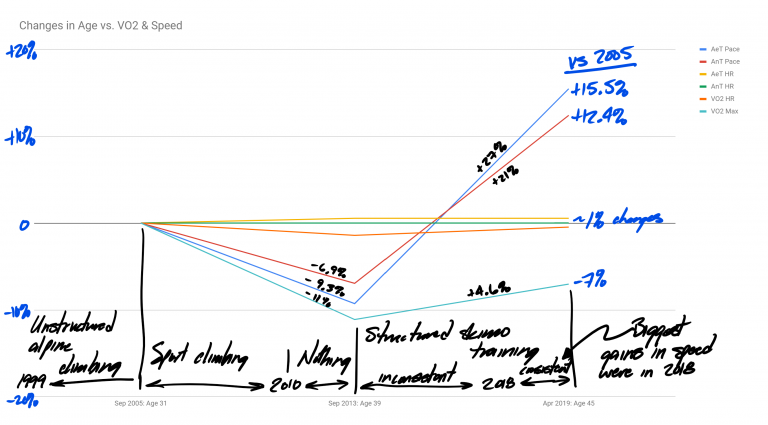
One coached athletes, Scott S., training data illustrates this clearly. Over an eight-year period of structured skimo training, his VO2 max declined 11 percent between age 31 and 39, and recovered only 4 percent with dedicated training. Yet his race performance—measured by actual paces—improved dramatically over the same period. The performance gains came from improvements in economy and threshold, not from changes in VO2 max.
Why Do So Many Training Programs Focus on VO2 Max?
VO2 max is easy to measure, easy to compare across subjects, and easy to show improvement in—particularly in untrained populations. This makes it a convenient metric for exercise research, where studies need a quantifiable outcome to demonstrate that a training protocol works. But convenience does not equal importance.
Using VO2 max as the primary measure of training success is misleading because most studies are conducted on untrained subjects, whose VO2 max improves regardless of the training type. The quick gains in VO2 max that untrained people experience create the impression that VO2 max-focused training is the most effective approach. For trained athletes, those gains have already been captured, and the metric stops being a useful proxy for performance improvement.
Consumer wearables have amplified this distortion by featuring VO2 max estimates prominently in their interfaces. The metric is presented as though it is the single most important number in your fitness profile. For most endurance athletes, it is not.
When Does High-Intensity Training Belong in Your Program?
Nothing in this article should be read as an argument against high-intensity training. The argument is against treating it as the default or the foundation. Intensity has a place, and understanding when that place is can make a significant difference in your development.
For athletes who already have a well-developed aerobic base—where the spread between aerobic and anaerobic thresholds is 10 percent or less—adding structured high-intensity work is the appropriate next step. At that point, the aerobic infrastructure is in place to support the harder training, recover from it, and convert the stimulus into performance. This is the utilization phase, where you begin to spend the capacity you have built.
There are also cases where an athlete’s VO2 max is genuinely the limiting factor—where the engine is small relative to the demands of their goals. Younger athletes early in their development, athletes returning to training after a long break, and athletes whose training history is exclusively low-intensity may all have meaningful room to grow their VO2 max. For these individuals, a period of targeted high-intensity work can produce real and lasting gains.
The question is always one of sequencing and proportion. High-intensity training is a powerful tool when applied to a body that is prepared for it, at a point in the training cycle where it serves a clear purpose. It becomes counterproductive when it replaces the aerobic base work that makes it effective in the first place.
What Should You Focus on Instead?
If your VO2 max is already near its ceiling—and for any athlete with a year or more of consistent training, it likely is—the highest-return investments are in economy and lactate threshold.
Economy improves through technique work, sport-specific practice, and strength training that supports efficient movement patterns. Better economy means you consume less oxygen at the same pace, effectively making your existing engine go further on the same fuel. Economy can continue improving for years, even decades, with deliberate practice. This is one reason why experienced endurance athletes often perform better in their 30s and 40s than they did in their 20s, despite declining VO2 max values.
Lactate threshold determines the highest pace you can sustain without accumulating lactate faster than you can clear it. Improving your threshold means you can race at a higher percentage of your VO2 max for longer. This is trained through a combination of large-volume aerobic base work (which builds the metabolic infrastructure for lactate clearance) and appropriately timed, moderate-intensity training once the aerobic base is established.
VO2 max still matters. A larger engine is better than a smaller one, all else being equal. But for trained athletes, the gains available through economy and threshold improvement are larger, more sustainable, and more directly connected to real-world performance than chasing a marginal increase in VO2 max.
References
Coyle, E.F. “Increased muscular efficiency displayed as Tour de France champion matures.” Journal of Applied Physiology 2005 Jun;98(6):2191–6.