
One of the most important distinctions in endurance training is the difference between building capacity and utilizing it. At Uphill Athlete, we refer to these as Capacity Training and Utilization Training, terms originally coined by Bob Bowman, the coach behind Michael Phelps’s 18 Olympic gold medals. The concepts apply well beyond swimming. They explain why some athletes improve steadily over years while others see rapid early gains followed by a frustrating plateau.
For mountain athletes—mountaineers, trail runners, ski mountaineers, and climbers—understanding this distinction is essential to making good decisions about how you spend your training time.
What Is Capacity Training?
Capacity Training improves the long-term performance potential of the athlete. It builds the underlying physiological infrastructure—the aerobic base, the strength foundation, the technical skill—that supports everything you will eventually ask your body to do. In Training for the New Alpinism, we refer to this as Base Training.
Bowman uses the analogy of a cup. Capacity Training increases the size of that cup. A bigger cup means a greater volume of sport-specific work your body can absorb and benefit from later. Aerobic capacity, leg and hip strength, core stability, and technical proficiency are all separate cups. If any one of them is too small, that limitation will constrain your performance regardless of how hard you train in other areas.
Another useful analogy: Capacity Training is like putting money in the bank. The deposits are slow, sometimes tedious, and don’t produce immediate returns. But the larger your balance, the more withdrawals you can make when it counts—during Utilization Training and during the event itself.
Key characteristics of Capacity Training: it takes a relatively long time to develop, it is less sport-specific and more general in nature, and it requires a short-term sacrifice of peak performance in exchange for a higher long-term ceiling.
What Is Utilization Training?
Utilization Training maximizes whatever capacities an athlete has already built. It is sport-specific, high-intensity work designed to model the demands of your event and convert your general fitness into performance. In Training for the New Alpinism, we call this Specific Training.
Extending the highway analogy: if Capacity Training builds the road system, Utilization Training dumps fast-moving traffic onto it. If the roads can handle the load, you get an enormous amount of productive work done. But if there is a section still under construction, that bottleneck limits the entire system.
Here is how Utilization Training applies across different systems:
Aerobic utilization increases the fraction and duration of your maximum aerobic power that you can sustain. This is aerobic power training.
Anaerobic utilization increases the fraction of your anaerobic capacity you can tap into during hard efforts. This is anaerobic endurance.
Power utilization increases the rate at which you can generate maximal force or strength.
Technical utilization increases your speed and movement economy under fatigue.
Utilization Training is quick-acting. Gains can appear within weeks. But those gains are also volatile and short-lived. And here is the critical point: Utilization Training draws down your capacity reserves. After a prolonged utilization phase, you will need to return to capacity-building work to replenish what was spent and address any weaknesses that surfaced.
Why Does Capacity Training Come First?
This question has been tested repeatedly at the highest levels of sport. Distance running, rowing, cross-country skiing, and swimming have all gone through periods where coaches debated the balance between capacity and utilization. In every case, the stopwatch settled the argument: athletes who built capacity first and added utilization later outperformed those who jumped straight to sport-specific intensity work.
The pattern is consistent. Athletes who rely heavily on Utilization Training often see rapid initial improvement, then hit a plateau they cannot break through. The reason is structural: if the underlying capacity is insufficient, no amount of high-intensity sport-specific work will compensate. The cup is too small. The bank account is too thin. The highway has a bottleneck.
Athletes with large, well-developed capacities can absorb and benefit from much more Utilization Training. This is why experienced, high-level athletes spend more time on sport-specific intensity work than beginners should. They have already built the infrastructure to support it. For athletes earlier in their development, the highest-return investment is almost always more Capacity Training.

What Capacities Should Mountain Athletes Build?
The specific capacities you need depend on your sport, but the framework applies across all mountain disciplines. Here are the fundamental qualities to target, each ideally trained in dedicated sessions to maximize adaptation.
Aerobic capacity is the ability to produce high levels of energy through aerobic metabolism. It is the most important quality for any endurance event lasting more than a few minutes, and the longer the event, the more critical it becomes. For most mountain athletes, this means a high volume of lower-intensity, foot-borne exercise. For rock and ice climbers, the same principle applies to the shoulders, forearms, and core, albeit at shorter session durations.
Strength capacity is the ability to develop high forces in working muscles. It ranges from general exercises like deadlifts, squats, and pull-ups that condition less experienced athletes and reduce injury risk, to more sport-specific movements: loaded box step-ups for mountaineers, Bulgarian split squats for runners, hangboard training for rock climbers, and ice axe hangs for ice and mixed climbers.
Power capacity layers on top of strength. Every mountain athlete performs better when they can generate high forces faster. Power training uses relatively low resistance at high speed of movement. Hill sprints are a versatile example for most mountain sports. Campus board training serves this function for climbers.
Technical capacity is the quality that improves movement economy: it costs you less energy to climb harder, run faster, or move efficiently over rough terrain. Technical mastery comes only through thousands of correct repetitions. Practicing skills poorly ingrains poor movement patterns. A good coach can accelerate this process considerably.
Anaerobic capacity is the ability to perform very intense exercise lasting 30 seconds to two minutes. It plays a minimal role for mountaineers and ultra-distance runners, but can be important for skimo racers, VK runners, and technical climbers. It is trained through repeated short bouts of exhaustive sport-specific effort.
When Do You Shift from Capacity to Utilization?
Once your fundamental capacities are well developed, you bring them together in Utilization Training that closely models the demands of your event. These sessions combine several qualities simultaneously: heavy weighted steep hikes for the mountaineer, high-intensity uphill intervals for the trail runner or ski mountaineer, and long demanding bouldering or lead sessions for the climber.
The amount of Utilization Training you need—and can productively absorb—depends directly on how much capacity you have built. If the cup is small, Utilization Training yields limited returns and risks overdrawing the account. If the cup is large, you can handle a substantial utilization phase and see significant performance gains from it.
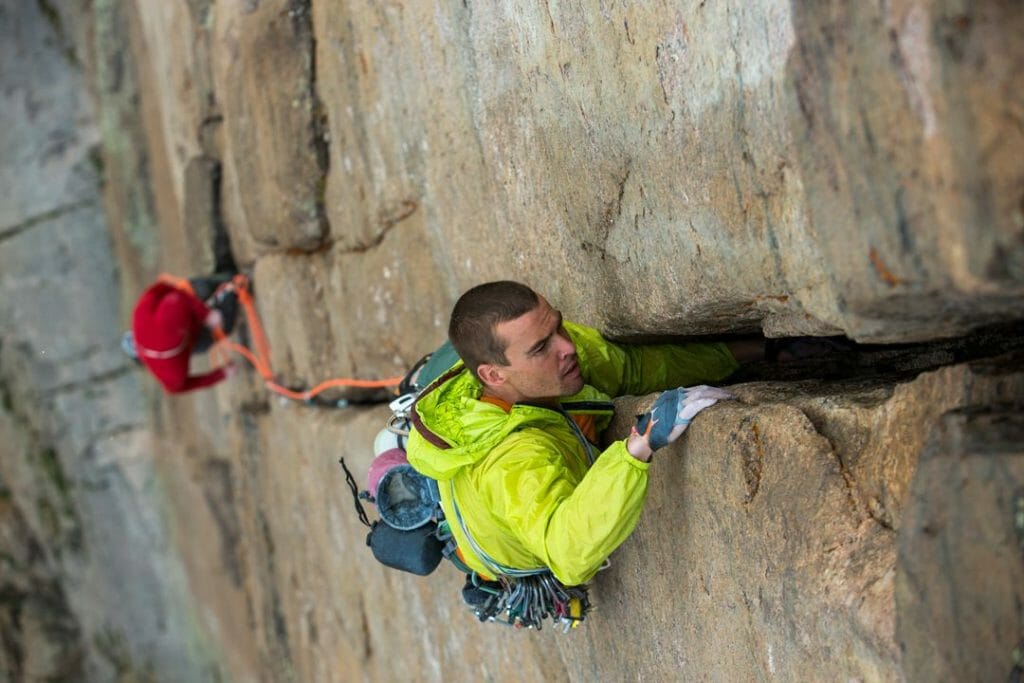
A concrete example illustrates this well. In 2015, German sport climber Alex Megos described checking out a route called Demencia Senil (5.15a) and finding it beyond his capacity—he could not make the moves past the third bolt. Two years later, after building the capacity he lacked, he returned and sent the route on his second attempt. He had the awareness to recognize the deficit, the patience to walk away and build capacity rather than waste it on something he could not yet do, and the discipline to return when the time was right.
How Should You Apply This to Your Training?
Take the long view. Meaningful capacity is built from year to year, not week to week. The athlete who invests in a broad, deep foundation over multiple seasons will consistently outperform the one chasing short-term intensity gains.
Plan your year. To perform at your best, you need to engage both Capacity and Utilization Training at the right time. This sequencing—building capacity first, then converting it through utilization—is what makes training periodization part science, part art. We go into detail on this in Training for the New Alpinism and Training for the Uphill Athlete, and it is the framework our coaches use with every athlete.
[TK: Link to Training for the New Alpinism and Training for the Uphill Athlete book pages]
Be honest about where you are. If you have been jumping straight to high-intensity, sport-specific work and your progress has stalled, the answer is likely that one or more underlying capacities are underdeveloped. The highest-return investment at that point is to step back and build the foundation, even though it means a temporary dip in performance. The long-term payoff is a higher ceiling.

Further Reading
Olbrecht, J. The Science of Winning: Planning, Periodizing and Optimizing Swim Training. Luton, England: F&G Partners, 2000.
House, S., Johnston, S. Training for the New Alpinism: A Manual for the Climber as Athlete. Patagonia Books, 2014.House, S., Johnston, S., Jornet, K. Training for the Uphill Athlete: A Manual for Mountain Runners and Ski Mountaineers. Patagonia Books, 2019.