
Consider this week of mountain activity, all performed by one person:
Days 1–2: Approach on foot from Chamonix to the north face of the Grand Jorasses. Climb the Colton-MacIntyre route (ED, VI, 1,200 meters) and descend into Italy. Total time: 27 hours. Total fuel consumed: two gels and half a liter of water.
Day 3: Pace a friend in a 50K trail race.
Day 4: Win the Chamonix Vertical K race.
Days 5–6: Travel to Alaska.
Day 7: Win the Mountain Marathon in Seward, Alaska, setting a new course record.
Kilian Jornet did all of this in a single week in 2015. It sounds impossible. But the reasons behind it are comprehensible, and the most important one is directly measurable: metabolic efficiency.

On top of whatever genetic gifts Kilian possesses, what he has developed over 20-plus years of consistent training is an extraordinarily high aerobic capacity combined with a high degree of fat adaptation. Exercise scientists call this high efficiency. The good news for the rest of us is that metabolic efficiency is one of the most trainable aspects of endurance. You do not need to be Kilian to improve it dramatically.
Metabolic efficiency is a measure of how well your body converts its fuel sources—fat and carbohydrates—into ATP, the molecule that powers muscle contraction. Aerobic metabolism, which burns fat, produces roughly 16 times as much ATP per gram as anaerobic glycolytic metabolism, which breaks down glucose and glycogen. Since a gram of fat also contains about twice the calories of a gram of carbohydrate, the overall efficiency difference is approximately 8 to 1. A gram of fat produces about eight times the usable energy of a gram of carbohydrate.
Think about what that means in practical terms. An athlete who can burn fat efficiently at moderate intensities has access to a fuel source that is nearly inexhaustible—even a lean athlete carries tens of thousands of calories of stored fat. An athlete who relies primarily on carbohydrates is running on a tank that holds only about 2,000 calories of glycogen and needs constant refueling.
This is why Kilian can climb a 1,200-meter north face route for 27 hours on two gels. His aerobic system is so well developed that fat provides the majority of his energy even at intensities that would push a less efficient athlete into glycolytic metabolism. He is not superhuman. He is supremely efficient.
Total efficiency in endurance sport has two components. Metabolic efficiency is the fuel economy: how much work you get from each gram of fat or carbohydrate. Biomechanical efficiency is the movement economy: how much total energy (regardless of fuel source) it costs you to move at a given speed. Watch world-class runners who seem to float along barely touching the ground, or elite climbers who move across difficult terrain with apparent effortlessness. That is high biomechanical efficiency.
Both are trainable. Both matter enormously. This article focuses on metabolic efficiency—how to measure it, how to interpret the results, and what to do with the information.
A Metabolic Efficiency Test (MET) measures the ratio of fat to carbohydrate being used to fuel your exercise at different intensities. It answers a simple but powerful question: are you a fat-burning aerobic machine, or are you primarily carbohydrate-dependent?
The test uses the same laboratory equipment as a Gas Exchange Test (GET)—a mask that measures the concentrations of oxygen and CO2 in your exhaled breath—but with a different protocol. An MET uses a very gradual ramping up of intensity, with stages long enough to capture an accurate picture of your metabolic response at each level. This is critical because the aerobic system is slow to respond to changes in workload; if intensity increases too quickly, the test will not reflect your actual aerobic capacity.

The key metric from the test is the Crossover Point: the intensity at which fat and carbohydrates each contribute 50 percent of your total caloric needs. This point corresponds very closely to your Aerobic Threshold. It represents the maximum intensity at which fat is still the dominant energy source—the maximum capacity of your aerobic system before the anaerobic system begins to overwhelm it.
Moving the Crossover Point to the right—to a higher heart rate and higher work output—is the first training goal of every endurance athlete. The farther to the right it sits, the more work you can do while running on the nearly inexhaustible fuel source of fat. The farther to the left, the sooner you become dependent on glycogen and the sooner you hit the wall.
When you get your MET results, you will see a graph with two lines. The blue line represents the percentage of calories coming from fat at each intensity. The red line represents the percentage coming from carbohydrates. Where the lines cross is your Crossover Point. Here is what different results look like and what they mean.
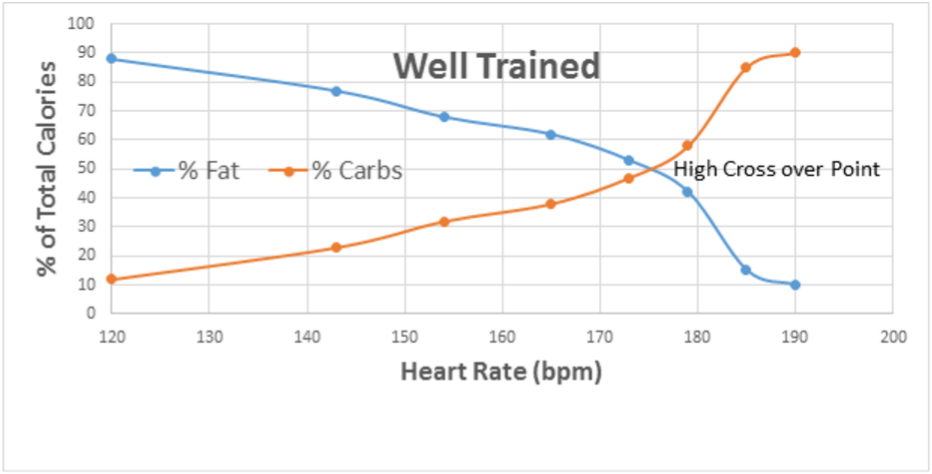
This graph shows a very well-trained endurance athlete with high aerobic capacity and high metabolic efficiency. Fat provides the vast majority of energy at low intensities, and the Crossover Point does not occur until approximately 88 to 90 percent of maximum heart rate. Even at very high intensities, fat still contributes significantly to total energy production.
If your results look like this, you have developed the most basic and most important quality in endurance training. Continue what you have been doing. You will likely benefit from the judicious addition of higher-intensity training specific to the event you are preparing for.

This is the result we see most often from athletes who train by feel rather than by monitoring their actual metabolic response to exercise. For these athletes, it feels good to push the pace right up to their endurance limit in almost every workout. They run at a pace they can just comfortably sustain for the duration, finish tired, get a flood of endorphins, and feel satisfied that they trained hard.
The problem is visible in the graph: the Crossover Point occurs early, at a low heart rate and low work output. Fat contributes relatively little to energy production at any intensity. This athlete is leaving an enormous amount of endurance capacity on the table. They feel fast but they have no base.
Time-constrained athletes are especially prone to this pattern. When you only have 45 minutes, the instinct is to make it count by going hard. Over months, this systematically deconditions the aerobic base.
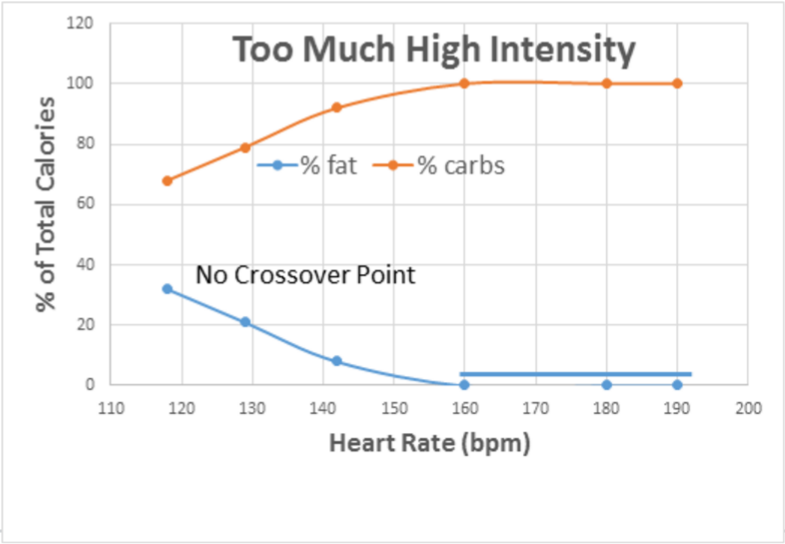
This is the most extreme version of aerobic deficiency, and we see it in athletes who rely on low-volume, high-intensity interval training programs. Even at the lowest intensities, fat never contributes the majority of their energy needs. In many cases, there is no visible Crossover Point at all. This athlete relies on anaerobic glycolytic metabolism for virtually all exercise—including workouts that should be low-intensity aerobic sessions.
These athletes need to eat constantly during any sustained exercise. They have, through training choices and sometimes diet, reduced their aerobic capacity to near-insignificance. Essentially, half of their endurance engine has been deactivated.
If your test results look like Profile 2 or Profile 3, you have Aerobic Deficiency (AD). Do not despair. While it can be disappointing to see such results, the upside is significant: there is a tremendous amount of potential waiting to be unlocked, and with proper training you will see meaningful improvement.
The biggest hurdle for most athletes in this position is mental. It requires a paradigm shift in how you view your training. You arrived in this state through the training choices you have made, and reversing it means doing something that will feel counterintuitive: slowing down.
Here is the path forward:
Do all of your aerobic training below your Aerobic Threshold. Yes, this will be painfully slow if you have AD. We know. You will feel like you are wasting your time. You will wonder how such low intensity can possibly be doing anything for you. We have heard it hundreds of times. The reason it feels so slow is that your aerobic system is currently capable of producing only that much power. There is only one way to improve that: train high volumes at this low intensity. No amount of high-intensity training will have the desired effect. In fact, any high-intensity training done while trying to rebuild the aerobic base will actively negate some of your aerobic development.
Get on a structured training plan. You will be significantly more successful with a plan that manages your progression, your volume, and your intensity distribution. Self-coached athletes with AD almost always default back to training too hard because it feels more productive.
Be patient and consistent. These methods work, and they work very well. We have documented dramatic improvement in hundreds of cases. But they require consistency over weeks and months, not days.
[IMAGE: Before-and-after MET comparison graph: Professional high-altitude mountaineer. Dashed lines show first test with Crossover Point at 11% treadmill grade (3 mph). Solid lines show second test several months later with Crossover Point moved up to 21% grade (3 mph). Blue = fat, red = carbs.]Source: uphillathlete.com/aerobic-training/getting-tested-part-2-how-to-interpret-your-test-results/ — before/after graph
The graph above shows real-world test results from a professional high-altitude mountaineer who came to Uphill Athlete for coaching. His first test, shown by the dashed lines, demonstrated poor fat adaptation and poor aerobic capacity: the Crossover Point occurred at just an 11 percent treadmill grade at 3 miles per hour. This athlete needed to eat an energy gel or bar every hour during exercise.
The second test, done several months later after focused aerobic base training, showed a dramatic improvement. The Crossover Point moved up to a 21 percent grade at the same speed. This represented a massive increase in aerobic work capacity that transferred directly to his climbing performance. He could move faster, go longer between meals, and sustain effort at intensities that previously depleted him.
This kind of improvement is not unusual. It is the expected outcome of consistent, properly structured aerobic base training for athletes with AD.
If you decide to get tested, choosing the right lab matters more than most athletes realize. Not all metabolic tests are the same, and the wrong test will give you data that is unusable or misleading.
The fitness industry has done its best to convince athletes that aerobic endurance can be defined by a single number: VO2max. This has driven heavy marketing of VO2max tests at gyms and health clubs, which have become profit centers for these facilities. The testing equipment has become cheaper and simpler to operate, and the machines come with pre-programmed test protocols designed to find maximum oxygen uptake as quickly as possible.
The problem is the ramp rate. A standard VO2max protocol increases workload rapidly—sometimes with stages as short as 30 seconds to one minute—to take you from easy effort to failure in 6 to 10 minutes. Some tests allow only a 30-second warm-up before data collection begins.
This is exactly wrong for finding your Aerobic Threshold. Your aerobic system is slow to respond to increases in intensity. When you first begin exercising, energy comes from anaerobic sources—stored ATP for a few seconds, then glycolysis. It takes several minutes for the aerobic system to fully come online. At each subsequent increase in intensity, it takes another few minutes for the aerobic system to stabilize at the new workload. If the stages are too short, your aerobic system is perpetually playing catch-up, and the test results will not reflect how your aerobic metabolism actually responds to exercise.
A test that can identify your Aerobic Threshold and your fat-versus-carbohydrate utilization needs stages lasting at least three minutes each. This allows you to reach metabolic equilibrium at each intensity before the load increases. You can still get a VO2max number from a test with longer stages—but the test takes longer, which means fewer tests per day, which cuts into the revenue stream the equipment manufacturers promised.
Search for a lab that advertises Metabolic Efficiency Testing. They will understand what you are looking for and will use an appropriate protocol.
Do the test on a treadmill. For mountain athletes, this means either walking steeply uphill (for climbers and skiers) or running (for runners). Do not do this test on a bike unless you plan to do your training on a bike.
If you can only find labs offering VO2max tests, ask specific questions. Ask: “Will this test identify my Aerobic Threshold?” Make it clear you mean Aerobic Threshold, not Anaerobic Threshold. If the technician hesitates or does not know the term, cross them off your list.
Ask how long each workload stage is. If the answer is less than three minutes, the test will not give you usable aerobic data.
Ask if you can warm up for 15 minutes on another treadmill before the test begins. A long warm-up is critical. Without it, your aerobic system will not have stabilized before data collection starts.
Ask if they can provide the raw data. You or a knowledgeable coach can evaluate it independently. This is especially useful if you are uncertain about the lab’s expertise.
Universities are often your best option if you cannot locate a dedicated MET facility. University kinesiology or exercise physiology labs typically have graduate students who can field your questions and understand the difference between a VO2max ramp test and a metabolic efficiency protocol.

Metabolic efficiency testing is the most informative assessment available to endurance athletes. It tells you exactly where your aerobic system stands, how dependent you are on carbohydrates, and whether your training has been building the right kind of fitness or systematically eroding it.
Not every athlete needs a lab test—our Heart Rate Drift Test and field-based assessments provide excellent data for most people. But if you have access to a good lab, or if you suspect you have Aerobic Deficiency and want definitive confirmation, a properly conducted Metabolic Efficiency Test is the gold standard.
The test itself takes an hour and costs $175 to $400 depending on the lab. What it reveals can redirect months or years of training. For an athlete who has been unknowingly training too hard and deconditioned their aerobic base, seeing the graph is often the moment the paradigm shifts. It is hard to argue with a picture of your own metabolism.
Know where your Crossover Point sits. Then get to work moving it to the right.
Downloadable Resource: Uphill Athlete Lab Guidelines (PDF) — a printable guide to bring with you when choosing and visiting a testing lab.