Behind deep mountaineering experience and good health, the next most powerful driver of success on very high summits is the use of supplemental oxygen. Since 2012, oxygen masks have been refined and reengineered to deliver flow rates as high as 6 liters per minute—a 300 percent increase over the traditional 2 liters per minute. This technology has fundamentally changed what is possible on 8,000-meter peaks, enabling compressed acclimatization schedules and faster ascents. Understanding how supplemental oxygen works, and its limitations, is essential for any climber planning an expedition above 7,000 meters.
How Does Supplemental Oxygen Work at Extreme Altitude?
Oxygen equipment on high-altitude climbs uses an open circuit system. The mask delivers a mixture of ambient air, pure oxygen flowing from the cylinder (at a defined flow rate in liters per minute), and whatever oxygen remains in the mask’s reservoir from the previous inhalation. Some of the bottled oxygen is captured in the reservoir; the rest is lost. This means that to some extent, every breath is different.
When you are resting, your breathing rate and depth decrease, so a proportionally larger share of each breath comes from the bottled oxygen. In effect, you “decrease your altitude” significantly while resting. When you start moving, your breathing rate and depth increase, and more of each breath is filled with the rarefied ambient air. The supplemental oxygen makes up a smaller proportion of the total volume.
Why Does Body Size Affect How Well Supplemental Oxygen Works?
For a small, light person with a lung volume of 4 liters, a large proportion of each breath will be filled by the pure oxygen flowing from the bottle. For a large person with a maximum inspiratory capacity of 6 to 7 liters or more, proportionally much more of each breath will be filled with rarefied ambient air, because the total volume of each breath is larger and the fixed flow rate from the bottle cannot make up the difference. This means that the effective “mask altitude” at a given flow rate varies between individuals based on their lung volume, body mass, aerobic fitness, and exertion level.
What Is “Mask Altitude” and How Is It Calculated?
Dr. Tom Hornbein, who made the first traverse of Mount Everest in 1963 via the West Ridge, worked with Bill Sumner in 1962 to estimate the effective “mask altitude” of different oxygen flow rates at different levels of exertion. Their calculations, while based on averages with significant individual variation, remain a useful reference.
For a climber receiving 4 L/min of supplemental oxygen while working maximally on the summit of Everest, Hornbein and Sumner estimated a mask altitude equivalent to approximately 7,200 m (23,600 ft)—a reduction of roughly 1,900 m (6,200 ft) from the actual summit altitude. For the same climber at rest, the estimated mask altitude drops to approximately 3,200 m (10,500 ft).
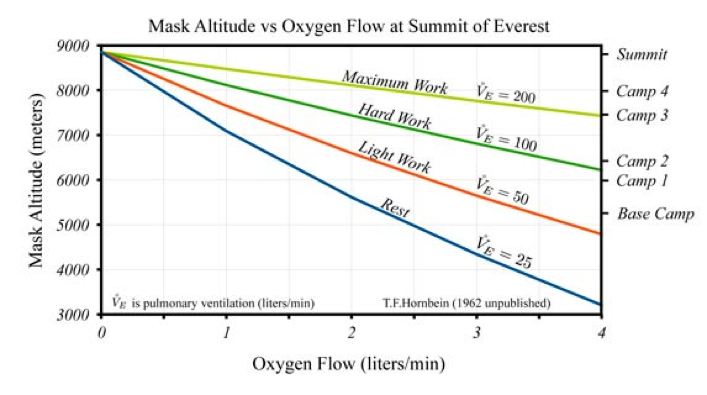
Reprinted with permission of Dr. Hornbein.
The practical implication: at higher flow rates (6 L/min), the altitude reduction is even more dramatic. This is why guide services using high-flow supplemental oxygen can offer compressed acclimatization schedules. The oxygen effectively lowers the altitude the climber’s body is experiencing at any given moment.
How Powerful Is Supplemental Oxygen Really?
Consider this thought experiment, originally posed by Dr. Monica Piris, who has served as expedition doctor on 25 Himalayan expeditions including 16 to Everest: an aerobically trained climber with a high flow rate of supplemental oxygen and a guaranteed supply could probably climb Everest in a single day coming directly from sea level. The exact flow rate required would vary by individual based on lung volume, body mass, and aerobic capacity. But the point is clear—supplemental oxygen, at sufficient flow rates, can compensate for a remarkable degree of altitude exposure.
As Dr. Piris stated: the only significant and dangerous effect of decreasing barometric pressure, as far as we currently understand it, is its effect on oxygen availability. There are likely other physiological responses to sudden changes in pressure, but none of them appear to be lethal when supplemental oxygen is available.
What Should Climbers Know About Managing Their Oxygen Supply?
Guide services selling compressed acclimatization schedules or rapid ascents rely heavily on high-flow supplemental oxygen (6 L/min) during the climb. As a climber, you must stay aware of your supply throughout the climb and descent. Running out of supplemental oxygen unexpectedly at extreme altitude is a life-threatening emergency. Monitor your bottles, know your consumption rate at different exertion levels, and plan conservatively.
It is also worth understanding that choosing to use supplemental oxygen is not an argument against proper physical preparation. Highly trained bodies utilize supplementary oxygen more effectively than untrained ones. A fit climber on supplemental oxygen will be warmer, faster, and safer on summit day than an unfit climber at the same flow rate. Supplemental oxygen makes up for a lot, but it rewards fitness rather than replacing it.
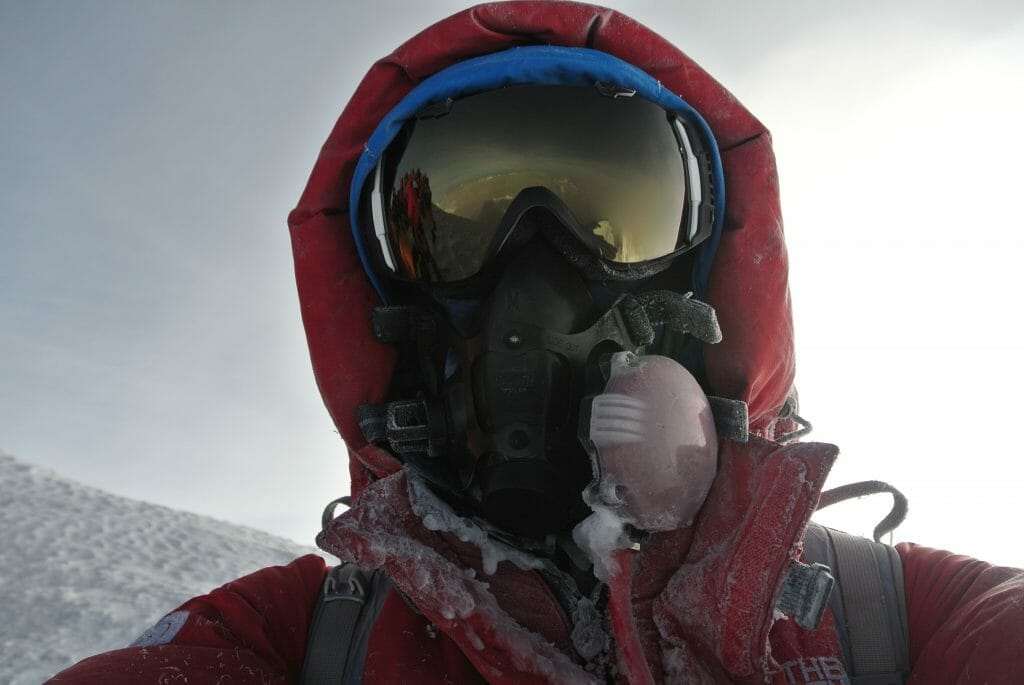
Practical tip from experienced 8,000-meter climbers: energy chews work significantly better than gels when wearing an oxygen mask.