
Endurance is the ability to maintain a high rate of work output for long durations. But what powers that output? What is it that fuels the muscle contractions that propel you through hours of climbing or racing? The answer is a single molecule: ATP (adenosine triphosphate). Training for endurance is, at its most fundamental level, an organized method to increase your muscles’ rate of ATP production.
This article provides a simplified overview of how your body produces energy for movement, how the two metabolic pathways interact, and why the aerobic system is the foundation of endurance performance. For deeper treatments of specific topics, see the linked articles throughout.

ATP is a short-term energy storage molecule used by every cell in your body. The energy released when its chemical bonds are broken powers muscle contractions and other cellular functions. Your body does not maintain a large reservoir of ATP. Instead, after ATP is broken down and its energy used, the component molecules are rapidly reassembled into fresh ATP through metabolic recycling. The faster your muscles can resynthesize ATP, the more work you can do in a given time.
This recycling rate is the target of all endurance training. Every training session you do, whether an easy Zone 2 run or a hard interval workout, is ultimately an attempt to improve some aspect of your body’s ability to produce ATP.
Your body uses two metabolic pathways to produce ATP. Both are always active to some degree, but the balance between them shifts depending on exercise intensity.
The aerobic pathway requires oxygen and can utilize fats, sugars, and proteins as fuel. Because the body’s fat stores are many times larger than its glycogen (sugar) stores, the aerobic pathway can sustain activity for very long durations. In well-trained endurance athletes, aerobic fat metabolism dominates as the fuel of choice in events lasting more than two hours. The tradeoff: aerobic ATP production is rate-limited. It can only fully meet the energy demands of relatively low-to-moderate intensity exercise.
The anaerobic pathway does not require oxygen but can only use glucose (sugar) as fuel. When aerobic metabolism can no longer meet ATP demand, anaerobic glycolysis makes up the shortfall. This is the high-power pathway—it fuels the speed that matters in events lasting less than two hours. But its output is self-limiting: glycogen stores are small, and the process produces lactate as a byproduct. Once lactate accumulates faster than it can be cleared, fatigue sets in and the only option is to slow down.
The intensity at which aerobic metabolism can supply the bulk of the ATP needed is called the aerobic threshold (AeT). When demand exceeds that capacity, the anaerobic system begins contributing a growing share of the total ATP output. The higher the intensity climbs above AeT, the faster lactate accumulates.
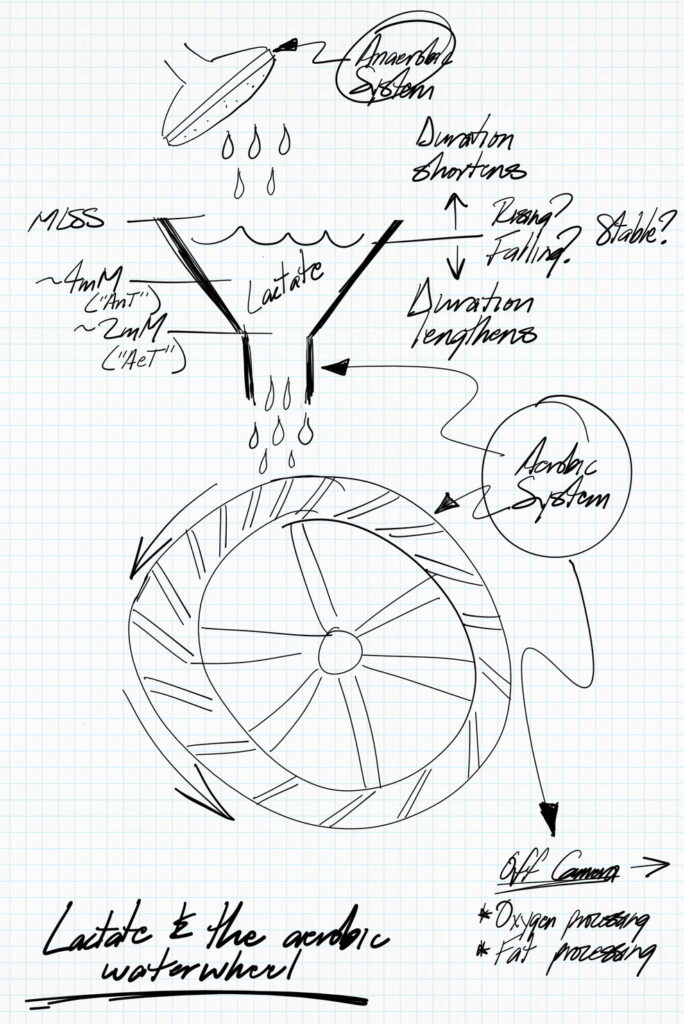
For events lasting from roughly 2 minutes to 2 hours, endurance is most limited by the ability to manage lactate accumulation. You cannot significantly reduce how much lactate your muscles produce at a given intensity—lactate production correlates directly with the high-power glycolytic output you need. But the rate at which lactate can be removed from working muscle is highly trainable. This removal rate is what determines your endurance at higher intensities.
Lactate is not a waste product. It is a fuel. It can be taken up and oxidized by skeletal muscles, the heart, and the liver. The greatest reservoir for clearing lactate produced during hard efforts is in the slow twitch muscle fibers, which run on aerobic metabolism. For these fibers, lactate is a preferred fuel source. The greater the aerobic capacity of your slow twitch fibers, the more lactate they can absorb and use for energy.
For events lasting longer than 2 hours—ultra-distance races, big alpine climbs, multi-day objectives—the aerobic threshold pace becomes the primary performance determinant. Your ability to sustain output at or near AeT, powered primarily by fat metabolism, determines how fast and how far you can go. The larger your aerobic engine, the higher that pace will be.
This is the counterintuitive conclusion that follows from the physiology: to improve your higher-intensity endurance, you must first maximize the aerobic capacity of the slow twitch muscle fibers that clear the lactate your hard efforts produce. When coaches and athletes talk about having a “big motor” or a “great aerobic base,” this is the metabolic reality they are describing.
Building that base requires consistent, long-duration, low-to-moderate intensity training—aerobic training done below or at the aerobic threshold. This work triggers the adaptations in the aerobic metabolic pathway that expand the capacity of your slow twitch fibers: more mitochondria, more oxidative enzymes, greater capacity to take up and use lactate as fuel.
Aerobic base training is not the whole story. Once you have maximized your aerobic capacity for a given training cycle, appropriately timed high-intensity work allows you to build further on that foundation. But without the foundation, the high-intensity work has less to build on, and the gains from it will be smaller and less durable.
Note on terminology: Lactate Threshold, Anaerobic Threshold, Maximum Lactate Steady State (MLSS), Onset of Blood Lactate Accumulation, Functional Threshold Power, and Critical Power are all names for what is essentially the same metabolic event: the point at which lactate production exceeds its rate of removal. Physiologists distinguish between the precise definitions, but for practical training purposes they all represent the intensity beyond which exercise can only be sustained for a limited time.