
You are dedicated to your training—committing to strength work, building your aerobic base, honing your skills for technical objectives—but are you seeing the progress you expect? If the answer is no, nutrition may be the missing piece. What you eat impacts your performance, recovery, and day-to-day energy levels. Without a targeted nutrition strategy, you risk burnout, injury, and leaving your potential unrealized.
This article covers the fundamentals of sports nutrition for mountain and endurance athletes: what macronutrients and micronutrients do, how to structure your eating around training, what your plate should look like on different training days, and the most common mistakes we see athletes make.
What Are Macronutrients and What Do They Do?
Macronutrients are nutrients your body needs in large amounts that provide calories (energy). There are three: carbohydrates, protein, and fat. A calorie is simply a unit of energy. When you see “low calorie,” think “low energy.”
Carbohydrates
Carbs are the preferred energy source of your muscles and brain and should serve as the centerpiece of any athlete’s diet. They are stored in the liver and muscles as glycogen. When fully recovered, the average person can store up to about 500 grams (2,000 calories) of glycogen in the muscles and an additional 100 grams (400 calories) in the liver.
Carbs are also protein-sparing. When your body does not have enough carbohydrate available, it will break down muscle tissue to create more through a process called gluconeogenesis. This is one of the many reasons it is important to top off your stores before heading out for a session and why carb loading can improve performance in endurance events.
Simple carbs (sugars) are found in foods like fruit, candy, and sports drinks. They are digested quickly, which can spike blood sugar—less ideal in daily life, but useful during exercise when muscles need a fast energy source. Complex carbs (starches and fiber) are found in whole grains, potatoes, legumes, fruits, and vegetables. They digest more slowly, producing a steadier energy release. Fiber is indigestible by the body and plays important roles in digestion, cholesterol metabolism, and gut health.
A note on ketogenic diets: While the brain can use ketones (derived from fat) for energy, this is not optimal. Research on the ketogenic diet indicates reduced performance in endurance athletes and detrimental effects on various health measures.
Protein
Protein is best known for muscle growth and repair, but it also supports digestion, immunity, hydration, energy production, and nutrient transport. Proteins are composed of amino acids. Of the 20 total, 9 are considered essential—meaning they must come from food. Among these, the branched-chain amino acids (leucine, isoleucine, and valine) are particularly important for building muscle, with leucine being the primary stimulator of muscle protein synthesis.
Most animal proteins (meat, eggs, dairy) contain all essential amino acids in the right ratio. Plant proteins are typically incomplete, meaning they are deficient in at least one essential amino acid. Plant-based athletes can meet their needs by eating a variety of complementary protein sources—for example, rice (low in lysine, high in methionine) paired with beans (the reverse). Vegetarians and vegans may need to increase total protein intake to account for lower bioavailability of plant-based protein.
Fat
Fat’s primary role is to store energy. It is broken down and used for fuel during low-intensity exercise, provides insulation, comprises certain hormones, and is necessary for the absorption of some nutrients. Energy from dietary fat is not available to your body for several hours, making it a poor source of fuel during training.
Saturated fats (solid at room temperature: meat, dairy, coconut oil) should be limited to less than 10% of total daily calories. Unsaturated fats (liquid at room temperature: nuts, seeds, avocados, fatty fish, plant oils) include omega-3 fatty acids, which are anti-inflammatory and must be obtained from the diet. Trans fats are effectively banned in the US and Europe due to their association with heart disease.
A note on alcohol: Alcohol provides calories but is not required for survival. Moderate consumption likely will not cause harm, but it does not support health, restorative sleep, or athletic performance.
Which Micronutrients Should Mountain Athletes Pay Attention To?
Micronutrients (vitamins and minerals) do not provide calories but play essential roles in immune function, bone health, oxygen transport, and recovery. Most are tightly regulated in the blood, making deficiencies hard to detect through standard lab work. The best way to ensure adequate intake is to eat a varied diet and, when needed, work with a registered dietitian. The following are the micronutrients most commonly encountered as challenges among mountain and endurance athletes.
Iron is critical for oxygen transport. It comprises hemoglobin, the protein in red blood cells that carries oxygen to your muscles. As many as 35% of athletes may be iron-deficient. Iron is lost through sweat and can be destroyed through foot-strike hemolysis (the physical breakdown of red blood cells from repetitive ground impact). Iron status is especially important at high altitude, where there is less oxygen in the air. Good sources include beef, liver, tofu, lentils, spinach, and fortified cereals. Plant-based iron is less efficiently absorbed, so plant-based athletes may need to increase intake or supplement—but only with current lab work, as excess iron can cause organ damage.
Vitamin D supports bone health, immunity, and mental wellbeing. If you live above about 40 degrees north latitude (or below 40 degrees south), you may not get enough UV exposure to synthesize adequate vitamin D, and dietary sources are limited. A supplement may be warranted. Food sources include fatty fish, fortified dairy products, and fortified orange juice.
Calcium supports bone health, muscle contractions, and nerve function. It is abundant in dairy products. Athletes who limit dairy should incorporate foods like tofu and fortified orange juice.
Vitamin B12 is involved in nervous system function, red blood cell production, and metabolism. It is not found naturally in plant foods, so strict vegans will likely need to supplement. Good sources include liver, fish, beef, and fortified nutritional yeast.
Antioxidants (vitamins C and E, selenium) neutralize free radicals, which are produced at elevated rates during physical activity. A colorful plate of fruits and vegetables is the best source. Megadoses of vitamin C supplements may actually impair performance and training adaptations—whole food sources are preferable.
How Much Should You Be Eating?
The single most important thing you can do for your nutrition as an athlete is to ensure you are eating enough. Your total daily energy expenditure (TDEE) includes your resting metabolic rate (the energy your body needs just to exist), non-exercise activity (daily movement that is not intentional exercise), the thermic effect of food (the energy required to digest what you eat), and exercise activity. On most days, your body’s primary calorie burn comes from simply keeping you alive—not from training.
This means you need to eat even on rest days. Your body requires energy for basic functions regardless of whether you trained. Calorie needs are highly individual, depending on metabolism, body composition, training load, and other factors.
Consequences of inadequate fueling are serious: increased injury risk, hormonal imbalances (including menstrual and sexual dysfunction), decreased immune function, poor performance and recovery, and decreased metabolism. Chronic underfueling can contribute to Relative Energy Deficiency in Sport (REDs), a condition that can impair bone health, cardiovascular function, sleep, mental health, and immunity.
When Should You Eat Relative to Training?
Throughout the Day
We recommend not going more than 3 to 5 hours while awake without eating a meal or snack containing both carbohydrates and protein. Research on within-day energy deficiency shows that going long periods without eating can decrease metabolism and disrupt hormonal function, even if total daily calorie intake is adequate. Eating consistently also keeps you in an anabolic state for more of the day, supporting muscle repair and growth.
Before Training
The goal of pre-training fuel is to top off your energy stores and provide your muscles with a quick source of carbohydrate. The less time you have before a session, the higher the proportion of carbohydrate should be. Two hours before a long run, you might eat toast with peanut butter and a banana. With only 30 minutes, a banana alone is a better choice—the peanut butter would slow digestion and potentially cause GI distress.
During Training
Your body stores enough glycogen to power roughly 90 minutes of exercise. Beyond that, you must eat carbohydrates to continue providing energy to your muscles. Skipping intra-workout fuel risks bonking (glycogen depletion and blood sugar collapse), muscle breakdown through gluconeogenesis, and performance decline.
After Training
Post-training nutrition serves recovery. You need carbohydrates to replenish glycogen stores (refilling the fuel tank) and protein to repair muscle tissue. Insulin, released in response to carbohydrate intake, acts as the key that opens muscle cells to let protein in. A post-training meal or snack should include both carbs and protein.
What Should Your Plate Look Like on Training Days?
The Performance Plates, adapted from the United States Olympic Committee’s Athlete’s Plate model, provide a visual guide for meal composition across different training days:
Easy day (rest day or short recovery workout under 30 minutes): roughly equal portions of carbohydrates, protein, and fruits/vegetables.
Moderate day (workout lasting 60–90 minutes): increased carbohydrate proportion, steady protein, slightly reduced fruits/vegetables.
Hard day (workout lasting 2+ hours, or doubles): carbohydrates dominate the plate, protein stays steady, fruits/vegetables reduced further.
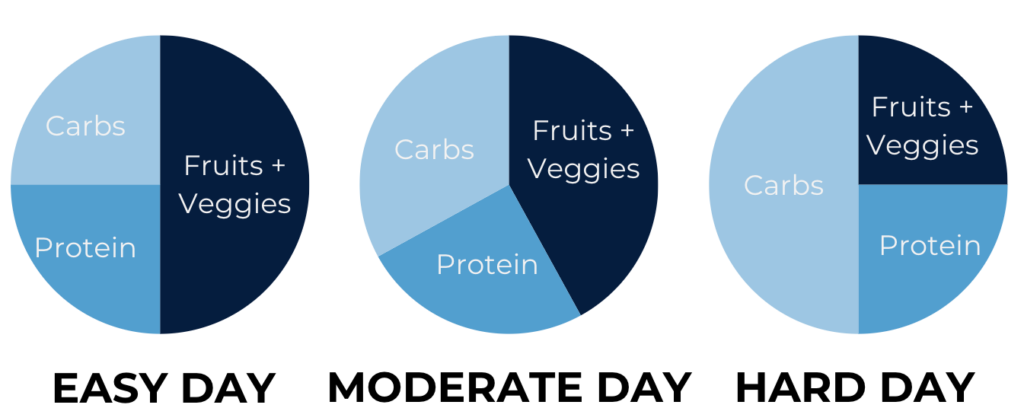
As training intensity and duration increase, the proportion of carbs on the plate increases because the demand for quick-acting fuel rises. The reduction in fruits and vegetables on hard days is intentional: high fiber intake can cause GI distress during intense exercise, and filling up on salad may prevent you from eating enough carbohydrate to match your energy needs.
Fat is not shown on the plates because it naturally appears in the foods that provide flavor and preparation: cooking oils, salad dressing, cheese, nuts, and fatty fish in the protein section. During a training cycle, even on rest days, following the moderate plate is wise to maximize recovery and preparation for subsequent sessions.
Above all, listen to your body. As you approach peak training, you may crave more carbohydrates than the plates suggest. Learning to respond to those signals is an important part of developing your nutrition instincts.
What Are the Most Common Nutrition Mistakes Endurance Athletes Make?
Underfueling. Whether intentional (weight loss efforts) or unintentional (lack of appetite, time constraints), underfueling is the most consequential nutrition mistake an athlete can make. Red flags include frequent injury, long recovery times, loss of menstrual period, erectile dysfunction, excessive fatigue, loss of hunger cues, and failure to progress despite consistent training. The solution is straightforward: eat more, eat consistently (every 3–5 hours), and match the proportions on the Performance Plates to your training load.
Inappropriate macronutrient proportions. In a protein-focused culture, many athletes worry about protein intake while failing to eat enough carbohydrate—the muscles’ preferred fuel source. A meal of only protein and vegetables is neither complete nor adequate for athletes. Every meal should include all three macronutrients; every snack should include at least carbs and protein.
Skipping pre-workout fuel. Fasted training increases injury risk (particularly for athletes who produce estrogen) and frequently leads to unintentional underfueling across the day. If time is the barrier, prepare a carb-heavy snack the night before—overnight oats, rice balls, or a granola bar require minimal morning effort. The more you practice eating before training, the better your gut will tolerate it.
Fad diets. Ketogenic diets, intermittent fasting, and “clean eating” protocols share a common problem: they make it difficult to eat enough calories and carbohydrates to support training. Inadequate fueling harms both health and performance. Following strict dietary rules can also take a toll on mental health, with dieting being a major predictor of developing disordered eating. If you cannot see yourself following a diet for the rest of your life, it is not sustainable and it is not the right approach for you.
Do You Need Supplements?
Supplements sit at the top of the nutrition priority pyramid because they are meant to supplement an already sound diet, not replace or compensate for an inadequate one. Over-reliance on supplements is unsustainable, less effective than eating well, and expensive.
There are legitimate cases for supplementation—vitamin B12 for vegans, vitamin D for athletes in northern latitudes, iron when confirmed by lab work. But before adding any supplement, ask four questions: Do I actually need it? Has it been shown to be effective in studies on active humans? Is it safe (remembering that the supplement industry is not regulated the same way food and medications are)? Does it fit my budget? If any of these answers is not a clear yes, reconsider.
How Should You Approach Hydration?
Hydration involves replacing fluids and electrolytes lost through sweat, breath, urine, and feces. It is highly individual and may require some experimentation to dial in for training and competition.
A useful starting point for daily hydration: take your body weight in pounds, divide by two, and drink that many ounces of fluid per day. The best indicator of hydration status is urine color—a lemonade color indicates optimal hydration, apple juice color indicates slight dehydration.
During training, two factors matter most: sweat rate (liters per hour) and sweat sodium concentration (how salty your sweat is). For sessions under 90 minutes in normal conditions, water alone is generally sufficient. For longer efforts, incorporate salty snacks or an electrolyte supplement. Hydration needs also increase during winter sports (fluid is lost through breath even without visible sweating) and at high altitude (where respiratory fluid loss increases).
What Should You Take Away from This?
Adequate nutrition may be the difference between a PR and a DNF. It may be what keeps you healthy and free of injury throughout a training block. The core principles are straightforward:
Eat enough total calories. Your body needs fuel even on rest days.
Eat a meal or snack containing carbs and protein every 3 to 5 hours while awake.
Make carbohydrates the centerpiece of your meals, increasing the proportion as training load increases.
Eat before all training sessions. Eat during all sessions longer than 60 to 90 minutes.
Supplements may serve a purpose but cannot compensate for an inadequate diet.
Nutrition needs differ for everyone. The guidelines in this article provide a strong starting point, but learning what works best for your body—through attention, experimentation, and ideally the guidance of a registered dietitian—is an ongoing process.
Reviewed by Chantelle Robitaille, MSc.