
Downhill running is where many trail runners lose time, accumulate injury risk, and burn through their quads. The good news is that technique improvements in three specific areas can make descents faster, more efficient, and less painful: core engagement, eye position, and cadence. These are learnable skills, not genetic gifts, and they respond quickly to deliberate practice.
When we run technique clinics, the most common questions are not about climbing. They are about how to go downhill without knee pain, ankle injuries, or blown-out quads. The three tips below address all of these, and the drills at the end give you a way to practice them outside of your regular runs. These techniques help on all terrain, but descents are where they make the most visible difference.
Your core comprises several layers of muscles that connect the upper and lower body. From the most superficial to the deepest: the rectus abdominis, the external obliques, the internal obliques, and the transverse abdominis (TA). The TA connects to the pelvic floor muscles that provide support from the bottom of the pelvis. The outer hip houses additional stabilizers: the gluteus medius, gluteus minimus, piriformis, and several deep lateral rotators.
These deep muscles work together to provide stability as you repeatedly impact the ground and propel yourself forward. When any of them are underdeveloped or not firing, your larger muscles try to compensate. This leads to muscle tension at best and alignment issues or injuries at worst. Proper core engagement also maintains good posture, keeping your hips and center of gravity forward on the hill. As surfaces change between stable and unstable—snow, rocks, roots, mud—a stable core is what enables nimble, confident movement down the trail.
Your brain reads what your eyes see and responds instantly. Proprioceptors in your connective tissue, fascia, and muscles send impulses to your brain about where you are in space, and without any conscious direction, you are already several steps down the trail. Looking as far ahead as possible gives your brain and body ample time to respond and puts you in the best position to use gravity to your advantage.
Try this: stand up and look 4 to 6 feet in front of you. Feel where your hips are in relation to your feet. Now bring your gaze down to your feet and feel what happens to your hips. They are almost certainly behind your center of gravity now, in a mini squat. That position shortens and contracts your quad muscles, requires more strength in the hips to stabilize your joints, and demands more force from your larger muscle groups to move down the trail. It is like pushing a big gear on a bike when you could be spinning in the granny gear.
That increased tension means your legs work harder than necessary, which leads to less efficiency, more fatigue, and potentially more overuse injuries over time. By contrast, if you focus your gaze down the trail and engage your core, your hips stay close to your center of gravity. From this position it is easier to stabilize, absorb force, and propel yourself forward. When done this way, downhill running really is free speed.
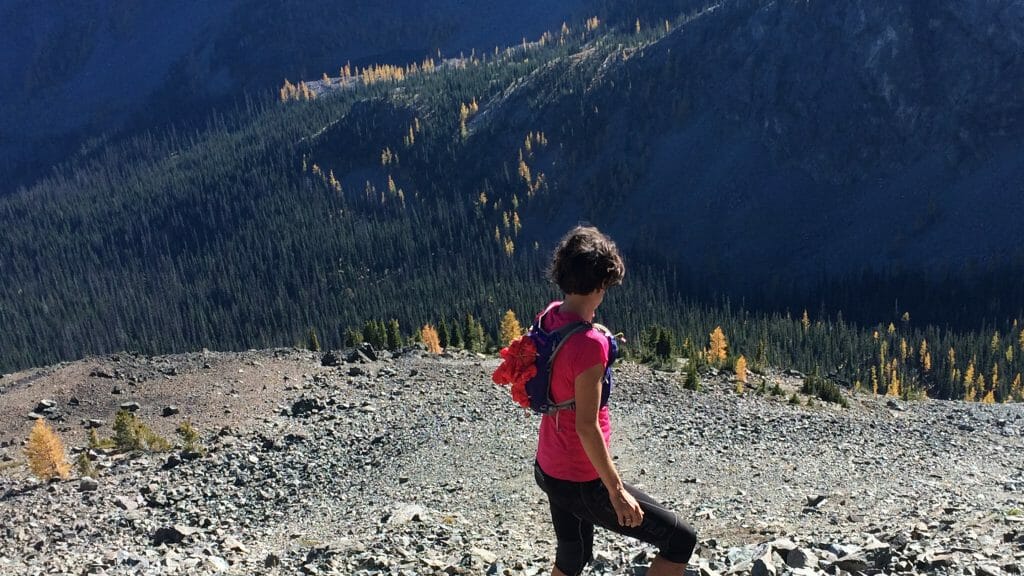
A high turnover of approximately 180 steps per minute (3 steps per second) reinforces the other two tips. A slower cadence means you are landing with your foot out in front of your hips, sending the full landing force of the downhill up through your body. This puts excessive pressure on your joints and demands more from your muscles. If you happen to land on a root or rock while your hips are still traveling toward the next footfall, your muscles have to work overtime to stabilize through a much longer ground contact time.
With quick steps close to your hips, even if you hit an unexpected obstacle, you have already transitioned to the other foot and your proprioceptors have reacted to keep you upright. It is also easier to maintain core engagement and keep your hips forward when you are maintaining a quick turnover. The combination of all three—core engaged, eyes down the trail, fast cadence—is what turns descents from something you survive into something you gain time on.
In addition to keeping these three cues in mind during your regular runs, practice the following drills a few times per week. They take very little time and build the neuromuscular patterns that make the technique changes automatic.
Lateral and forward hops. These build quick tempo and core stability. The goal is to stay tall throughout and keep your feet glued together. This is not a squat exercise. Start with 20 seconds and work up to 45 seconds. Progress by hopping on one foot.
TV watchers (supine core hold). This strengthens the deep core muscles. Engage by pulling your belly button toward your spine. If you are unfamiliar with engaging your core, this is a good foundational exercise to establish the pattern before applying it to running.
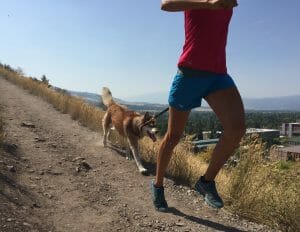
Grassy hill repeats. Find a grassy hill—a park or golf course works well—and run down it, practicing quick feet. Using a hill without obstacles gives you confidence to look further ahead. Start with short repeats of 30 to 60 seconds, as your brain is working hard to form new neuromuscular pathways. Once the pattern feels natural on smooth terrain, move to more technical trails.
For athletes who want a more complete strength and core program to support their running, our strength training content covers the full progression from general core work through sport-specific muscular endurance.