
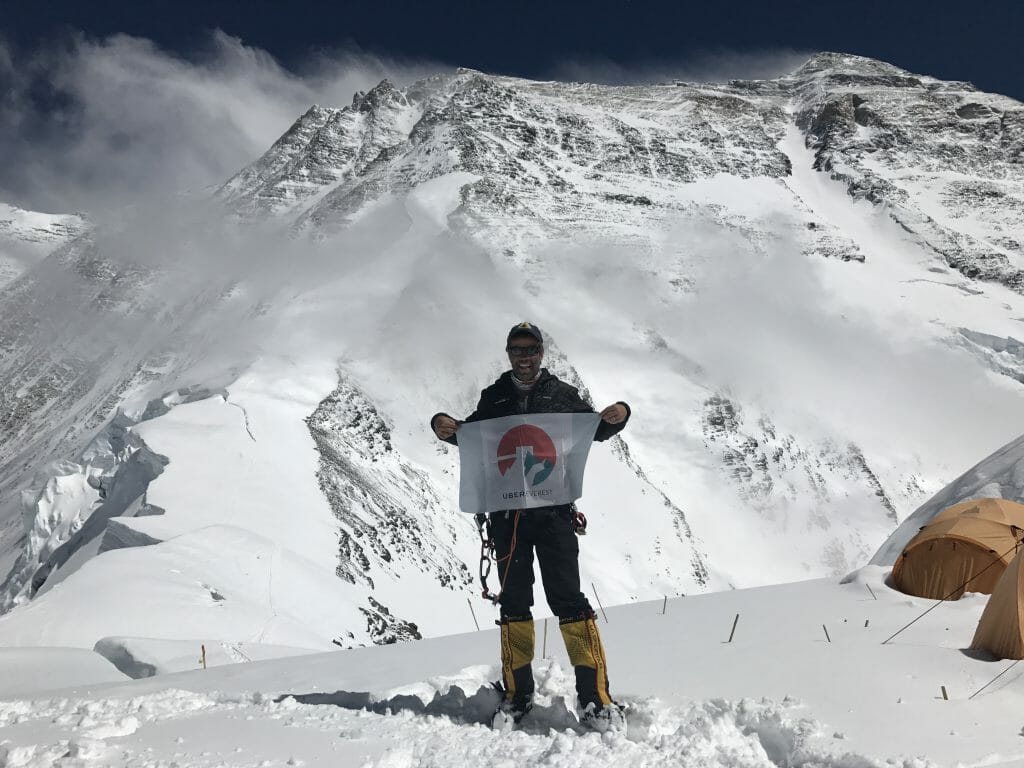
In the past I’ve trained toward massive, singular goals: summiting Everest, climbing in Antarctica, skiing Cho Oyu. Having a clear goal lets you know exactly where you need to be in terms of fitness, and when you need to get there. A big mountain on the horizon is a strong motivator.
Then in 2017, not long after Everest, I joined Uber as Chief Business Officer, Asia Pacific. One year later, my role expanded to CBO for all of the company’s international operations. That means moving people around cities in 60-plus countries. I became so busy developing new teams and markets around the world, often in frontier places like Pakistan and Nigeria, that work assumed the qualities of an expedition. Company priorities became my next big mountains. The path toward each goal was a long, hairy ridge leading to a summit just out of sight. The scale of it all was, and continues to be, both energizing and daunting.
I took more than 50 red-eyes in 2018, and close to another 50 in 2019—from my home in Singapore to Latin America, Europe, the Middle East, Africa, elsewhere in Asia, and quarterly to San Francisco. Layered on top of the day-to-day demands of my dynamic career, this high volume of travel struck me as being a modern sort of fitness test. Wanting to thrive, not merely survive, I followed simple protocols for staying healthy and mentally acute. I didn’t drink on planes; I engaged in intermittent fasting; I made it a priority to work out when I landed; I got outside whenever I could. (Having grown up in Colorado, I need light. Sitting in a conference room for too long is death to me.) Exercise was a crucial form of stress relief.
Still, I felt I was barely holding on to my fitness. I certainly wasn’t increasing it.
“Corporate athlete”—it was a term I threw out when I emailed Steve House in the summer of 2019. Maybe it can be a new Uphill Athlete offering, I half-joked.
I’d borrowed the phrase from a 2001 Harvard Business Review article a corporate coach gave me back when I was a partner at Goldman Sachs. The gist of the article is that whereas elite athletes train and rest for a relatively small amount of actual performance or competition, the length of your “playing time” in a corporate role could be decades. In most cases you’re not resting enough. You’re not training the right way. That’s where mental and physical routines can transform an unsustainable lifestyle into a sustainable one.
What I proposed to Steve in my email was that he train me over the course of three hectic months of work travel in the fall of 2019. It’ll be fairly typical, I wrote. A crazy number of red-eyes, continents, countries. But I want to see if I can improve fitness during that time, not just maintain it.
I was already familiar with Uphill Athlete and their training methodologies. I’d read Training for the New Alpinism when it came out and had applied its principles to my own high-altitude preparations: an Everest attempt in 2014 (cut short by the Khumbu Icefall avalanche), Cho Oyu in 2016, and Everest again in May 2017, that time a Rapid Ascent from the north side with Adrian Ballinger’s Alpenglow Expeditions. I enlisted Steve as a coach for the final month leading up to my departure for Tibet. Those finishing touches boosted my confidence on the climb.
So I knew firsthand what Uphill Athlete could do for me in the mountains. But what about in my working life at a Silicon Valley startup with its ridiculous amount of travel? Could there be an intersection there?
Steve agreed to take on my global footprint. I pulled him into a whirlwind of complex itineraries between home and Abu Dhabi, Riyadh, Munich, Yokohama, Istanbul, New York City, Delhi, San Francisco—wherever I needed to go. Collaborating with him was ultimately an effort to establish a framework and some consistency around what was a very inconsistent existence.
It worked like this: I would share a rough outline of my upcoming two weeks with Steve, and then he would dial training in around the flights and work and family engagements. We aimed to get five or six workouts in a week, ideally in the morning. I’ve always found that it is more predictable to work out early, before the day has a chance to go sideways. It is what I do whenever I’m home in Singapore, where we have a super-strict priority as a family to have dinner together.
Even so, given the unpredictability of travel, there was a lot of fluidity to the plan. Sometimes a red-eye was late and I couldn’t get to a gym after landing, or maybe I couldn’t fit in a full hour-and-a-half-long run because it was going to be a tight morning. Perhaps a hotel gym didn’t have the right equipment. In each of those cases I’d communicate with Steve via WhatsApp, and he’d push a workout to the afternoon, substitute a workout from the day before, or adjust duration as needed. It was all about creativity and flexibility. If we found a pool, Steve threw in swimming. Occasionally a Peloton bike would show up in a gym. After work dinners, I’d tack on a late-night walk around whatever city I was in. And hotels always have a stairwell just waiting to be used instead of the elevator.
Oftentimes I wasn’t even staying in a hotel, just changing in an airport bathroom. That became a big piece of the puzzle for us: How do you get workouts in when you never get to a hotel on a trip? Because no matter where I am in the world, I’m always trying to get home. I don’t want to spend an extra night in a hotel ever (and I try not to because Uber is still a start-up). I’d always prefer to sleep on a plane and be vectoring toward Singapore, my wife, and our daughters. With Laura, my wife, also traveling for work, I cover the home front while she is away. (She frequently needs to be on the ground in India with her team at EmancipAction, a nonprofit she founded that is dedicated to helping victims of child sex trafficking.)
I turned every walk to and from an airport gate into a Farmer’s Walk, bags in each hand. I never took escalators, always the stairs. Doing burpees in the galley on ultra-long-haul flights raised some eyebrows, but it was an efficient way to keep the blood flowing.
Another major factor in the training equation was my sleep. I’ve never been a good sleeper, and on airplanes it’s rarely perfect. Like a lot of people at Uber and other tech companies, I’m massively data-driven. I wear an Oura Ring and track my sleep religiously. It’s usually not great news, but I would often note it—hours and quality of the previous night’s sleep—in my comments on a workout.
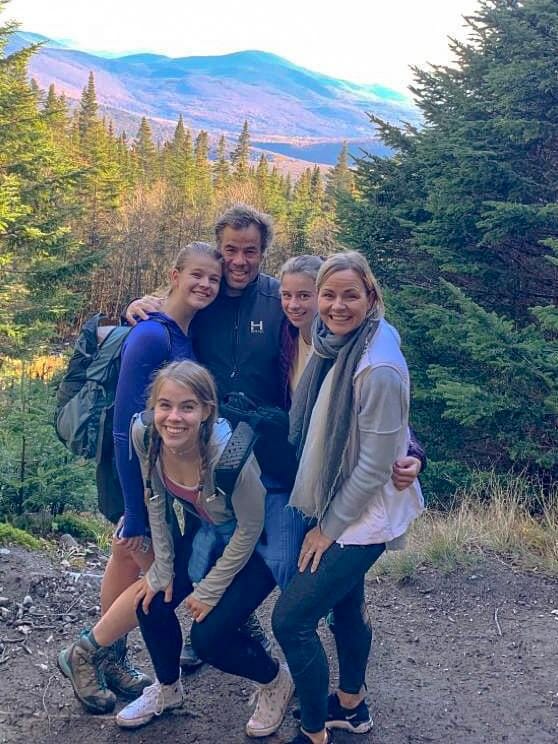
At one point in the fall, on my way from San Francisco to Dubai, I was able to finagle a one-day weekend stop in Hanover, New Hampshire, to visit my oldest daughter at college, along with my wife and our other two girls. Steve swapped out a gym workout for a last-minute family hike up Mount Moosilauke in the White Mountains. This life has taught me to grab micro-opportunities wherever they arise.
When you’re as untethered as I am, accountability is everything. It was amazing to wake up in a hotel or at home or get off a plane and know that Steve was out there on the other end of TrainingPeaks or a WhatsApp chat with a plan for the day—and that they wanted to know I was getting it done. At times it probably seemed ridiculous to them, the sheer amount of movement and all the different cities. On the other hand, it was fun to figure out how to fit the training in. Hopefully it was as interesting an experiment for him as it was for me.
Looking back on the three months I spent working with Uphill Athlete, I am convinced of the broader applicability of Steve’s training principles. Imagine scaling everything that they have learned about endurance and strength across the government, tech, and nonprofit sectors. These stressful jobs with high burnout rates—jobs that will kill you if you don’t get on the fitness bandwagon early in your working life. For that population, training is about sustainability and survival, not just one climb, one race, or even several seasons of racing. The training may look a little different, but it is just as impactful for a 50-plus-year-old “corporate athlete” like me who’s after career longevity and performance.
People are living longer, which means they will need to be productive for longer. None of that is going to happen if we don’t take care of ourselves along the way.
To that end, companies need to prioritize fitness and wellness for their employees—from day one. It doesn’t matter whether you’re desk-bound or a traveler like myself. Physical well-being should be a core part of corporate culture. The science is perfect and the economics are perfect: If your people are healthy, they are better able to handle stress. They’re not missing work or filing insurance claims. Managers interact more effectively with their employees, as well as with partners and clients. Everyone wins.
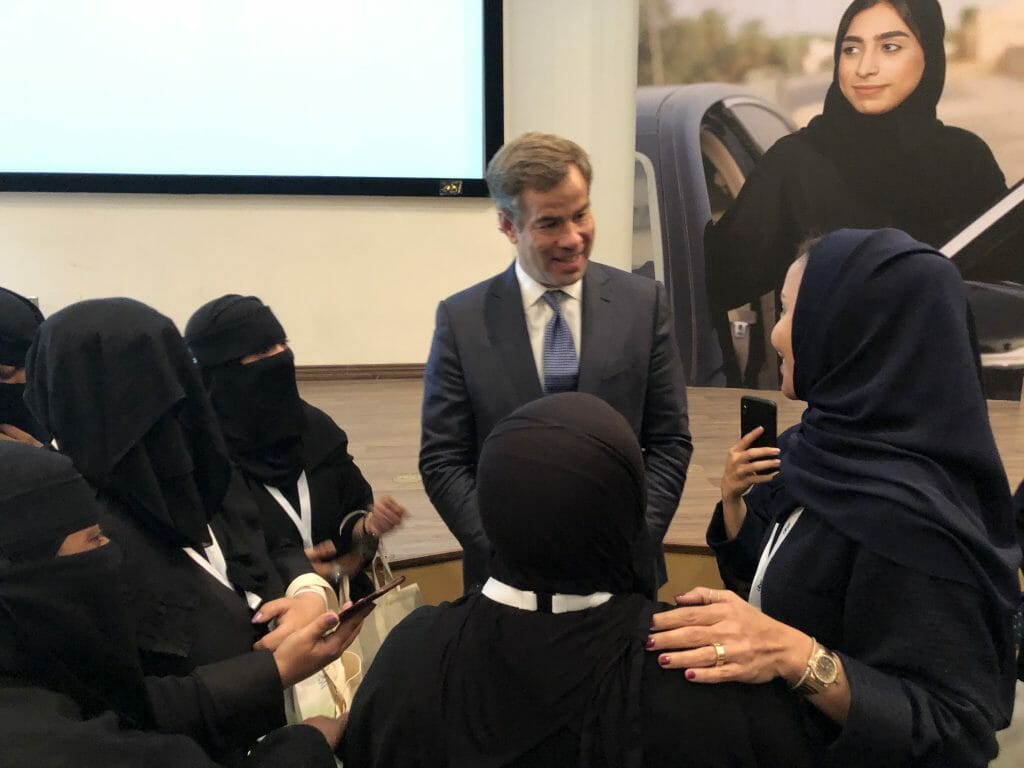
I may be ping-ponging around the world, but I am never too far from the Uphill Athlete ethos and community, even in the middle of the desert. On a recent Middle East trip, I did an event in Dubai with two amazing women: the first Saudi woman to summit Everest and the first Emirati woman to have reached 8,000 meters, which she did on Everest. In the conversation I moderated, we drew from our experiences on the mountain to lay out recommendations for entrepreneurs in the Middle East. It was similar to a talk I’ve given for a couple years now at Uber around the world, about how lessons I’ve learned on Himalayan expeditions apply to the work we do as a company. I touch on taking new approaches to old problems; training; being efficient with what you have; relying on data; remaining present and focused; and celebrating wins.
When my team summited Everest, we radioed down to Monica Piris, our expedition doctor. “Congratulations,” she said. “You’ve got 15 minutes before I call you back. I want you moving in 20.” It is the perfect analogy for what we do at Uber: We launched a new city, fantastic. The next morning we have to move thousands or hundreds of thousands or millions of people around that city. Acknowledging a big win is vital, but you can’t rest on it.
One of those victories came the same week as the panel in Dubai, when we celebrated enabling women to drive on the Uber platform in Saudi Arabia. It was yet another high point along this extended Uber expedition. The next day’s run in the streets of Riyadh wasn’t the same as carrying skis into the backcountry, but it made me feel just as alive.
-by Brooks Entwistle, Chief Business Officer, International, for Uber
Title image: Training in the heat and humidity of Singapore, but at 4,000 meters with a hypoxic mask. This alleyway in Chinatown is known as “the lane of pain.” Brooks Entwistle collection