
Companion to the Uphill Athlete Podcast episode “Multi-Sport Training and Seasonal Planning“
Most of our readers will know this athlete, and if they don’t, they just might be this athlete. Someone who runs three days a week, goes to the climbing gym a few times a week, and skis all winter while talking about the mountain bike race that’s on the calendar in the spring. They secretly wonder whether loving all of these activities is the reason they aren’t as good at any of them as they think they should be.
Steve will admit that this describes him at this stage of life and it fits a lot of the athletes we know too. In the years since Training for the New Alpinism came out, training for two or more sports at once has gone from the exception to the norm for mountain athletes. Chantelle encounters these types of athletes every day who are feeling a bit lost and think they’re the only ones feeling this way. The truth is, this reality is pretty common, particularly for people living in places where the sports change naturally with the seasons. They come to us with a key question: Can I train for more than one sport at once?
The simple answer is yes, but with some careful planning. Without it, your efforts may cancel each other out, but handled with intention, the training is additive and moves your fitness forward.
Here is the framework we use with our athletes: name one priority, run an honest gap analysis against it, let each sport get louder or quieter around that priority, and keep strength training all year. Consider an athlete training to climb Rainier while also wanting to mountain bike, go to yoga, and keep a weekly group strength class, and they don’t want to give anything up. With a good plan, they rarely have to drop a sport for good; what they give up is doing everything at high volume at once. The key issue here is to train with intention. If you fill your week with random training sessions, you shouldn’t expect your climbing to improve. You can’t expect your uphill hiking pace to improve unless you practice the right skills in the right amounts.
Training two or three sports with equal intensity all year leads to little improvement in any of them. This is the most common multisport mistake we see, and it comes from training as if we were still teenagers. A 16- or 18-year-old is still developing and can often absorb that kind of load. Once we become adults, our ability to recover from workouts tends to change dramatically, and a plan has to account for it.
Health and performance are both important goals. Chantelle hears constantly “I’m just training for x” and she pushes back on the word “just”: if you’re training, it matters to you, and it deserves a real approach. Training to keep up with your grandchildren, or to be ready for whatever adventures your friends are planning, is a goal. Training to climb Everest is a goal. They are different goals and we train for them differently, but both need preparation.
Treating a health goal as somehow lesser tends to create confusion and guilt. It also tends to produce misaligned training plans that can set people back further. One question helps sort out which kind of goal you have: would missing your goal actually change anything about your year?
For Steve, a spring trail race is fun. There’s energy, there are friends, and everyone shares a cold beer together at the finish line. If he can’t do it, he’s honestly not that upset. What matters more to him is keeping up with his active kids and going on adventures with them for a long time. That puts him in the health-and-fitness group, and that is a perfectly valid place to be.
Chantelle points out where this can often go wrong. Suppose Steve says his goal is to keep up with his kids, and that maybe he’ll jump into a trail race with friends at the end of the season. If, in the back of his mind, he really wants to run that race, he hasn’t been honest about his goal. He’ll likely spend the summer hiking and climbing, realize the race is a month away and he hasn’t run as much as a mile, then cram in as much running as he can. That risks injury and a race day spent looking to just survive until the finish line.
Chantelle laughed while describing this on the podcast because she knows that Steve would do exactly that. He admittedly can get away with doing something like this because he did structured training for 23 years and some of it is still in his body. He also admits that he gets away with it a little less every year.
The fix is to be honest with yourself. If you’re secretly hoping to beat a friend up your local hill, or to join a climb of the Grand Teton in August that your friends are planning, name it, at least privately, so you can put the right training in place.
You can train well for only one priority at a time, which is why Chantelle doesn’t ask athletes what their priorities are; she asks what their priority is.
Start by writing your goals down and putting them on a calendar so you can see when each one falls. Across a year you can have two A goals, meaning top-priority events, if they sit in different seasons, but you can’t have two A races in July and August. If two important things land in the same season, decide which matters most, map that one out first, and then see where everything else fits.
Run an honest gap analysis. The first question to ask yourself is: what do your goals demand? The traditional coaching approach is to walk through each demand one at a time: aerobic fitness, sport-specific fitness, durability, technical skill, strength, muscular endurance (ME), fueling, equipment, experience with the activity, and mental preparedness. Next, rank yourself honestly against each one for the season ahead.
The steps are the same for everyone, even when the athletes look nothing alike. Chantelle described three: someone training for health and fun; someone who races skimo in winter and trail races in summer; and someone preparing for a long technical alpine route who also has a summer 50K and a fall backcountry hunt on the calendar.
Your ranking tells you where and how to dedicate your training time. If your aerobic fitness is in a good place but your technical skills are rusty, technical skill needs specific emphasis. If your summer goal is simply to stay active and enjoy yourself, but your mountain biking never seems to improve, then technical mountain biking skills deserve focused attention. Chantelle describes this as zooming out and zooming back in. Look at everything you want to achieve, identify what will take the most time and what you already have a strong handle on, and then plan your training accordingly.
Chantelle considers balance a myth and prefers to think about harmony, the way it works in music, where some parts get louder and some get quieter. If you’re running, skiing, hiking, and climbing, they can’t all be loud at once, because you can’t carry a high volume of all of them at the same time. The work is deciding which sports get louder and which get softer to keep you in harmony with your body and your goals. Then you plan the training to move from least specific to most specific as the goal gets closer. This is the first-principles thinking we have applied to unconventional activities like rock and alpine climbing. Ask which of your activities support your aerobic base, which support strength, and which support one another.
For most athletes, the conflict between training for different sports comes down to timing and volume. This worry is common: will running hurt my climbing, will lifting slow down my running, am I sabotaging one sport by loving another. Science and coaching call this the interference effect: when strength and endurance are trained together (concurrent training), endurance work may blunt some strength and power adaptations. Triathletes juggle three sport disciplines and even build workouts, called bricks, that combine two disciplines back to back. Plenty of endurance athletes strength train, so concurrent training doesn’t have to hold you back, but it does take careful planning.
Chantelle sees interference mostly when athletes try to carry a high volume of endurance training and a high volume of strength training at the same time; otherwise strength and endurance tend to complement and help each other. This is one reason she isn’t fond of the label “hybrid athlete.” If you strength train and do endurance work, you’re simply an athlete, and a well-rounded one.
The way to manage interference is to shift volume across the season. Early in the season you can do heavier strength work aimed at strength and power, often three to four sessions a week. As endurance volume grows, strength volume comes down, usually to one or two sessions a week as a big goal approaches, but it stays in the plan. As Chantelle puts it, “You’re not lifting your way to the finish line. You’re running your way to the finish line.”
The same logic applies to any favorite activity. Her example is the athlete who loves their Peloton and wants to climb Rainier: “You’re not spinning your way up the mountain, friend.” The bike can stay, but it can’t have four days a week. Those days belong to time on your feet, which often means unglamorous work like weighted stairwell climbs, box step-ups, and strength training.
Chantelle added one more observation that left Steve feeling called out: the things you’re drawn to are usually not where you need to spend more time. The work you find yourself resisting tends to be where the gap is: strength training, mobility, going to bed at a reasonable hour, fueling yourself properly. Look for the resistance.
Instead of asking whether your sports conflict, ask what job each one does. Aerobic work supports almost everything, so even the Peloton is useful as long as it isn’t crowding out the training you need. Chantelle considers cross-country skiing arguably the best aerobic capacity builder there is. It’s frustrating to learn, but it’s low impact and helps almost everything else you’ll do. Climbing builds upper body and core strength, trains the mind, and helps people work with fear and risk assessment, all of which carry over to other mountain sports.
Here is a simplified example of how rock climbing and trail running can cycle through a year. In winter, most places are snowy, so running stays light and climbing-specific training leads. In spring, you peak for climbing over four to eight weeks; during that peak the overall climbing volume drops to a few big days, and running starts to trend up. By June the climbing goes to maintenance while trail running volume keeps rising toward a fall event. You then may take a little break, assess how your body handled the past year of training and start the review and planning process all over again.
Underpinning all of this is the principle of specificity. Training starts more generally and as an objective or goal gets closer, the more training starts to look like that event. Running plays a major role across most of a runner’s training plan, but it matters less at the start of training.
Moving with the seasons is also healthy. It’s fun to try a new sport, and it’s good for our bodies to move in different ways, especially as we get older. We’re both north of 50. We could get away with a lot of dumb things in our 20s and arguably our 30s. In our 40s we need to start preparing for the bigger changes that arrive in our 50s and 60s, and strength training becomes even more important.
Your weekly training layout depends on where you are in the year, what your goals are, and how close you are to your main event. Let’s use the example of a summer ultrarunner who races skimo in winter. The following table summarizes how that athlete’s year shifts with the seasons.
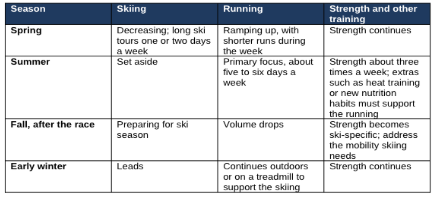
In spring, skiing volume starts to decrease and running ramps up. Spring conditions are the best for long ski tours, so the longer outings are probably on skis, one or two days a week. During the week, shorter runs get the body used to running again, and strength training stays in, as it does throughout the year.
In summer, the athlete commits fully to running, probably five to six days a week, with strength training two to three times a week. Anything extra, such as heat training or practicing new nutrition habits, has to support the running. A bike ride is fine. A five-hour mountain bike ride followed by a four-hour trail run the next day probably isn’t the best use of time, although in early summer, with the race still months off, it could fit. The test is whether the added activity serves the main goal.
After the fall race, running volume drops and strength training shifts to become more ski-specific. This is the time to check in with your body, look at what the summer’s running volume may have changed, and address any mobility you need for skiing. The aim is to recover from the run season and arrive at ski season in a good place physically and mentally. In early winter, ski training leads, and the athlete might still run outdoors or on a treadmill as long as the running complements and supports the skiing.
Like many coaching questions, the answer is an annoying “it depends”. Most athletes will feel better doing easy aerobic work first and the strength later, so you never crush your legs in a hard strength session right before a key endurance workout. Chantelle adds two useful exceptions. The first comes from keeping hard days hard and easy days easy: for some athletes it works well to do a strength workout first and follow it with a shorter, moderate-intensity aerobic session. The muscles are already activated, and many people feel good and get a solid moderate session out of it.
The second exception is for trail runners working on durability. Two long runs back to back can be hard to fit around family and work, and a strength workout followed by a moderate-duration run lets you practice running on tired legs and notice what happens to your posture. In all cases, the best answer will depend on the overall goal and on the capacity of the athlete doing the work.
Most beginners we work with start with two aerobic sessions and two strength or sport-specific sessions a week, then work up to about three and three. As people get fitter, they need more sessions, because a fitter body needs a bigger stimulus. Chantelle’s baseline for anyone, whether training for health or for something big, is that strength training should be seen as a non-negotiable one to two times per week plus at least three aerobic sessions a week. If you’re not following any plan, that alone will put most people in a good place for general health and fitness. She notes that the American College of Sports Medicine recommends at least 150 minutes of moderate-intensity aerobic exercise a week for health, along with resistance training two to three days a week, which isn’t hard to reach, and going beyond that depends on your goals, your interests, and your experience.
Experience changes how much each session costs you physiologically. Someone new to strength training will find those workouts take a lot out of them, and they may need two days of recovery before the next demanding session. Chantelle has done strength training consistently for more than 30 years and can lift, then go run or ride, and feel great. A lifelong climber can spend four hours in the gym with friends and be fine the next day, while a new climber might struggle to brush their hair the next morning. Learn how much recovery each of your activities takes so you can arrive at every session, easy or hard, understanding its intention and ready to do it well.
Training two sports without overtraining takes self-awareness and knowledge: how to structure a week, what to do when and why, how to recognize the signs of overtraining, and how to protect recovery and nutrition. This is not a project for an inexperienced athlete working alone. It is entirely possible, but it takes real attention.
Setting a sport aside for a block makes the most sense when your goal is in a sport you have less experience in, and each session in it takes more out of you than your primary sport does. Chantelle’s spring/summer season is a good example. She was training for an eight-day mountain bike adventure in the Dolomites. She took up mountain biking more seriously just a few years ago. Her winter was spent skiing and running, and her spring was focused on running a 50K. Once the 50K passed, she got specific to biking and changed her strength training to match.
Getting Zone 1 and Zone 2 work on a mountain bike is difficult, and running wouldn’t be specific enough, so she trained on road and gravel bikes and was not running at all. She made these specific changes because she needed focused time on a bike to build the strength, technical skill, and durability the trip demanded.
In powersports they call this “seat time”. If you want to get better at climbing, you need to climb. If you want to get better at running, you have to run. If you truly want to improve in a particular sport, that may mean setting other things aside for a while.
For the health-and-fitness athlete, the approach is much gentler. Steve’s strength training progression takes him about five months, and he cycles through it a couple of times a year. The rest of the time he follows the conditions and whatever he’s enjoying, and he doesn’t taper one activity to make room for another. As long as he gets a certain amount of aerobic training every week, with easy, medium, and hard weeks that he can judge for himself, he can gradually keep improving. He is honest with himself that he feels he has plateaued and that if he wants to improve, he will need to commit to structured training and follow through on it. Sometimes you may choose to improve, sometimes you may choose to maintain, and both of these are valid options.
Strength training should remain a focus year-round because, if nothing else, it helps keep you from getting injured. Steve’s ski partners have had more knee surgeries than he can count. He’s had no injuries to his lower extremities from a lifetime of skiing, and he believes that’s largely because he’s been strength training since he was 11. Strength and joint integrity, especially in the hips and shoulders, are what let you keep doing these sports for a long time. Chantelle points out that while strength training isn’t the most Instagrammable training, it’s one of the things that makes the most difference.
Multisport athletes often need a coach because the right plan depends on more variables than one person can usually track. Chantelle often hears athletes say they don’t deserve to work with a coach because they’re “just” training for health. They do: that’s often exactly who benefits most. People also ask why we don’t sell training plans for multisport athletes, and that’s because it’s really difficult to build one without all the right context. The right training plan for a multisport athlete truly depends on the individual, their sports, their age, how much of this kind of training they’ve done before, the quality of training they can get done, and the quality of their rest and recovery.
Chantelle hears constantly: “I’m doing all these things, I’m so active, but my skiing isn’t getting better, my running isn’t getting faster, and I’m still the last one up the hill in my group.” It resembles the runner who runs six days a week at the wrong intensity and never gets faster. If you find yourself nodding along as you read, we would encourage you to take another look at what is truly important to you and organize your training so you have the opportunity to improve where it counts. Then, with the seasons, come back to the next thing, and little by little each sport improves; getting better in one often lifts your performance in another.
Start by knowing what kind of athlete you are. Define your goals and choose your one priority. Run an honest gap analysis, with help from a coach or your training partners if you need it. Decide what each sport is for and how it benefits or detracts from the others, decide how strength training fits, and periodize all of it across the weeks, the seasons, and the year. Managed well, your sports help each other and make you a more diversified, stronger, and more agile athlete.
You’ll find more on combining sports here.
Listen to the full conversation with Chantelle on the Uphill Athlete Podcast.