
The 10 Percent Test is a simple assessment that tells you whether your aerobic base is developed enough to benefit from high-intensity training. It compares two numbers: your Aerobic Threshold (AeT) heart rate and your Anaerobic Threshold (AnT) heart rate.
The rule: If the spread between your AeT and AnT heart rates is greater than 10 percent, you have Aerobic Deficiency. You should focus on building your aerobic base with Zone 1 and Zone 2 training before adding any intensity. If the spread is 10 percent or less, you have earned the right to add Zone 3 and Zone 4 work to your program.
The formula: Divide your AnT heart rate by your AeT heart rate. Example: if your AeT is 128 and your AnT is 150, then 150 ÷ 128 = 1.17. Your AnT is 17 percent greater than your AeT. That spread is too wide. You need more base work before intensity training will be productive.
We commonly see spreads of 25 to 30 percent in athletes who come to us for coaching. Elite endurance athletes typically have a spread of 5 to 7 percent—sometimes only 10 beats between thresholds. The closer those two numbers are, the more powerful your aerobic engine has become.
To perform the test, you need to determine your AeT (via our Heart Rate Drift Test, a blood lactate test, or a lab-based Metabolic Efficiency Test) and your AnT (via a 30- to 60-minute field time trial). Both methods are covered in our complete assessment guide.
If the internet is to be believed, the best way to build endurance is to train hard, collapse in a pool of sweat, and feel like you have given your all. If you only have 45 minutes, go out and run as hard as you can. That must be real training, right?
The appeal of high-intensity training is obvious. It produces visible results quickly. Anaerobic adaptations arrive fast—you feel fitter, faster, more capable within weeks. For time-crunched athletes juggling work, family, and training, the logic seems airtight: if you cannot train long, train hard.
The problem is that this logic has been tested for over a century in competitive sport, and it has lost every time.

The stopwatch does not lie. A historical review of record times in distance events across rowing, swimming, and running over the past 50 years tells the same story: an endurance athlete cannot achieve maximal performance on a diet of high-intensity training alone.
Athletes who build a large volume of aerobic endurance training first and then layer event-specific high-intensity work on top consistently outperform athletes who rely on steady hard training. This is the settled finding of a century of real-world experimentation at the highest levels of sport.
The reason is physiological. For any event lasting longer than two minutes, energy is supplied predominantly by the aerobic metabolic pathway. High-intensity training primarily targets the anaerobic glycolytic system. It does not optimally train both systems simultaneously, despite what HIIT marketing claims. The adaptations to different training stimuli are distinct, which is why coaches seeking different adaptations use different workouts.
The potential benefit of high-intensity training is directly proportional to the size of your aerobic base. Without that base, intensity has nothing to build on. With a big base, a small amount of intensity produces outsized returns. This is why elite endurance athletes spend 80 to 90 percent of their training volume at low intensity.
“Death by threshold” describes a specific trap athletes fall into when they do a lot of Zone 3 training—moderate-to-high intensity around the Anaerobic Threshold—without a sufficient aerobic base to support it.
The pattern is predictable. At first, the hard training works: you see rapid improvement because glycolytic adaptations occur quickly. After about a month, the gains level off. The natural response is to add more—more intervals, higher intensity. It was working, so more should make it work again. But it does not. Performance drops instead of rising.
By trying to escape the hole, you dig deeper. This is how athletes develop Aerobic Deficiency. By constantly stressing the glycolytic system while neglecting aerobic base work, the slow-twitch aerobic infrastructure deconditions. The athlete feels fast on short bursts but has no endurance foundation underneath.
Every fall, most high school runners show up having not completed the summer training their coach prescribed. With three weeks before the first meet, the coach throws them into interval training. Because they are young and strong, they improve rapidly. They go to the district meet and run their best times.
Three weeks later at the state championship, they are done. They cannot get out of their own way. The coaches respond by adding a third weekly interval session. Because the aerobic base was never built, the added intensity further erodes what little base exists. Performance continues to decline through the rest of the season.
The same pattern plays out in adult endurance athletes. Many come to us having trained for years by shoehorning workouts into whatever time they have—going out for 45 minutes and running as hard as they can sustain. From a health standpoint, this is fine. From a performance standpoint, it is a dead end. You get better for a while, then you plateau, then you start going backward if you respond by training harder.
The gains from moderate-to-hard training come fast, plateau fast, and reverse fast. High-intensity training layered on top of a solid aerobic base produces compound returns over months and years. High-intensity training in place of an aerobic base produces diminishing returns in weeks.
This is where the 10 Percent Test gives you a definitive answer.
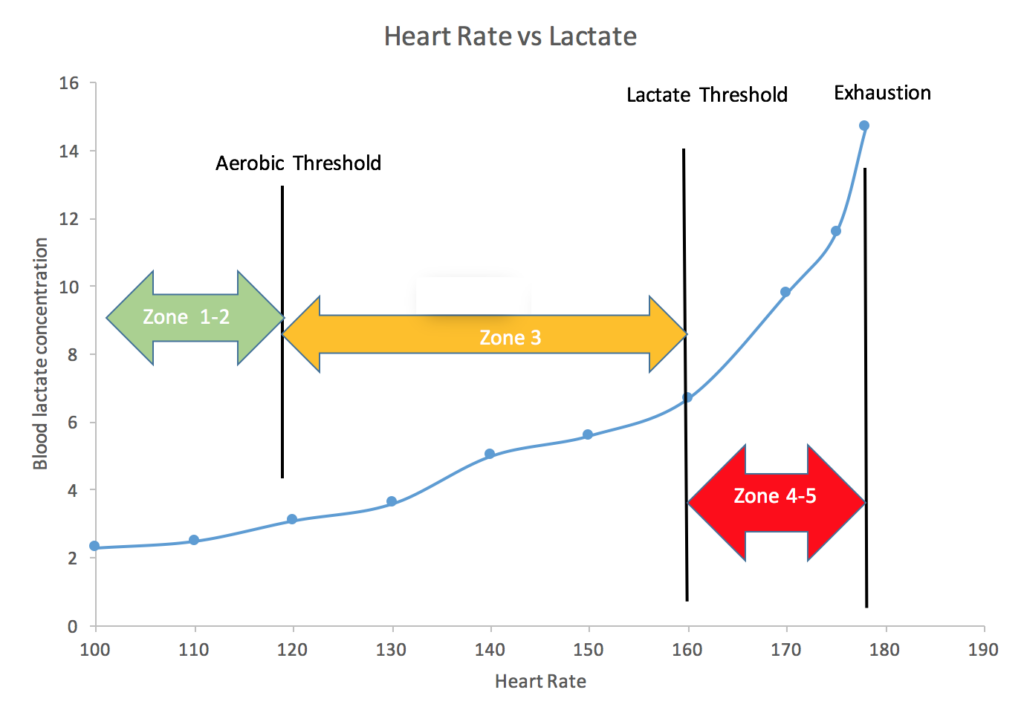
This athlete has an AeT at approximately 120 beats per minute and an AnT at 160. With a 40-beat spread, they have significant Aerobic Deficiency. Adding intensity at this stage will not accelerate development—it will undermine it. This athlete needs months of focused Zone 1 and Zone 2 training to raise the floor before intensity becomes productive.
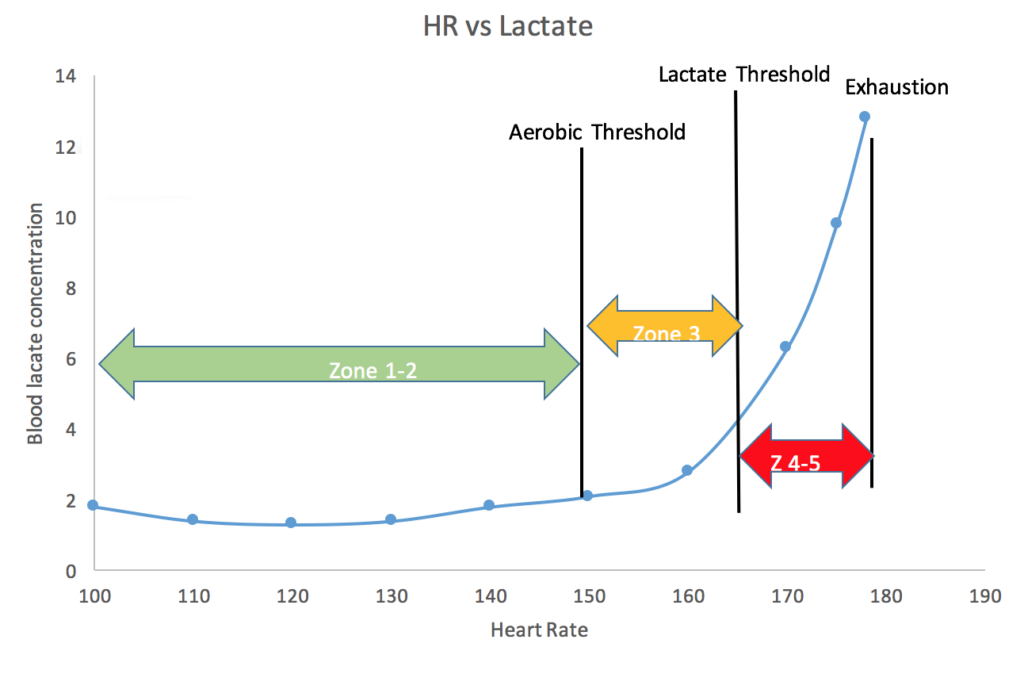
After a season of focused aerobic base work, the same athlete’s AeT has moved from 120 to 150 beats per minute—a 30-beat improvement. The AnT nudged up to 165. The spread is now within 10 percent. This athlete can now sustain a pace for several hours that they previously could barely hold for one. And they have earned the right to add intensity.
Raising your AeT requires stubbornly training at and below your AeT heart rate during all aerobic workouts, including climbs. The biggest stimulus to aerobic capacity is the frequency and duration of low-to-moderate-intensity work. After a few weeks, you will start to notice that you are moving faster at the same heart rate. That is the signal to retest.
Be aware that both AeT and AnT will fluctuate based on your recovery state. Neither is fixed. Test in a reasonably rested condition for the most reliable result.
Once the gap between AeT and AnT has narrowed to under 10 percent, you are ready to add intensity. But the transition requires care. Here are the guidelines.
It may seem counterintuitive that the fitter athlete needs easier easy days than the less fit athlete. But the fitter person is moving much faster at AeT. That faster Zone 2 pace imposes a higher neuromuscular load and associated fatigue. For the very fit, too much Zone 2 training can actually lead to overtraining.
The solution is polarization. The fitter you are, the more polarized your intensity distribution needs to become. Easy days must be genuinely easy—Zone 1—so that hard days can be genuinely hard. Training too often in the middle makes your easy days too hard and your hard days too easy. You get mediocre at everything and excellent at nothing. This is death by threshold applied even to athletes with a good base.
1. Start with Zone 3. Begin by adding Zone 3 work a little at a time. It might be a single 10-minute effort the first week.
2. Begin with 5 percent of your weekly aerobic volume. Start with total high-intensity work time equal to roughly 5 percent of your weekly aerobic volume. See how you recover before adding more.
3. Zone 3 uses long work periods with short rest. Typical Z3 intervals are 15 to 60 minutes with a work-to-rest ratio of 4:1 or 5:1. Example: 10 minutes of work followed by 2 to 2.5 minutes of active recovery.
4. Zone 4 uses shorter work periods. For Z4 efforts of 4 minutes or less, use equal rest (1:1 ratio). For work periods longer than 5 minutes, use a 2:1 ratio.
5. Keep rest intervals short. Short recovery keeps the aerobic system engaged. Too-long rest shifts the training effect toward anaerobic, which defeats the purpose.
6. Do not reduce your aerobic base volume. If you are forced to cut low-intensity training to fit in hard sessions, you are adding too much intensity too soon.
7. Only add volume as you can handle it. Once you reach about 10 percent of total weekly volume in Z3, consider replacing some Z3 with Z4. Replace 2 minutes of Z3 with 1 minute of Z4. Only progress when the current load feels manageable.
8. You must be rested enough to execute properly. High-intensity workouts only achieve their effect if you can sustain the required effort for the full duration of each interval. If you cannot, the workout is counterproductive.
9. Space hard workouts 48 to 72 hours apart. Minimum 48 hours between high-intensity sessions. 72 is preferable.
10. Make easy days easy enough so hard days can be hard enough. This is the single most violated principle in endurance training.
11. Rest when you are tired. High-intensity training has a powerful effect but can push you over the overtraining cliff quickly. Keep easy volume high and take rest days when your body signals fatigue.
12. Make intensity event-specific. High-intensity work should model the demands of your goal event. For runners and ski mountaineers, this means running or skiing fast on uphill grades similar to your race terrain. For alpinists and mountaineers, this means hiking steeply uphill with a weighted pack.
The range of possibilities for high-intensity endurance training is vast. As exercise scientist Per Åstrand observed, it remains unclear whether endurance is more effectively improved by four 4-minute efforts at 95 percent of max heart rate or two 16-minute efforts at 85 percent. What matters most is that you go hard for a defined period, rest, and repeat—while following the guidelines above.

Sustained steep uphill hiking with a weighted pack at Zone 3 or Zone 4 intensity is one of the most effective high-intensity workouts for mountain athletes. If your hill is shorter than about 1,000 feet of vertical, break the workout into intervals with downhill recoveries. A stair machine is another option. An hour of accumulated vertical at high intensity is a significant workout—build to it gradually.
Warm-up for all sessions: 15 to 20 minutes of running or skiing, gradually building intensity in the last 5 minutes so the final 2 minutes are in Zone 3. Follow with 2 to 3 accelerations of 15 to 20 seconds uphill with 2 minutes of active recovery between each.
2 × 15 minutes uphill at Zone 3 intensity with 3 to 4 minutes of active recovery. Follow with a 20-minute Zone 1 cooldown.
3 × 20 minutes uphill at Zone 3 intensity with 5 minutes of active recovery. Follow with a 20-minute Zone 1 cooldown.
3 × 3 minutes uphill at Zone 4 intensity with 3 minutes of active recovery. Follow with a 20-minute Zone 1 cooldown.
4 × 8 minutes uphill at Zone 4 intensity with 3 minutes of active recovery. Follow with a 20-minute Zone 1 cooldown.
High-intensity training plays a critical role in every endurance athlete’s program. But it is a supplement to the aerobic base, not a replacement for it. A layer that goes on top, not a foundation.
The sequence matters: build the base, test whether the base is sufficient using the 10 Percent Test, and only then add intensity in controlled, progressive doses while maintaining the aerobic volume that supports it. Athletes who follow this sequence develop fitness that compounds over months and years. Athletes who skip to intensity develop fitness that peaks in weeks and then degrades.
If you have Aerobic Deficiency—if the spread between your AeT and AnT is greater than 10 percent—you have not yet earned the right to go hard. Build the base. Retest. When the gap closes, add intensity carefully using the twelve guidelines above. The payoff will be larger, more durable, and more directly transferable to your mountain and endurance goals than anything high-intensity training alone can deliver.
What is the 10 Percent Test?
The 10 Percent Test compares your Aerobic Threshold (AeT) heart rate to your Anaerobic Threshold (AnT) heart rate. Divide AnT by AeT. If the result is greater than 1.10 (a spread of more than 10 percent), you have Aerobic Deficiency and should focus on base training before adding high-intensity work. If the spread is 10 percent or less, you are ready to add Zone 3 and Zone 4 training.
Can I do HIIT without an aerobic base?
You can, and you will see quick initial results. But those gains will plateau within weeks and then reverse as you develop what is called death by threshold—the progressive erosion of your aerobic capacity from too much high-intensity training without the base to support it. The potential benefit of intensity is directly proportional to the size of your aerobic base.
What is Aerobic Deficiency?
Aerobic Deficiency is a training state in which the gap between your Aerobic Threshold and your Anaerobic Threshold is greater than 10 percent. It indicates that your aerobic base is underdeveloped relative to your top-end fitness. It is caused by training choices—typically too much moderate-to-high intensity and not enough low-intensity volume—and is correctable with focused Zone 1 and Zone 2 training over weeks to months.
How often should I do high-intensity workouts?
Space high-intensity sessions at least 48 hours apart, with 72 hours preferred. Start with one session per week and add a second only when you can comfortably handle the first without cutting into your aerobic base volume or feeling undertrained on your easy days. Total high-intensity volume should begin at roughly 5 percent of your weekly aerobic training time and can progress toward 10 percent for well-trained athletes.
Why does the fitter athlete need easier easy days?
Because the fitter athlete is moving much faster at their Aerobic Threshold. A Zone 2 workout at 8-minute-mile pace imposes a significantly higher neuromuscular load than Zone 2 at 12-minute-mile pace. Without genuinely easy Zone 1 days, the fitter athlete accumulates fatigue that compromises their hard sessions. The fitter you are, the more polarized your training distribution needs to be.

Steve House sprinting through Smith Rock State Park while training for his 2009 attempt on Makulu.