
The Problem: How Do Mountain Athletes Measure Intensity?
Swimmers use race pace. Track runners use splits. Road cyclists use power meters. Rock climbers use grades. Each of these sports has a relatively straightforward metric for monitoring how hard you are working during training.
Mountain athletes do not have this. The effort required to move through mountain terrain depends on factors that change constantly: steepness, altitude, surface conditions, weather, pack weight, snow depth. A pace that feels moderate on a groomed trail at 5,000 feet becomes brutal at 14,000 feet in wind-loaded snow. There is no fixed external standard you can use to regulate intensity across all the conditions you will train and perform in.
This creates a real problem, because training at the right intensity is one of the most consequential decisions you make as an endurance athlete. Too hard on your easy days and you accumulate fatigue without building your aerobic base. Too easy on your hard days and you fail to develop the top-end capacity you need. Getting intensity right requires a method of monitoring that is portable, personal, and available in real time during every workout.
Several methods have been used. Some work well. Some do not. Here is what we have learned.
The Methods: What Works and What Does Not
Perception
Perceived exertion—how the exercise feels to you—is the oldest method of intensity monitoring and it has genuine value. Your brain is constantly integrating feedback from muscles, cardiovascular system, respiratory system, and metabolic state to create a composite sensation of effort. Experienced athletes develop a calibrated sense of what different intensity levels feel like.
The problem is that perception is subjective. Individuals can interpret the same signals very differently, especially when they are inexperienced, fatigued, stressed, or excited. An athlete who has never trained with zones has no internal reference for what “aerobic base intensity” actually feels like. Perception is valuable as a complement to other methods, but unreliable as your only metric.
Blood Lactate
Blood lactate monitoring is accurate and directly measures a key metabolic marker. A lactate step test gives a precise snapshot of an athlete’s metabolic response at different intensities on the day of the test. When we have the opportunity, we use lactate testing with athletes we coach because the data is genuinely useful.
The drawback is practicality. Portable lactate monitors exist, but daily finger-prick testing during every workout is not realistic for most athletes. And because your metabolic response shifts with recent training, recovery, nutrition, and stress, a test performed three weeks ago may not accurately reflect your state today. Blood lactate is excellent for periodic assessment but impractical for day-to-day intensity regulation.
Heart Rate
Heart rate monitoring offers the most accessible and effective objective measure of intensity for mountain athletes. A modern heart rate monitor provides precise, real-time data measured in beats per minute with single-beat accuracy. Heart rate is not a perfect proxy for metabolic intensity—it can lag behind changes in effort, and it is influenced by factors like heat, altitude, dehydration, and caffeine—but it is the best objective metric available in the field.
The critical requirement is that your heart rate zones must be anchored to your personal metabolic thresholds, not to a formula based on percentage of maximum heart rate. There is enormous individual variation in metabolic response to changes in exercise intensity. Formulas like “220 minus your age” are statistical averages across large populations. They may or may not apply to you. Our training zone system anchors zones to two metabolic markers—Aerobic Threshold and Anaerobic Threshold—that are specific to your physiology. (See our complete guide to assessing these thresholds.)
Ventilation: The Missing Piece
Ventilation—your breathing rate and depth—provides real-time feedback on the metabolic processes fueling your movement at any given moment. It is the most underused intensity monitoring tool available to mountain athletes, and when combined with heart rate, it creates the most accurate field-based intensity monitoring system you can use.
Exercise physiologists identify two ventilatory thresholds—the First Ventilatory Threshold (VT1) and the Second Ventilatory Threshold (VT2)—that correspond closely to the Aerobic Threshold and Anaerobic Threshold respectively. These are not laboratory abstractions. They are physical sensations that you can learn to detect in real time during any workout, on any terrain, at any altitude.
The shortcoming of ventilation monitoring is that it relies on athlete sensitivity and does not generate recordable electronic data. You cannot download a breathing file the way you can download a heart rate file. But this limitation is precisely why combining ventilation with heart rate is so powerful: heart rate gives you the recordable data; breathing gives you the real-time metabolic context that heart rate alone cannot provide.
An athlete who monitors both ventilation and heart rate during training is using the most meaningful method of intensity regulation available in the field.
How Breathing Tells You Your Intensity
Your breathing is a direct, real-time measure of how hard your metabolic systems are working. Learning to read your breathing is one of the most practical skills you can develop as a mountain athlete. Here is what each threshold feels like.
The First Ventilatory Threshold: Your Aerobic Threshold
Steve House has worked as a professional mountain guide since 1991. One way he knows he is at a pace most clients can handle is that he can breathe with his mouth closed or carry on a conversation without losing his breath. This point is the First Ventilatory Threshold (VT1), also called the Aerobic Threshold (AeT).
At or below this intensity, fat metabolism is providing half or more of the energy for movement. Breathing is slow, controlled, and sustainable. You can speak in full sentences without needing to catch your breath. You can breathe through your nose. The effort feels easy to moderate—and for many athletes new to structured training, it feels uncomfortably easy.
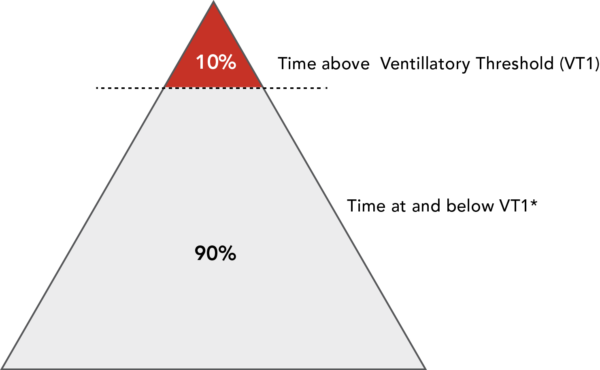
The practical marker: If you can breathe through your nose or speak in full sentences, you are at or below your Aerobic Threshold. This is your aerobic base-building pace, and it is where you should do the vast majority—80 to 90 percent—of your training.
The Second Ventilatory Threshold: Your Anaerobic Threshold
As your effort increases beyond AeT, your breathing becomes progressively deeper and faster. At some point, you cross a second threshold where breathing becomes noticeably labored. This is the Second Ventilatory Threshold (VT2), also called the Anaerobic Threshold (AnT). It has been described as the “breakaway breathing point.”
At this intensity, you can no longer speak a full sentence in one breath. You can manage a few words at a time before you need another breath. If you have ever climbed with a good guide who engages clients in conversation during the ascent, part of the reason is exactly this—it is an excellent way to gauge the climber’s exertion level. If the client is gasping and can only manage single words, they are above their AnT and operating on borrowed time.
The practical marker: If you can only speak a few words before needing another breath, you are at or near your Anaerobic Threshold. For mountain athletes, this marks the intensity where hard training sessions are conducted.
The Space Between
In reality, your aerobic and anaerobic metabolic systems are always working together to produce the energy you need. The aerobic system dominates at low intensities, and the anaerobic system makes an increasing contribution as intensity rises. The two thresholds mark the key transition points in this relationship.
Below AeT, the aerobic system handles the workload comfortably. Between AeT and AnT, glycolytic metabolism contributes increasingly to energy production, but the aerobic system can still clear the resulting lactate. Above AnT, lactate production exceeds the aerobic system’s ability to clear it, and the effort becomes unsustainable.
For most mountain athletes, the training distribution should look like this: approximately 80 to 90 percent of training volume at or below AeT, roughly 5 percent between AeT and AnT, and another 5 percent above AnT. This holds true whether you are a beginner or an accomplished professional. The ratio reflects the physiological reality that aerobic capacity is the primary determinant of mountain performance.
The Physiology: Why Your Breathing Changes
Understanding what is happening inside your body at each threshold is not strictly necessary for using breathing as an intensity tool. But it helps explain why the method works, and it reinforces why aerobic base training matters so much for mountain athletes.
What Happens at Your Aerobic Threshold
At intensities below AeT, fat metabolism provides the majority of energy for movement. This process is physiologically efficient and essentially sustainable indefinitely—the limiting factor is fuel stores, which you can replenish by eating. Breathing is slow and controlled because the metabolic demand for oxygen is well within your respiratory system’s capacity, and CO2 production is low enough that normal ventilation clears it easily.
The AeT corresponds to the point where blood lactate has risen approximately 1 millimole per liter above baseline, or has reached roughly 2 millimoles per liter. Below this level, any lactate produced is easily remetabolized by the aerobic processes in your slow-twitch muscle fibers. The system is in balance.
What Happens Between the Thresholds
Once you cross AeT, glycolytic metabolism begins to contribute a steadily increasing share of energy production. Glycolysis produces lactate as a by-product. At moderate intensities, the aerobic system acts like a vacuum cleaner, taking up lactate and using it as fuel in the slow-twitch fibers. The rate at which your aerobic system can clear lactate directly determines your endurance capacity at these intensities.
As power output continues to increase, so does the rate of lactate production. At some point, the rate of production exceeds the rate of clearance. That crossover point is your Anaerobic Threshold.
What Happens at Your Anaerobic Threshold
At and above AnT, CO2 production rises sharply because both the aerobic and anaerobic systems are working at high rates. This triggers the ventilation center of your brain to drive breathing deeper and faster in an effort to blow off the excess CO2. This is the “breakaway breathing point”—the moment when your breathing shifts from controlled to labored. Above this intensity, the duration you can sustain effort is inversely related to how far above AnT you are. The higher the intensity, the shorter the time.
Why AeT Drives AnT Performance
Here is the insight that is often misunderstood by coaches and athletes: the main determinant of your Anaerobic Threshold pace is your Aerobic Threshold pace.
This is because the faster your slow-twitch muscle fibers can clear the lactate produced by your higher-power fast-twitch fibers, the greater the intensity you can sustain for longer. A high AeT pace means your aerobic vacuum cleaner is powerful. That powerful vacuum cleaner directly supports a higher sustainable pace at AnT.
Many studies have shown that AnT is the best predictor of endurance performance in events lasting from about 2 minutes to about 2 hours. Increasing your AnT is clearly one of the best ways to improve endurance performance. But increasing your pace at AeT is the first and most important step in raising your AnT. The base builds the top.
Putting It Into Practice
Here is how to apply breathing and heart rate monitoring to your daily training.
Wear a heart rate monitor on every workout. Record the data. Over time, you will build a library of heart rate responses to different efforts, terrain, and conditions. This data is invaluable for tracking improvement and calibrating your zones.
Continuously cross-reference your breathing with your heart rate. During a Zone 2 session, check: can I breathe through my nose? Can I speak in full sentences? If yes, and my heart rate is at or below my AeT, the data and the sensation are aligned. If my breathing is labored but my heart rate is low, something else may be going on—altitude, heat, dehydration, or accumulated fatigue. If my breathing is easy but my heart rate seems high, my zones may need recalibrating. The combination of both signals gives you a far richer picture than either one alone.
Use breathing as your real-time governor on uncontrolled terrain. In the mountains, pace and heart rate can fluctuate wildly with terrain changes. Breathing is the most responsive, real-time signal you have. On a steep climb where your heart rate spikes with a sudden pitch change, your breathing tells you immediately whether you have crossed a threshold. Slow down before the heart rate data confirms what your lungs already know.
During hard sessions, use the sentence test. If your plan calls for a Zone 3 effort, you should be able to speak a few words at a time but not full sentences. If you can speak comfortably in full sentences, you are not working hard enough. If you cannot manage even a few words, you have crossed into Zone 4 territory.
After every workout, note the relationship between breathing and heart rate in your training log. Even a brief note—“nose breathing steady at 142 bpm” or “breathing labored at 155, lower than usual threshold feel”—builds a personal database that will make you increasingly accurate at gauging your own intensity over time.
With careful observation, an athlete who monitors both breathing and heart rate can gauge actual intensity almost as well as a laboratory gas exchange test. The difference is that this method is portable, free, and available during every single workout. It is the most practical intensity monitoring system a mountain athlete can use.