
It is week three of a new training approach. Maybe it is heart-rate-based training, a strength program, a new fueling protocol, or a plan built to correct an aerobic deficit. You have been doing the work, training differently than you used to, and the change you were looking for has not shown up. Your running doesn’t feel any faster, the strength sessions feel awkward, and the easy aerobic work below your aerobic threshold feels slower than it should. You start to wonder whether you have spent three weeks on something that does not work.
This is where many athletes quit, and it is usually the wrong moment to judge. Different systems in the body adapt on very different schedules, and six months is the shortest window in which both the fast and slow-adapting systems have responded enough to evaluate whether or not your plan is working. Athletes who complete about 90 percent of a coherent plan across that window usually start seeing the results they’ve been training for. At week three, those slow systems have barely started to respond, and the signals they are using to judge the work are among the least reliable. This is one big reason why we suggest athletes commit to at least six months of training, so that they give themselves the time and commitment needed to see results.
All good things take time. Blood volume shifts within days to weeks, mitochondria respond over weeks to months, and the heart, tendons and bone remodel over many months and years. The athlete who sees meaningful change is usually the athlete who has put at least six consistent months into one coherent approach.
Your own assessment of your training also gets more accurate with time. The first six weeks of any new approach are noisy: you feel different from day to day for reasons that may have nothing to do with the training, such as sleep, stress, heat and illness. By month three, the patterns start to stabilize. By month six, the patterns are usually clear enough that you can tell whether the approach is working.
Your aerobic threshold (AeT) is the clearest example. AeT is the intensity at which your fuel balance starts to shift: below it, fat supplies a large share of your energy and blood lactate stays close to resting levels. Above it, carbohydrate supplies a growing share and lactate begins to rise. Aerobic and glycolytic metabolism contribute at every intensity, and AeT is a physiological state that changes as your fitness changes. (https://uphillathlete.com/podcast/training-zones-and-how-to-use-them/). A single test gives you a snapshot, while a long run of consistent training data gives you a trend, and the longer the dataset, the cleaner the reading. That is the idea behind Continuous AeT, the weekly aerobic threshold reading inside the Uphill Athlete dashboard, drawn from the training you are already doing. You can learn more about it from our article on how and why Continuous AeT works. Most athletes never stay with one approach long enough to get that reading.
Most training adaptations take longer than athletes expect, and each system runs on its own clock: blood volume changes within days to weeks, mitochondria and capillaries over weeks to a few months, and the heart, tendons and bone over many months to years. These mismatched rates are behind many late-cycle injuries and plateaus, because a plan can load the heart and lungs at the right rate and still load tendons faster than they can remodel.
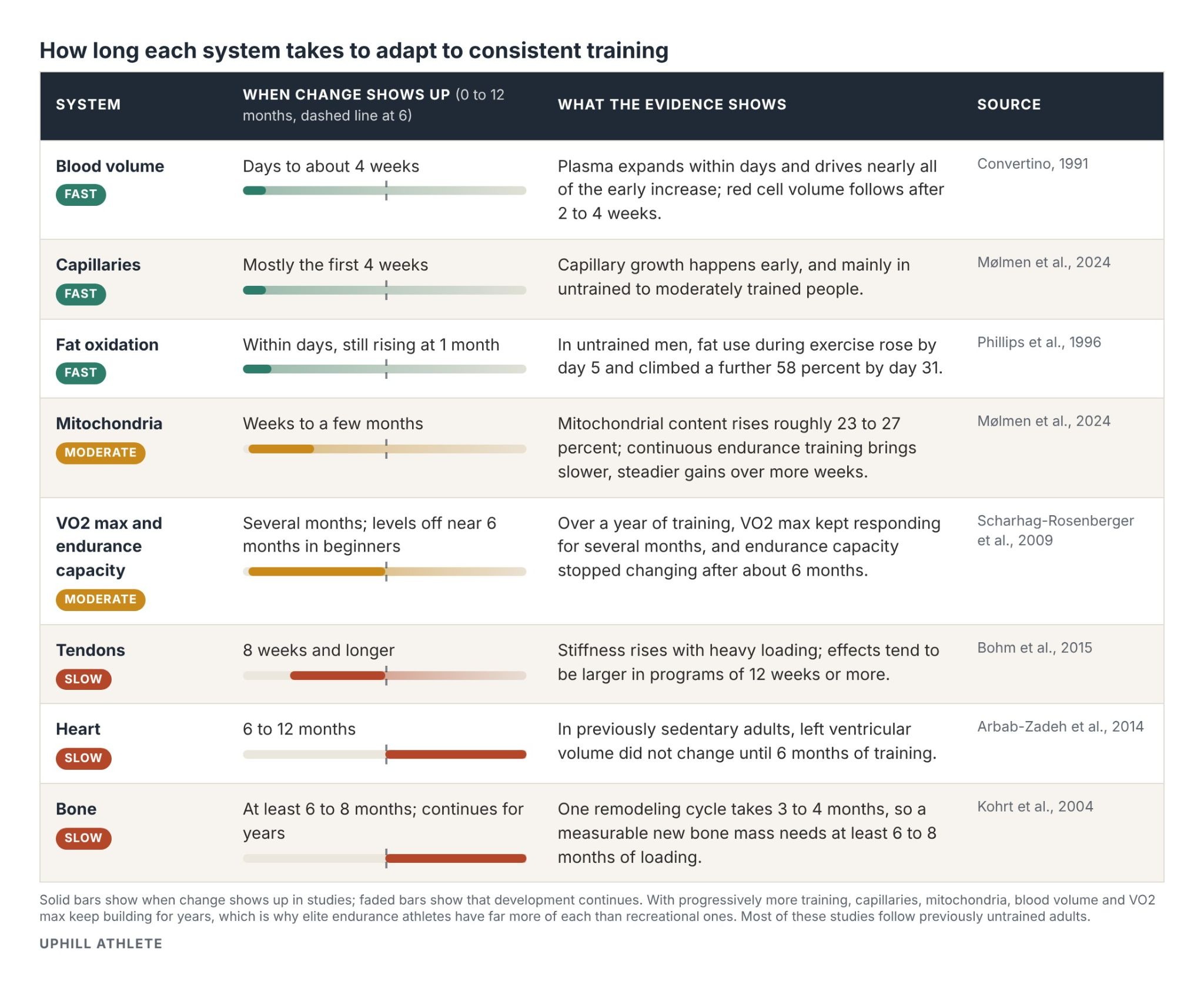
The fastest adaptations show up in the blood and inside the muscle cell. Plasma volume begins to expand in the first days of training, and for the first two to four weeks plasma accounts for nearly all of the increase in blood volume, after which red cell volume rises as well (Convertino, 1991). Mitochondrial content in the working muscles also responds early: a 2024 systematic review of 353 studies found increases of roughly 23 to 27 percent across endurance, interval and sprint training, with continuous endurance training producing slower but steady gains over more weeks (Mølmen et al., 2024]). The same review found that capillary growth happened mainly in the first four weeks of training, and only in untrained to moderately trained people. These early changes produce the first sensations of progress, such as a lower heart rate at a given effort, and they are a small part of what the training is building.
VO2 max and lactate threshold usually start to shift over the first few months in previously untrained athletes, which is when someone tracking objective data typically sees their training metrics start to change. The ability to burn fat as fuel at higher intensities improves over months of consistent easy aerobic work below AeT (Zone 1 and Zone 2) and training to correct an aerobic deficit is built to develop that capacity. Both keep improving well past the point where the early sensations of progress have leveled off.
The heart remodels on a much slower timeframe. In a study of previously sedentary individuals working through a year of progressive marathon training, left and right ventricular mass rose steadily, but the volume of the left ventricle did not change significantly until the sixth month. (Arbab-Zadeh et al., 2014). Over the year, VO2 max rose from about 40 to about 49 milliliters per kilogram per minute, driven by increases in maximal cardiac output and stroke volume. Even after twelve months, those hearts had not reached the compliance and performance of elite endurance athletes.
Connective tissue is slower still. A meta-analysis of 27 tendon studies, each at least eight weeks long, found that tendon stiffness increased reliably with training, that loading intensity mattered more than the type of muscle contraction, and that effects tended to be larger in programs of 12 weeks or more (Bohm et al., 2015). Bone responds on the slowest timeline of all, with meaningful changes in mineral content taking months under load and continuing over years of training. In our experience working with athletes, when cardiovascular load ramps faster than connective tissue can follow, the result is often the late-cycle injury that experienced athletes learn to watch for.
Most of this research has been done on previously sedentary or untrained adults. Trained athletes start further along on these timelines, so the early gains are usually smaller and the slow adaptations make up more of what is left to build, which is one more reason not to judge a new approach in the first few weeks.
An athlete who quits at week three has felt the early blood volume response and little else. An athlete who quits at month two has most of the early mitochondrial and capillary gains and part of the VO2 max response, and is still far from the cardiac remodeling, connective tissue resilience and metabolic flexibility the work is building. Six months gives the fast and slow systems together a fair chance to respond.
Six months of training will include everything a half-year of real life brings. You will get sick and miss a week, and you will travel and be unable to follow the plan as written. You will have a hard block where the work feels heavier than it should, and a recovery week where you worry you have lost fitness. You will go through a stretch at work where you sleep poorly for ten days running.
If you menstruate, you will train through about six cycles, which is enough to start seeing how your own training response shifts across the phases. Research on cycle phase and performance has not produced reliable general rules, and the authors of the largest meta-analysis recommend an individual approach (McNulty et al., 2020). Six cycles of your own training data is enough to start noticing whether your response shifts across the phases, and it takes a few cycles to distinguish a real pattern from coincidence. The athletes who continue training through month six usually treat the missed week, the poor sleep, the travel and the cycle phases as part of the six months and part of the data. They ride the variance and stay with the work. Athletes who stall tend to treat each interruption as a reason to start over or give up, and they never string together enough consistent weeks in one approach to see what it can do.
Athletes who complete about 90 percent of their plan over six months usually get the results they trained for. Hunter Allen made the point on the Uphill Athlete Podcast in The Evolution of Training Technology with Hunter Allen. Hunter raced professionally, co-developed the WKO+ analysis software on TrainingPeaks, and has coached cyclists for decades. His words echo what most coaches experience with their athletes too: “The athletes that do 90 percent of the training plan that we give them crush it. They crush it.” They beat their goals, their previous performances, and the athletes they were when they started.”
Athletes who hit the plan perfectly week after week often burn out before six months are up, or build a brittle relationship with their training in which any missed session becomes a crisis. Athletes who hit 60 or 70 percent of the plan are usually too inconsistent for the slower adaptations to take hold. Ninety percent tends to produce durable change without that fragility.
Ninety percent across six months is also the simplest description of what the work requires: showing up for almost every session, in almost every week, for almost every month. The sessions themselves are rarely heroic, and they look nothing like the training you see on Instagram. What separates the athletes who improve is that they string the months together, they are consistent.
Most athletes who abandon a new approach quit for three reasons, often in combination: they expected a faster timeline than the body runs on, they see no clear progress at week three, and they have no external structure holding them to the plan when their motivation dips. In each case they quit before the slow-adapting systems have had a chance to respond. Unrealistic timelines come first. The fitness industry has spent decades teaching people to expect transformation in weeks, and endurance physiology runs on a longer clock. In strength training the same impatience shows up as program-hopping, switching to a new program every few weeks before the last one has had time to work.
The second reason is that the evidence is missing when the athlete wants it most. Week three falls in the noisiest window of the whole process. The fast systems have started to respond, the slow ones have not, and day-to-day variation in how you feel is large enough to hide the trend. An athlete who needs to feel progress in order to keep going will usually misread this window.
The third reason is structural. The version of you who decided to start, in a clear moment at week zero, is a different person from the one reading the results at week three. Week-three you has incomplete data and a body that has not caught up, which puts you in a worse position to make a judgment call. Athletes who succeed usually have something outside themselves that holds the long view when their own view narrows: a coach, a paid commitment, a published plan with clear expectations, or a regular training partner. Athletes who stay past this point usually look back from month six and see the “week three frustration” as a normal phase they are happy to have pushed through.
Set up the six months so that week-three you is not the one making decisions. Write down your commitment before you start: the approach, the session frequency, the protocols, and how you will measure progress. Then commit to leaving the plan alone on the strength of three weeks of data, and schedule a check-in at month three to see whether the trend is moving in the right direction, with a full evaluation at month six. The commitment is to the training approach, not to executing every session exactly as written. Pain, illness, or signs that you aren’t fueling or recovering adequately are reasons to adjust the plan at any point.
Find structure that holds you to the work when your motivation dips. For most athletes this is a coach or a training group; for others it is a regular partner or a published plan with clear expectations. Whatever you choose should be external enough that week-three you cannot negotiate with it. Count the missed sessions and bad weeks as data and keep going: the target is 90 percent consistency across six months, so aim for 90 and let the rest go.
A Training Group is the lowest-cost way we offer to test the six-month rule on your own training. Training Groups are $59 a month, or $53 a month with a six-month commitment. Membership includes coach-led lectures and Q&A sessions, a coach-monitored WhatsApp community, access to all our training plans, and a group of athletes training for similar goals. At the end of six months you will know whether this approach moves your training the way we say it does.
Inside a group, you also get access to the Uphill Athlete training dashboard, which tracks your consistency, load, work balance and intensity distribution week by week. The dashboard includes Continuous AeT, a weekly reading of your aerobic threshold drawn from the training you are already doing (no need for regular testing), and our coaches can answer questions about your data on our weekly calls. Because the reading sharpens as the dataset grows, it is far more useful at month six than at week three.
Committing upfront also answers the week-three problem, because the decision about whether to keep going was made at month zero by the version of you who set the goal. The group, the coach support, the dashboard and the data are in place to carry you through the illnesses, hard blocks and quiet stretches that any half-year produces. At month six you will be deciding what’s next from six weeks of real training data, not your feeling or perception of how it went.
If the data is moving and your physiology is responding the way it should, the natural next step is a decision to choose a new plan and continue within the group or you might like to try a more individualized approach and try personal coaching for your next training phase. If the data is flat, that is also an answer, and important to help you look back at why that may have happened and what support you might need instead. Above all, we want to help get athletes to month six with a better understanding of their needs to help make an informed decision about whether they want to continue at that level, move up to personal coaching, or take what they have learned forward on their own.