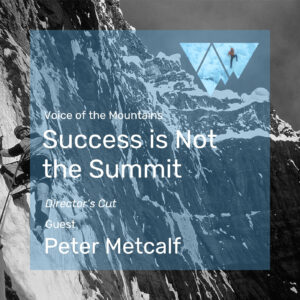
Peter Metcalf was fourteen years old when he found his people. He had joined a Boy Scout troop on Long Island, and one of the scoutmasters, recognizing a restless kid who scrambled over everything in sight, invited him along to a beginner rock climbing weekend in the Shawangunks. It was the spring of 1970. And something clicked. “I realized, these are my people,” Peter told me. “Spanky and the gang.” He meant the collection of blue-collar and white-collar oddballs who gathered at the cliffs, bound together not by background but by a shared, inexplicable pull toward vertical rock.
That weekend did not make Peter a climber, but it did open a door. And what followed, over the next decade, was one of the great apprenticeships in American mountaineering. It unfolded without a syllabus, without a timeline, and without any guarantee that it was leading somewhere. But it had a structure, even if that structure only became visible in hindsight.
This is what struck me most in our conversation, and what I want to explore here: the apprenticeship itself. How a person becomes capable of something extraordinary by accumulating, year after year, the unglamorous components of mastery. And how much of that accumulation depends on the people who show up along the way.
Peter’s Boy Scout handbook sat by his bed every night until he fell asleep. When he got serious about climbing, it was replaced by Mountaineering: Freedom of the Hills, which he studied with the same devotion, chapter by chapter, cataloging what he needed to learn next. Then came the biographies: Bonington, Patey, Joe Brown. Stories of men who had gone to the Alps, to the Himalaya, to the great ranges. The older climbers at the Gunks told him plainly: there is an apprenticeship here. You learn to lead. You learn to winter camp. You learn step by step.
And so he did. At fifteen, he lied about his age to get into a NOLS alpine guide course in the Wind Rivers, where he climbed with Don Peterson, the same Don Peterson whose battles with Royal Robbins on Tis-sa-ack he had read about five times in Ascent magazine. At the end of the course, he and a friend hitchhiked to the Tetons, talked their way into an advanced climbing class with Herb Swedeland, and climbed the Exum Ridge of the Grand Teton in an afternoon thunderstorm with long hair standing on end and sparks flying between their carabiners.
At sixteen, he took the Trans-Canada railway to Mount Robson for two weeks of glacier travel, ice climbing, and a summit that involved, improbably, a Malamute dog front-clawing up the Kain Face because it had leaped across the bergschrund and could not turn around. At seventeen, he and three friends from the Gunks drove to Alaska in a Volkswagen camper van with thirty days of food and climbed a new route on Mount Fairweather, having been told by Brad Washburn himself which ridge to attempt. Fred Beckey called beforehand to tell them it was above them. They went anyway.
I share these stories not because they are impressive, though they are, but because of what they reveal about the process. Each step built on the last. Each experience introduced new people, new skills and new terrain. The community carried him forward. The AMC instructors pointed toward the next challenge. Brad Washburn opened his photo archive and said, “I would go do that one.” Warren Blesser showed up at Berg Lake and joined the team. Johnny Waterman’s father connected Peter to a course that led to Robson. The path was not planned so much as it was constructed, link by link, through relationships and shared love of the mountains.
Peter described this to me as the ability to look at any large goal and “immediately know how to break it down to all of its components.” He learned that from climbing. First the Gunks, then winter camping, then bigger routes, then Alaska. But the deeper lesson, the one I find most valuable, is that the components are not only technical. They are human. Every stage of Peter’s apprenticeship was shaped by someone who saw something in him and offered the next step. And he was open enough, hungry enough, to take it.
This is the part of Peter’s story that has stayed with me since our conversation. Because I think we live in a time that wants to skip the apprenticeship. A time that celebrates arrival and undervalues the long, patient accumulation that makes arrival possible. Peter once compared the magazine-cover ethos of “seven days to greatness” with the mentality of the climbers who raised him, who said to him: Here are the years you will invest if you want to reach this goal.
Both acknowledge the goal.
But only one produces the metamorphosis.
What I mean by that is: Peter did not simply go to Alaska. He became the kind of person who could go to Alaska. He became it through years of reading, practicing, failing, hitchhiking, shivering through unplanned bivouacs, and showing up again the next season ready to learn the next thing. When he arrived at the base of Mount Hunter in 1980 for the climb that would define his mountaineering life, he arrived as someone who had been shaped, deliberately and also accidentally, by a decade of preparation. The route took thirteen and a half days instead of seven. He had the depth to endure it.
And when, years later, he found himself staring at the collapse of Chouinard Equipment and the need to build Black Diamond from almost nothing, he reached for the same method. He did not know how to do a leveraged buyout. He did not know corporate law, or commercial finance, or how to organize an industry insurance pool. But he knew how to identify the components he was missing. He knew how to find the people who could teach him each one. He cold-called Jack Stack, the author of The Great Game of Business, a man he had never met, and Stack gave him hours of his time. He called the defense counsel at Bell Helmets. He called every climbing friend who worked in finance or law. One by one, the picture filled in, just as the Washburn photos once filled in the details of an unclimbed ridge.
“Life is more serendipitous than most of us give it credit,” Peter told me early in our conversation. And that is true. But I would add that serendipity favors those who have done the work to recognize it. (Fortune favors the brave is another manifestation of this idea.) Every seemingly lucky break in Peter’s story arrived because he was already in motion, already building, already asking the next question. Fred Beckey walked into the Bugaboo camp, and Peter knew who he was because he had read the articles. Brad Washburn opened his archive, and Peter knew what to look for because he had studied the ranges. Yvon Chouinard offered him the job, and Peter was ready because he had spent weeks interviewing every retailer and competitor he could find.
There is a word for this that I keep coming back to: fidelity. Fidelity to the process. To the apprenticeship. To the belief that if you keep showing up, keep learning, keep breaking the problem down into its next component, you will eventually stand somewhere you could not have imagined at the start. You may not recognize the summit when you reach it, because by then you will have become someone who sees further than the person who first set out. And that is the real achievement.
Peter said something near the end of our conversation that I think captures this. He described Black Diamond’s strategic planning as “three to five years of evolution and a one-year revolution.” Periods of steady building, followed by moments of standing back, taking stock, and reimagining what was possible from the new vantage point. And then starting again. It was, he said, a constant rebirth.
I think that is what an apprenticeship really develops in us. A willingness to be reborn, again and again, into a version of yourself that is slightly more capable, slightly more aware, and slightly more humble than the one before. The mountain does not hand you that. The years do. The people do. The willingness to keep climbing, even when the summit is not yet visible, does.
And at the end, you look back and connect the dots. And you find that there is something there that you did not set out to create. A fidelity of capability that only emerged because you trusted the process enough to stay with it.