
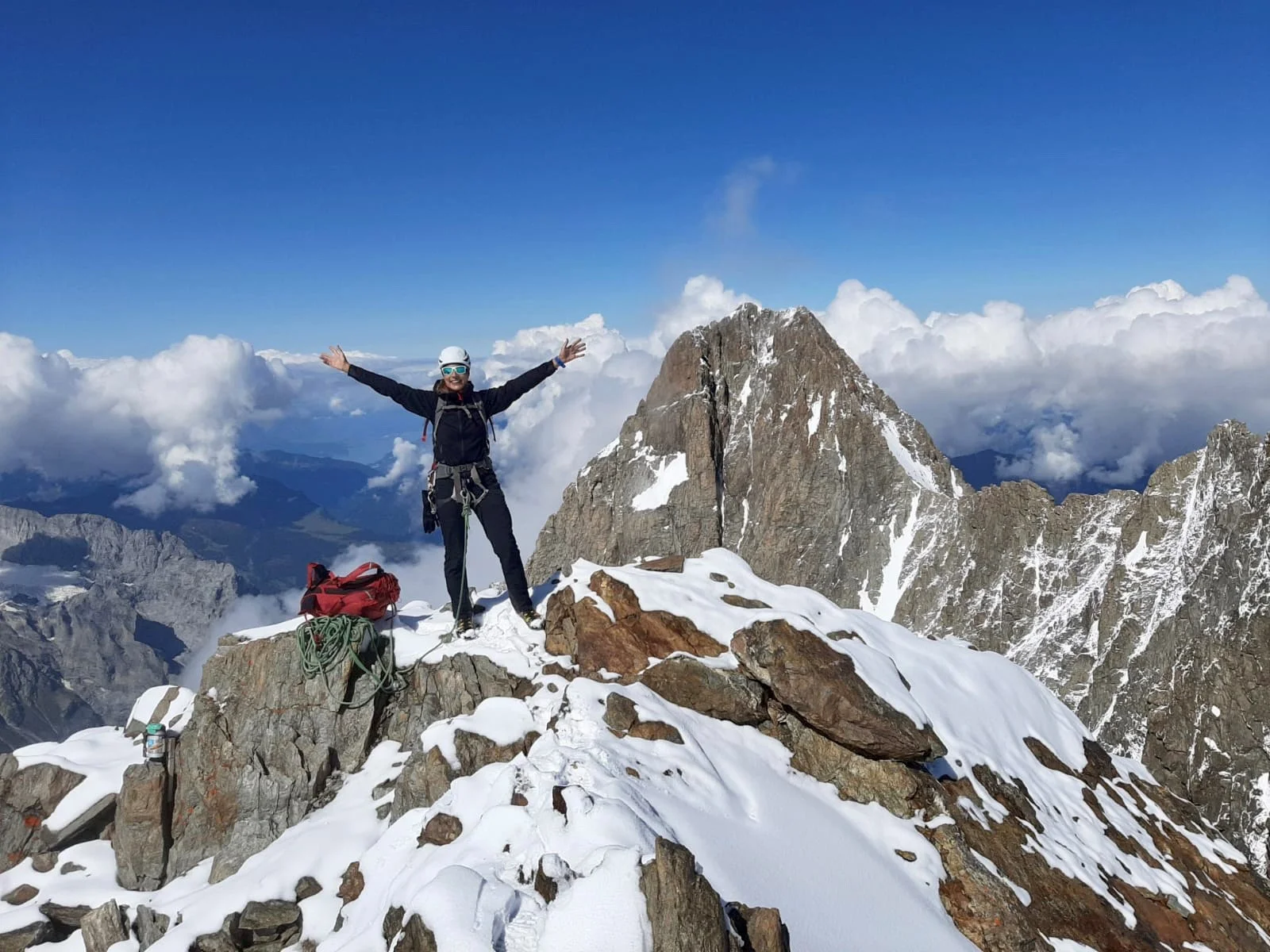
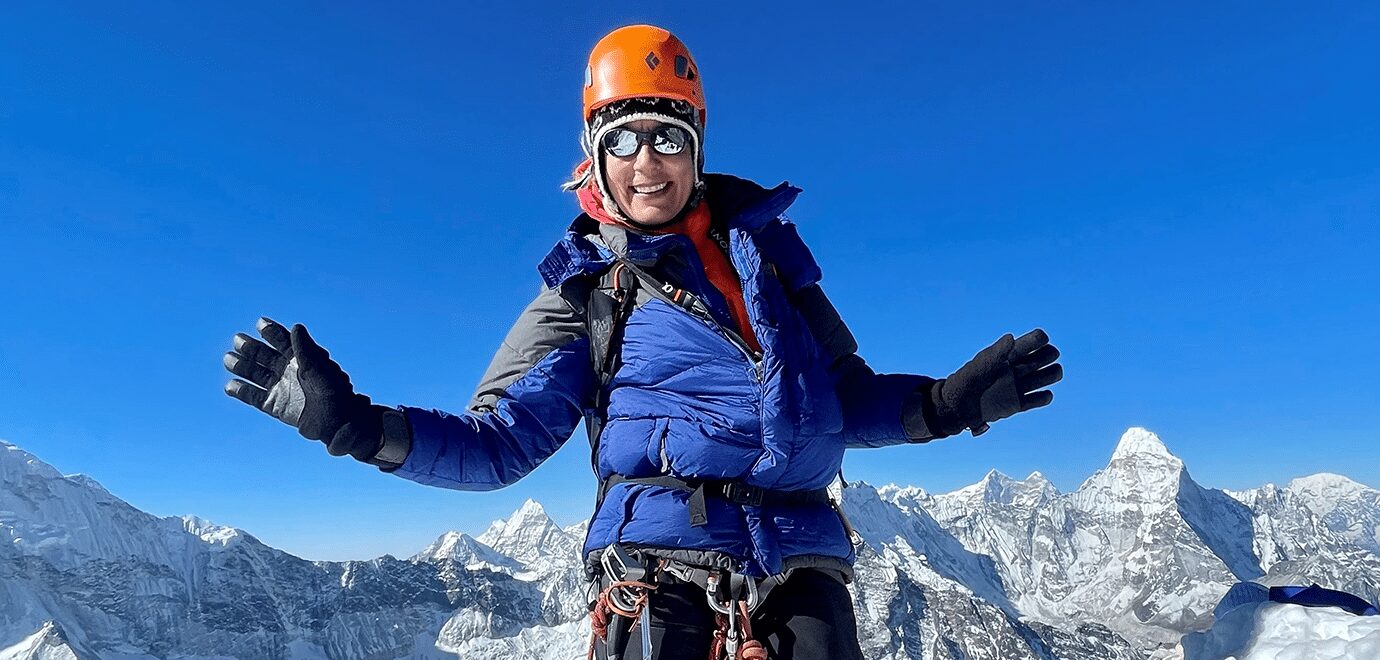
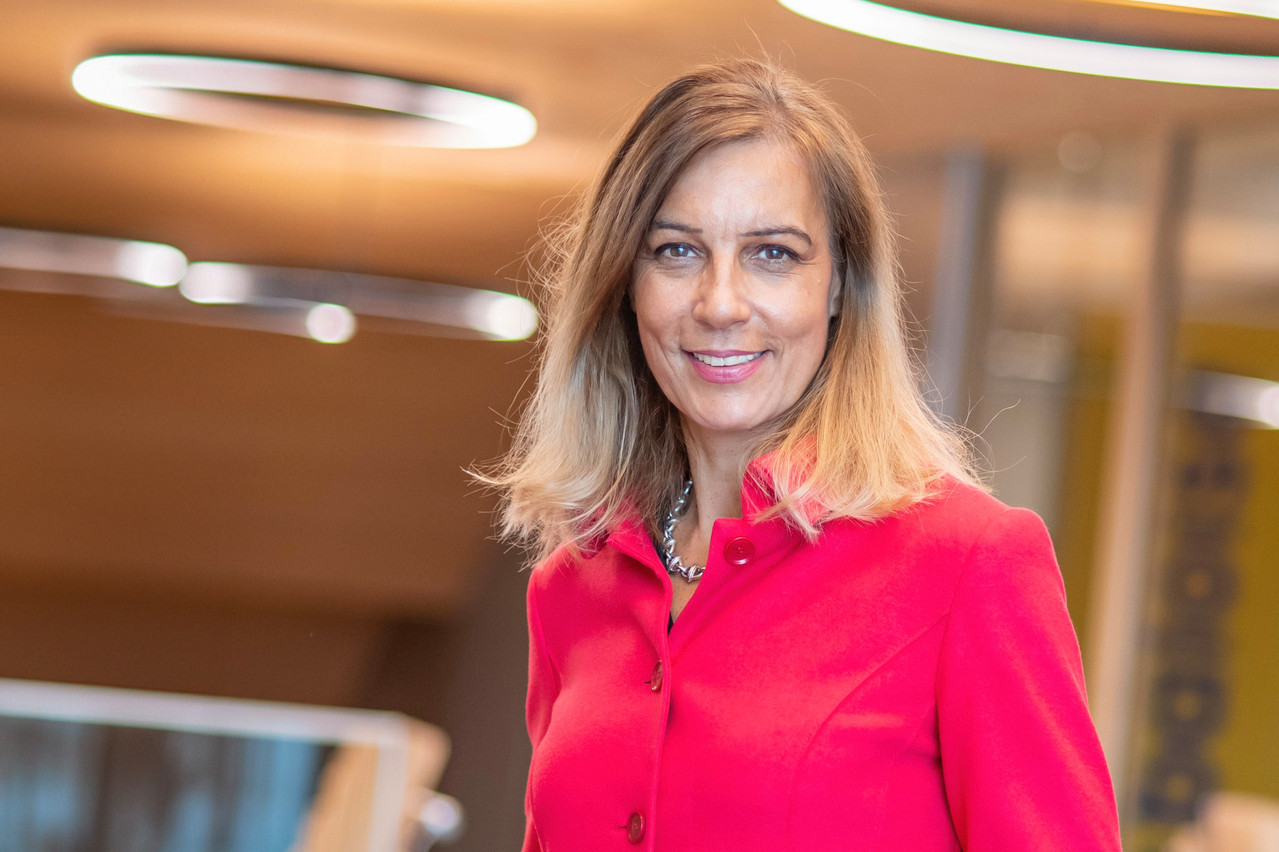
Dr. Christine Theodorovics — Viennese-born insurance CEO, doctoral researcher, and accomplished recreational mountaineer — joins Steve House for a wide-ranging conversation about what the mountains teach us that the boardroom cannot. Christine’s story spans a humble upbringing in Vienna’s public housing, a near-fatal attempt on Huayna Potosí with zero acclimatization, 25 years of quietly ticking off all 48 Swiss 4,000-meter peaks alongside a demanding executive career, and doctoral research interviewing 13 expedition leaders aged 39 to 97 across eight countries. What she found surprised her: at the end of every mountaineering life, what mattered most wasn’t summits — it was the human connection forged along the way.
The conversation moves fluidly between expedition leadership and corporate governance, Viktor Frankl and intrinsic motivation, quota politics and the permission women give themselves to lead. Christine argues that accountability can never be truly shared, that freedom requires a well-defined frame, and that the mountains remain one of the few places where positional authority dissolves entirely — replaced by demonstrated competence and trust earned in the field. A self-described “curious” person who has financed every step of her own path, Christine offers a perspective that is equal parts rigorous and warm, and thoroughly earned.
Exploring the poetic soul of the mountains.
Voice of the Mountains explores the mental and emotional adventures found in discovering who we are and what we’re capable of. Here we engage in self-reflection, humility, and embrace the beauty and struggle of the alpine experience equally.
Steve: In most of life, in the corporate world, in our personal lives, in our sporting ambitions, we are trained to wait for permission. wait for the title, the invitation, or the sign-off of the Expert’s Blessing. My guest today, Dr. Christine Theodorovics, is the CEO of a large international insurance company and a lifelong mountaineer.
And she is someone who has challenged this whole idea of waiting for permission when she was younger. She learned the high cost of impatience when she stood be beneath Wanda Potosi Sea and the Bolivian Andes, and thought, why? Why don’t I just do that now while I’m here? Well, suffice it to say she failed spectacularly the mountain, drove her back with altitude illness, but that failure didn’t crush her ambition.
It taught her an important lesson that she needed to build competence one step at a time, and not skip steps, then give herself that permission to move forward. So over the next two decades, while leading insurance companies across Europe, Christine didn’t ask for a new chance. She, she built her competence one step at a time.
And with mountaineering, she systematically climbed all 48 of Switzerland’s 4,000-meter peaks, one weekend at a time. She did a doctoral research project where she traveled around the world and interviewed climbing expedition leaders age 39 to 89, and tried to understand what they knew about leadership and how to translate that into leadership in the business world. of the things that she learned was that authority in the most dangerous and most stressful environments is not granted by a title. It is earned through what she calls qualified experiences. This sheds some truth on this old alpine maxim. Ability is the measure of permission. Think about that ability is the measure of permission. Her permission is one of meritocracy, responsibility, accountability, and hard work. And if not being afraid to take permission to define her own abilities and own her own accomplishments. It’s a conversation about the difference between youthful ambition and earned ability. Christine will never about taking power.
She talks about owning the process that gives her the permission to excel, not with pure approval, but with proof of self. I think this is a really important conversation because we explore the methods of building permission to excel that work both in a boardroom and in a biv wac. And this tells us and instructs us on knowing when and where you’re able to fully stand in, who you become and own the permission to act from that place. My name is Steve House, and this is Voice of the Mountains.
CTA: If you’re enjoying the show and want to take the next step in your training, join our newsletter and receive a free four week sample training plan. Head on over to uphillathlete.com/letsgo, and once you sign up, you’ll instantly get a link to try out some of our most popular training plans. It’s a great way to get a feel for how we train our athletes for big mountain goals. Check it out at uphillathlete.com/letsgo. That’s uphillathlete.com/LETSGO.
Steve: Welcome.
Christine: Hello. Hello, Steve. Uh, I’m really glad that you’re having me for your super podcast.
Steve: Well, thank you. You’ve said that in the end you only see the summit, but it’s the many small steps that get you there. Some people may hear that as something like a motivational platitude, but I think that you mean it as an operational philosophy. What did you mean by that?
Christine: Well, I think it’s, it’s two things. One is, I mean, the summit is you have to consider that, or I consider that as some sort of overarching goal, bit of your, a specific project or in your life. It’s some visionary thing, you know, it’s the summit and the many, many steps is the way how to, how you get that, that means you need to opera, uh, uh, make it operational, touchable, tangible, uh, and then develop a plan how to do it.
It’s easy to say, I want to do that, but you, you, you don’t basically put any flesh in the game and invest yourself. And so at the, at the same time, it’s, you know, working out how to do it, but also investing yourself, meaning doing, you know, taking all those steps with all the right efforts. And sometimes that’s really tough and it’s easy to say, I would like to do that without actually operate, you know, operationally thinking about it. I think that’s the crucial thing about the whole, I mean about everything. Happy on amount of being, not any project you would like to realize.
Steve: Mm-hmm. Mm-hmm. And it’s really hard to know what you don’t know when you start up climbing a mountain or starting a project. Right. There’s so much sort of ignorance, and I don’t mean that in a sort of negative sense. I mean that in just the practical sense that there’s a lot you don’t know. You don’t know how to climb a mountain until you’ve climbed a few.
Christine: Of course. Absolutely. I mean, that’s the whole thing about it. Otherwise, you would just take a plan and then you tick the boxes at a checklist and you just know what to expect. But that’s nowhere there. I mean, be it in the corporate word or be it on the mountain. There’s always some surprises coming around, so you should rather be surprised if there are no surprises, you know?
Steve: Yeah, of course. Take me back to your childhood and going to the Racks Mountains for the first time. Who are you there with? What are those mountains like, and what did those early memories feel like? Now I.
Christine: Uh, well, you know, my, uh, I mean, I really still love the acts in the schnier. Uh, it’s my favorite moms because it’s this homey feeling. Yeah. And, uh, my mother, she used to come from the Aus Mountain. She come from Sam ing, which you might know, it’s ster. So she always took us to the Iraq in the Schnier also to, to go skiing and so on, but also to go hiking because it was basically where she was from.
So I was exposed quite early to an area mountain, uh, environment. And I also have a small annex anecdote, which, uh, comes to my mind. Uh, you might know Victor, frankly, you know, the very famous, uh, Austrian psychologist and, uh. and, um, he was a, an TT fan and lover of the rocks. He was there every single weekend, uh, and climbing, you know.
And then afterwards he was helping out in one of the huts as a waiter to help the, the mountain huts, uh, tens there. And the thing is, he used to be at the auto halls, which is the major, um, hat, the bigger heart on the, on the vaccine. When I was little, I was sick, used to sit on his lap there, uh, you know, crawling around.
And I, I wish my mother had taken a picture of, of, of him and me, because I’m the biggest fan of his Viktor Frankel, because he combines this psychological analysis with his mountaineering experiences and, and, um, he was a complete passionate lp. I think that that was something which, uh, it’s a nice anecdote, but obviously I didn’t know who he was when I was three years old. But this was the early, I think in printing as a childhood, it imprints you somehow that you have a feeling, a, a good feeling about something. And that was the mountains. And the thing is, when you’re little, you do it with your parents, then you become a teenager, and you do everything else than what you did with your parents.
So I went to school with diving, basketball, playing, and horseback riding, but always far away from the mountains. Only skiing remained the common, you know, threat through my life. And only in, during or after my studies, actually, I came back via, uh, really exotic troubles in the Andes. Uh, as you mentioned before. To this taste of the mountains and the feeling that wherever I am in the entire world, as soon as I’m on the mountain, I somehow felt home. Because that’s this early imprinting, you know, whether you stand in the Andes in the Himalaya or in Africa, as soon as you’re in some mountain LP pan environment, it feels somehow area, you know, or you feel comfortable.
So, so that was a little bit the, the way I learned skiing there as well on the mini slope. So with one tea bar, till I was, I think 14 years old, this is where I learned skiing. But I mean, I learned skiing with three years, so that was my, my home turf, so to say. Yeah.
Steve: An amazing story. I mean, and Viktor Frankl, you, for those of you listening that don’t know him, you wrote this incredible book called Man Search for Meaning,
which. Recounts how he survived the concentration camps during the Second World War. He is a Jewish psychiatrist from Vienna, kind of a contemporary of Freud’s as well.
Like part of this, like very rich, uh, could have, you know, has defined, uh, psychiatry worldwide since, since their time hasn’t changed, I don’t think too much. And he was just, he, this book is something that I’ve probably read 15 times. It’s one of the, there are a few books that I read every couple of years, just go back to and read again and read again.
And that is, that is one of them. And it’s absolutely incredible if you, if you haven’t read it. Yeah, it’d be interesting to try to read it in the, in the German maybe it would be different. Um, yeah. You have, uh, you know, described yourself as kind of having a, a youthful delusion. When you were in La Paz and you went up to one Poti, um, what, what was that delusion exactly and what actually broke it?
Christine: Well, uh, it was actually, I mean, it was predictable. We knew at the time, I mean, I was very young. I didn’t even know anything about mountaineering. I didn’t even know that, uh, you know, I mean, there was a big danger or high altitude sequence. I only knew we need to be acclimatized. And the thing was, I was backpacking at the time, uh, and we weren’t oli for five or six weeks.
I was well acclimatized because they’re always above 4,000 meters. And when we wanted to climb the, which I thought is easy, we have no idea about anything really, super naive. uh, then, uh, I said, um, well, let’s go. And then it was a snowstorm. Uh, and so they canceled the trip and we already had booked a flight to the Amazonian part of, uh, Bolivia and spent a week there. Obviously after a week in the Amazon basin of Bolivia, you’re not acclimatized anymore. And then we came back and we naively thought, now we are gonna make the two. Uh, you know, we had three days left and, you know, for obvious reasons. So you completely fake because when you come from zero and you fly into LA Pass and the next day you run up to. The base came, I think was in 5,300 meters or something like this is a bit substantial. So I failed to die there. I mean, I nearly died because I had these lips completely black. And also the fingernails, you know, they were dark blue. And now I know I was really in danger. But at the time, I mean, I was 24 years old, I had no clue there was an internet or there was no inflammation.
So I’m happy I survived. but I, I also learned, you know, how hard, I mean, it’s really hard if you walk up. I mean, it was a LA long, uh, way up there, a long trek to go to the space camp. um, uh, but I, I really somehow got hooked because, uh, I really liked, you know, the atmosphere, the sleeping in the tent, although I was miserable. But, uh, but I thought, why do I necessarily have to do that in the Andes? Uh, I could also start climbing in the op, and that was a little bit, uh, yeah, the reintroduction to the mountains.
Steve: Uh.
Christine: climbed the rocks in Theni Pier with my mom when I came back, actually. Which was more adequate.
Steve: And you didn’t get, uh, blue lips and, and, and black fingers
Christine: Exactly.
Steve: Sounds like a lot more fun. And then you sort of created this project that you completed over 20 years of climbing the 48 4,000-meter summits in Switzerland.
Christine: Yeah.
Steve: That, that you did while, you know, building your career for many, for those couple of decades.
Talk about that and, and that balance. Was every year the same? Were there years where you gave up some mountaineering because of what was going on professionally? Or was it just, how did that work?
Christine: Yeah, no, that’s a good question. And the thing is, it wasn’t actually a project at all. You know, I just, um, I used to live in Munich at the time, and then, uh, I started climbing, uh, because it’s close to Ro and you know, from Vienna, it’s far. So, uh, from Munich, I started climbing. I did all the courses, you know, like, uh, how to behave on a glacier, um, jump in your Ravi and did all this training.
That was the end of the nineties. And then all of a sudden out of the blue, I got an, an offer, from a Swiss bank to, to work in Switzerland. I had no clue about banking. Uh, but they really wanted me, so they offered me a good job. And I said, well, okay, you know, why not? Uh, it wasn’t my plan to work in a bank really, or in finance.
But then there were the mountains, you know, I mean, that’s also an incentive if you offer the job so close to the mountains. And then, and that was in 2000, really started getting more into the, you know, alpinism, because it’s close. You can do it every weekend, the 4,000 meter peaks are just there. And so I just started climbing guided tours with some friends. And in the course of time, obviously you climb 4,000 meter peaks as well, and then you just continue. And I was there, I mean, like, I really continued every year, not a lot, but steadily. I used to run marathon at the time. So I was always in a very good shape and had any problems in terms of, uh, resilience or, uh, good condition. And again, this was, uh, 25 years ago, so it was easier. And, uh, so I always tried to keep a, some, some years a little bit less, some years a little bit more. And I think after maybe 10 years, I started getting into the more difficult 4,000 week, where I really needed also a guide one-to-one sometimes, you know?
And, and this guy, at a certain point, he said, look, I mean, you have already done so many, you could do all. And I wasn’t even aware of all, I mean, I, I wasn’t even aware they were 48. And then he said, well, have to do 10 more or something like this. And, and then it became a project when I realized I could do them all.
And, uh, uh, I, I wasn’t convinced at all because I’m not a good climber. You know, I’m passionate and I have a very good physical conditional ahead. Uh, I was very, you know, resilient, but I’m not a good technical climber. And nothing compared to you or your peers, I mean, that’s so far away. Like you wouldn’t even be able to say, but you know, thought if this mountain guide. Has the impression I can do it. He, he’s the expert and judge, I, I haven’t been up there yet, so, so in course of, in the course of the time, it was really a project with this specific hunka because he could judge. And then, uh, so I just, you know, ticked off the boxes, which also was, uh, then finally, because I had to do the KBA two times because, uh, the first time I went on there, on the mid summit and then I figured it counts for three, so I had to go back into the other two summits.
And so, so it was a game also. So,
Steve: Yeah.
Christine: I had to balance it a little bit with a job, but then again, if you live in Switzerland, you can do it in a, you know, like a weekend you do a four size
Steve: Yeah,
Christine: peak, you come back, and you work again
Steve: Yeah, yeah, yeah. Let’s, I’m very curious to hear your impression of how we first met and that experience. I want to hear your story and then I’ll tell you my story.
Christine: in 2005.
Steve: Yeah.
Christine: Yeah, that was really fantastic. So
Steve: What were you doing in Pakistan?
Christine: Yeah, I had this unique opportunity to go on this expedition. Tracking. It was a tracking expedition, um, like with a iron mess up. And that was a very spontaneous, uh, decision because, um, I was at the time training for the Ironman. I was in super good shape, and I was really, uh, I just finished Ironman and uh, so I didn’t plan anything for this summer because I was training all the time. And then a very good friend of mine said, look, there is, um, there is a, a trip where I can sign up with I not mess. It’s really tough. It’s an expedition like in Pakistan. I cannot go, do you want to go? And I said, well, try not mess. I mean, he’s in Idol, you know, my mother already went there when I was a kid and I said, well, can you just sign up there?
And she said, yeah, yeah. So I just signed up two weeks before and, and it just went, you know, it was like completely out of the blue and it was a fantastic, uh, trip because it was surrounding the Naga pa. I went with, I heard Messner with my book about Naga Nagapa written by him in my hand, you know, and I was like, uh, you know, what were you referring on this page to and so on.
And he, he was telling all his stories and everything. So it was a fantastic experience for a passionate alpinist. And I also like ine history or I really like all those stories and so on. And then so we see, so we did this trek around Naga, pa, and actually we wanted to climb the Mia Roy, which is a 6,000-meter peak. The thing is, we didn’t, because we found this Shu, the brother of OD, in this expedition. So that was another alpine historic moment. I mean, in all the books you can read, you, you, you, you read about it. And I was there when we found this book, it’s now in the museum and obviously with top everything is, we met a young US mountaineer called Steve House and was sitting in his camp at the Rual face. then, you know, everybody said, oh, those are two aspiring young alpinists, but they’re fantastic. And they climb, they will cry, try to climb the Rual face. And this is what re meso with his brother did for all the people who might not know the story, where the brother then afterwards died. So this is all historic.
And there you were sitting with Vince Sanderson trying to get some tips also from Rein because he did the same trip, uh, in 1970 and that was in 2000 oh five. this is how we met, and I thought that was really fantastic. And, and then we, we came back to Europe and one or two weeks after we came back, I read in the newspaper there was the, you know, like this was the super, super highlighted news the two of you made it in Alpine style to the top of, and it was just so surreal that we met before and then I read everywhere. And so that was a fantastic, I mean, all those coincidences you couldn’t plan, you know,
Steve: Oh yeah, of course. Yeah. And we had no idea that you guys were coming or that you were there. It was just like all of a sudden one day, like we’re, we’re in our rest period just waiting for the weather. It was the end of August. And I just sort of look up and, you know, Trekker passed through there and here comes some trekker and you know, it’s sort of, you’re in the meadow and people usually camp around the same place ’cause there’s the spring water and so on.
Like, no big deal. And then, and then like one of the treks, I, I, I really remember like looking up and like looking down and thinking like, wait, that’s Ronald Messner, like, like looking up again and being like, I mean he, he looked at me and I must have just had this like, complete, you know, just sort of what, like, I couldn’t believe like how is it that Reinhold Messner is this a dream?
Like we’re at the bottom of the RuPaul phase trying to climb this thing and Reinhold is here, this is, I can’t believe it. And then we, yeah, we, we, we ended up hanging out and you and I talked a bunch and we talked to Ryan Ho a lot. And like my re my memory of Ry hold was like, we’re trying to get tips that he wouldn’t, it felt to us like he wasn’t telling us anything.
I was like, we were like trying to like trying to pull something useful out of him. And
Christine: But
Steve: he was just like.
Christine: Years before.
Steve: Yeah, of course, of course.
Christine: I have not had all the details yet.
Steve: Yeah. Yeah. And he climbed a completely different route, and you know, everything is different. So what can you say now I, now I completely understand that, but at the time I was just like, come on, give us some information.
Christine: Oh, but
Steve: Uh,
but do you know, one thing he told us that we did is he said, um, he told us about how when he went down on the other side after he lost Gunther and then he walked out, that uh, he had a hard time getting help and he didn’t have any money. And so we actually put a bunch, like, I don’t know, several hundred dollars worth of Pakistani rupees in a plastic bag and put it in the bottom of our backpack in case we ended up on the other side.
We would be able to like hire a Jeep or whatever to come back around. So we did make one equipment adjustment. Yeah. Okay. We ended up coming back down the same side of the Reinhold route, but that’s another story. That’s so funny. Yeah. That, no, that was, that was really fun. And it was the only time really where we had a trekking group that, that sort of interacted with us.
I mean, we had at least one or maybe two couple of meals together or something. And we really, like, we talked to a lot of your expedition members and that was really fun.
Christine: Yeah. Uh uh, but there weren’t a lot of, uh, groups around. I don’t remember. We met many people on this track because it was really, we went with, with local peoples to find also the trail because sometimes there was no trail. And I
Steve: Yep.
Christine: At a certain point, there was an ent, like a mother who covered the complete trail, and so we had to walk around for two days.
So it was really expedition light. It was,
Steve: Yeah.
Christine: loved it. It was so remote. There was nothing, you know, I
Steve: Yeah.
Not too many people do the circumnavigation of that mountain, and it’s a huge mountain.
Mm-hmm.
Mm-hmm.
Christine: is huge. And the
Steve: Yep.
Christine: Obviously, it’s really high, so you know, and you cannot go because then you have to go back, and that’s to, I mean, it’s the point of no return.
So it was really expedition-like, you know, we felt like being on a real expedition.
Steve: So, if we’re going, connecting back to Expeditions, I wanna talk about your doctoral research and the interviews you did, and I mentioned them before, but you know, one of these guys was almost a hundred years old. What, what did they tell you about the moments that changed them, the near misses, the losses, the decisions that they had to make that they, they can’t forget?
Were there specific stories or something that surprised you?
Christine: of stories. Uh, I mean, I have all in all, I mean, I’ve to, you know, I interviewed 13 people over two or three years, and the rest was all the analysis. And I took slow because I, I worked, you know, I always took breaks of two years and then I, I I, I, I got myself back again in the analysis and everything, um, but as 333 pages of transcripts, so it’s really 13 interviews that, so it’s a lot.
I mean, to boil it down, it’s diff difficult. But the thing is, what I was most not astonished but surprised is that the, the underlying theme of everybody and leadership and, and, and all the accounts was really this human aspect. There was no, um, regrets about not having done an expedition, not having reached the summit.
It was all the human-related experiences in the human-related field that touch people, whether it’s dramatic things or bonding with people and, you know, having experiences together in a positive way. And it actually boiled down to that it’s the human aspect. And that was quiet, it’s surprising in the sense that if you think about corporate management or leadership and expedition guys, you know, they’re really mountaineers and then they go up in the ice and they survive catastrophes and so on. So you don’t necessarily all of a sudden think about empathy and human aspects. Of course, you also do. But I wouldn’t have immediately said, that’s the first thing I’m thinking about. But at the end of the day, it always came back to that, be it in a conflict, be it in the bonding, be it in a positive surprise.
It was always this human interaction, which was at the center of all the accounts. And that’s quite, that’s quite a lesson, huh? I mean, at the
Steve: Yeah.
Christine: day, we are all human beings, huh?
Steve: Yeah, absolutely. And I’m also fascinated by the kind of age range. ‘Cause you had expedition leaders that were 97 and then some that were, one was 39, I believe, and the style of doing expeditions changed so much from 19, let’s say 50 to 2000. And, and whenever the last one that you expedition was
Christine: One was actually, uh, the span, the Spanish
Steve: mm-hmm.
Christine: who climbed all the 8,000-meter peaks as the first, uh, lady. Oh, oh yeah. And um, and then, um, the oldest was Norman Dfu, and he, at the time was 93. He, he’s now passed away, but I was so lucky to get hold of him. He lived in Salzburg and, uh, I was at the time working in Austria.
So I, I, I went and saw him, and that was an extraordinary experience because he was still part of a, you know, like a different generation. I mean, he’s the one who organized the first expedition US expedition on Everest in 1963. And he was awarded by John F. Kennedy, a medal, which he had in his apartment, with a picture of him and John F.
Kennedy, plus the two shoppers, which he brought along. And that’s also a leadership singer. He brought along the shoppers to receive the medals from the US president. And there was also a nice anecdote. He said they nearly got a text by the bodyguard because, you know, they had these scarves, they put on your, um, you know, on
Steve: Ah,
Christine: in the, in Nepal.
So they probably wanted to put it in front of Kennedy in the bodyguards who were ready to jump at them and take them down because he cannot touch the US president. So, I mean, to talk to somebody like that, he was, he was teaching Marilyn Monroe. Marilyn Monroe in Hollywood because he was a photography and film teacher before.
Uh, so I mean, those are things where you, it’s it’s a different sphere. It’s a different, and then, I mean, she’s like our age. I mean, she’s our generation and you
Steve: Yeah.
Christine: And she was like contemporary. So, so that, that was the, the, the time period. I also wanted to have a, a long time period because the style of the expeditions fundamentally changed in this time period.
Plus, during the time period. At the end, the commercial expeditions were also introduced. So, I mean, drew also talked to some of the commercial expedition leader leaders, which are completely different than obviously, um, the expedition leaders, which, uh, which were working or, or climbing with professionals or experts for
Steve: Mm-hmm.
Christine: So yes, it’s, it was a large range of people, but it was hard to find women. Huh. I have to say, I, I didn’t interview a lot of women. Huh.
Steve: Yeah, and well, I mean. This, uh, voice of the mountains. I also struggle with that, like to find, you know, it’s, it’s not balanced. Part of that’s a reflection of who are my friends. I have more male friends and female friends. It’s also a reflection of the topic of the season, which is, you know, business and then, uh, the, and then the mountains, you know, and all those things that sort of select, uh, seems to select pretty male-heavy.
Do, was there a moment when someone told you something in those interviews that changed how you see yourself or how you see leadership?
Christine: Well, I think, uh, it was a lot, what I mentioned before, this human factor. I mean, one of the things that I thought was really, I mean, one of the most reflective persons was Jacque responding then. was he still alive? But, uh, when I interviewed him, and I actually, his book, one of his books was the reasons I had this idea for the thesis because he was so reflected about leadership. I mean, he’s one of the, of the few expedition leaders who invested himself to improve as a leader, to improve his leadership skills and afterwards really reflected on all, everything which happened, wrote many books about it. And that’s when I read one of those books, he inspired me to write this thesis, which I did really for pure joy because the title or the subject did not necessarily do anything positive to my career or anything.
It was really a combination of something I wanted to accomplish. And I’m a, I’m very interested in leadership and, uh, as analist, I thought the match was good. Um, Circus Pennington, when I interviewed him, he really, he was really convinced that you need to invest a lot of time to bond the team. And he had many examples where he didn’t invest himself or where, for example, very pr for practical reasons in the tracking towards the base camp, which at the time took many, many weeks and not like now.
Uh, so u usually where going in one group, sometimes these groups, groups split up in two and he might hang out with one group more than with the other group. When they arrived at base camp, there was a complete asymmetry in the relationship he had built up, and thus the team itself didn’t bond really well. That is very blunt. Maybe if you want to look it from, from external and say, well, that, yeah, that’s true, that can happen. But that’s not bad. That’s not so, um, uh, dramatic. yes, it was at the end of the day, it took a lot of effort in the other team, for example, for him as a leader make up again and then to bring them together.
And the more he invested in the base camp time, the less issues he had afterwards. You know, when they went to the high camps and they had the walkie talkies at the time, because then you cannot have a lot of conversations anymore or discuss things because you’re very limited in your time and you’re way out to, you know, you have a space of, I don’t know, five minutes, uh, every day at four, and then you call yourself. So I think that was extremely interesting on how much. To build this team and to bond, this team should be invested to make sure that afterwards the work. And the interesting thing is, when I finalized the thesis, I actually introduced a chapter on remote meetings because it was during COVID. And at the time, all these teams called came up and they, they completely substituted any human interaction in real life because of COVID. And thought that was really a lesson learned because you cannot, even though we do, uh, meetings with team meetings, and that makes a lot of sense in terms of, uh, you know, saving time and money, but you cannot completely substitute it.
You need to invest in the team a team knows each other and has a confidence level. You can do a lot, uh, by a, a remote, but you cannot define it from the very beginning. ’cause this confidence level and this, uh, trust is very hard to install. If you don’t spend time together, invest yourself. I thought that was one of the really interesting things that you can relate to, and where many mistakes are happening in our corporate world because people think they’re safe. If they don’t, do not bring teams together. In reality. In reality, I think it’s a very good idea to at least once a year or to make a new team, get to know each other.
Invest two days somewhere. Doesn’t matter where to get to know, and then everything works nicely. That’s one of those things where I thought, well, he has a point and he has done it many times, and that you could translate really easily.
Steve: Andy’s done it from, you know, his early expeditions in the early sixties that were massive. Like his early, you know, he was the leader of the early, some of these early British Everest climbs from the south side, and they came to Southwest Face, and then later on in the seventies and eighties, they were going as teams of four to the Himalaya and doing things.
So quite he, he, he lived through this incredible spam. I’ve been trying to get him to come on this podcast, but I think he’s, uh, I think he’s not doing interviews the moment, so hopefully I can find a way to convince them.
Christine: I was lucky, you know, when I, when I, I was referred to him and I remember so well, was very strict. Uh, he said, um, okay, you can come and, um, interview me, but make sure you have read all my books before and he was right. I mean, he wrote so many books and he didn’t want me to waste his time to ask exactly the same questions we, which he had already answered in the book.
So I was, I was really reading all these books and then referring to certain things there, which I thought was a, a valid ask.
Steve: Yeah. Yeah, absolutely. And you know,
Christine: A lot of time, and initially we had 45 minutes. I was there two hours with him, so he was really, really very nice and very in his sense. It was one of the most interesting interviews I had.
Yeah.
Steve: uh, I can imagine what an incredible guy, I’ve had the chance to meet him a few times. So you found that in this idea, one of the ideas that you kind of elaborated on in your thesis was how expedition leadership, as we’ve observed a few times, has evolved from this hierarchical command towards sort of a small agile team with more distributed leadership.
And you talk about emotional intelligence taking precedent over things like positional authority. That’s, you know, I think a lot of small companies or startup companies, they, they think in those terms, but at the corporate level, you know. At least the, the people I know that work in places like, uh, Cisco or other big corporations, Walmart, you know, they, they’re not really our operate, they’re trying to operate that way, but they, but they really struggle to, how does that affect how you lead both in the, in the group, but, uh, have Etsy, ba b and you know, your CEO role for, for the three countries, Italy, Austria, and Luxembourg.
Christine: Yeah, no, it’s a, it is a very important point you’re making here. I mean, there have been many, many, uh, uh, tries, you know, uh, also in the corporate work to incorporate a little bit more, you know, agile, uh, leadership styles or be leaner, approachable and so on. And I think a lot of things have changed. There are less hurricanes, there are less formalities than many years ago, not everywhere, but, uh, that you can really, I mean, change and it’s also society with changes, but a complete this, these agile teams with no authority, with little authority, which just auto managed themselves. We have tried it, uh, different organizations where have been working. The, the problem is also with the startups. It works till the startups gain a certain size. Usually, a startup consists of a couple of people and maybe three founders, with some programmers or whatever. they’re successful, they grow, and usually at the size of, it’s around 60. People, something like that. You need, I mean, at the very latest, usually with 30 starts, but six, you need structures because otherwise it gets completely Celtic anarchical and you waste time and resources really. uh, even if you have same, still the same goal, it or you already need some sort of governance, who is signing what, who is deciding what, otherwise it doesn’t work. Now, in a, in a, in a big company, the, the thing is usually why doesn’t it work? And I’m convinced that you still need authority and you need hierarchies. It’s just easier. And then it’s the question how you live that. But the thing is, if you have a, uh, self-organizing team, the authority be shared, but the accountability never is at the end of the day, somebody puts the head there.
Usually, it’s the CEO, but it’s the head of the department. Somebody is there. I mean, he cannot, accountability, it’s, it’s somebody who’s embracing it. He knows or she knows what, what she has to do. The team accountability, very difficult to enforce. I mean, the decision is for everybody. Ownership gets very blurry, and when things go wrong, not knowing whether things go well. You always say the success is many mothers. Huh? Then nobody feels responsible. So who, who do you go to? Uh, and the managers. Themselves. They, they, they don’t intervene because they delegated the o Sorry. So nobody’s responsible.
So what’s happening? Nothing. Eh, so that’s the one thing. So the result is slow decisions, uh, you know, turning in circles, risk avoidance, finger pointing, and so on. So, so that’s, that’s one thing. It’s very difficult to, to be accountable. The, the other thing is it’s really, um, the role ambiguity and, uh, it, that creates a little bit like silent power struggles.
No. If you’re not key on your role and everybody does everything, then people, I mean, people want to show off. They want to be in a, you know, you still want the salary rise or do something else one day. So you need to, you know, so you have these silent power struggles. People don’t know who decides what.
Then they pretend they did something, which they didn’t, you know, so informal hierarchies then emerge, at the end of the day, that’s very lot. I mean, there’s a group, there’s always some silent leader, or the most experienced person, or the most out sport. So informally it emerges, but it doesn’t exist real in reality.
So the, you have those hierarchies, and then you have conflicts which are not outspoken, but they go underground because we are all in the same, you know, it’s like we all love each other. But then again, there are, there’s a conflict, but we are not, not allowed to have one. So that’s also. Difficult. The third point is that the managers of today are simply not trained for it.
I mean, you can try it, but then at the end, do you live all that? If it’s you in a big organization, at the end of the day, it’s your head. You know, if it doesn’t, you know, how do you handle that
Steve: Yeah.
Christine: organization, that’s very, very, uh, very difficult. And the last thing is, it always is assumes this trust level.
You know, uh, sometimes companies say like, we are family and so on. Well, that’s not really true because in a family, you don’t get fired. And in a company that can happen, we, you know, it’s not an n it’s not some cozy environment. It can be cozy and nice, it can also be really tough. And then, you know, if you have no accountability, no structures and everybody is just, you know, floating around, it’s very hard.
And at the end of the day, you have cons, meritocracy. You have a consequent management. At least if you’re a performance-related, um, and you don’t do something well, or also the team, because the decision-making gets painfully slow and nothing happens. And that’s also frustrating for people because consensus is only consensus-based. It doesn’t, doesn’t work. You know? So yeah, it’s, it’s, it’s a stretch. But that doesn’t mean that you cannot make an effort to change the culture. I mean, you can be less hierarchical. You can be very approachable as a CEO, as a, as a, and that’s what I ask and what I do, because you can learn a lot, a lot. I mean, if I sit in the canteen and I talk to people on the table, or I have an apple, or I have a drink, they, I mean, I talk to everybody and you learn a lot.
And I think that’s a little bit more the way I would approach it. Because what I also learned, the whole thing about freedom and empowerment, yes, you should give people empowerment, but you need to define the frame really well because it’s easy to say to somebody, just do it as you think, because I empower you.
But you don’t give any guidelines. That’s actually not fair because you need to provide a frame, a very good frame, you know, a very well-defined frame. And we think this frame, you should give this freedom. So you, you can tell the person, this is the frame and within, I trust you, you the expert, do whatever you want. And if you have a question which is outside of this frame, please come and ask or, or, or talk to your other frame. You, uh, colleague who is the frame owner of another frame. And then your, your task as a manager is to make this frame not leaky. You know, that then all of a sudden the person doesn’t know whether it’s his responsibility or not. That allows real freedom and then it’s constructive because then it’s not this societal delegation, which there is not really delegation because people don’t dare to act because they don’t know whether they have the right to do so. So I think that’s actually a fairer thing. It has to do with governance.
And it might seem that you put some rules, but in reality, it’s fairer because people know what they can do and what they cannot do. And the frame can be quite large. You know, you don’t have to make a mini frame at the beginning or at the end, maybe it becomes bigger, but then you can just empower really people.
So that would be my interpretation of the whole topic, uh, and what I’ve seen, um,
Steve: And how does that apply? You’ve been talking about it through the lens of the corporate CEO. How does that work in the mountains? What is the
Christine: I think that’s very difficult. Different already on the area where we are thinking of, I think a lot of the conflicts in the areas of, um, uh, the big expeditions, you know, in the fifties where they climb all the 8,000 meter peaks. I think there was a lot of conflict because of this hierarchical, um, attitude and behavior of the expedition leaders. Why? Because they came from a very hierarchical background. Usually those were military guys, because those expeditions, they were all military background because those expeditions were funded by the state. They were very prestigious. And they are the logistics and everything. So that’s very military know-how. So by definition, male military background, you have this, um,
Steve: top down?
Christine: behavior. It was also in the corporate life at the time like that. So that’s, it’s also a society-driven, uh, development. And on the other hand, um, I think one of the other conflicts was the leader, the expedition leader, not necessarily a very good ionist. So the acceptance was purely about to, you know, the entitlement was purely the position power. And that’s always a problem if people know he or she’s the boss. But she’s only put there for a reason, which is not necessarily the content of the person’s, uh, you know, being or existence, but because somebody put for whatever other reason.
And we have, uh, many examples, uh, you know that, I mean one of the best is of the K two expedition. He was put the Italian Go government. So was he a good AIST in mountaineer? No. Uh, did he know how to, to get the state funds and, and logistics and organized logistics, yes. So the thing is, I think a lot of those conflicts were between the, the highly motivated LPs, experts, they could act completely independently and these very bureaucratic, hierarchical, old, old-fashioned at the time, not old-fashioned.
Now with our lens, it’s always easy to say, expose that to, at the time that was the thing. Uh, people, uh, expeditions, uh, leaders, and then all of a sudden you’re on the mountain and this, this, um, entitlement becomes different because all of a sudden this logistics person who raised the funds and organized the, the expedition has less knowhow about what’s going on on the, on the mountain. And all of a sudden these experts took over and very often with fractions in the, in the expeditions of an mess now, and Naga Paat, but also Herman Bull and Naga Paat in 1953, he just took off because he knew he could do it and he took accountability. So the leadership changes and he goes from this, I say organizational logistics, leadership to the expert.
I would call it the expert, because that’s then the expert. I mean, you trust the expert. He knows, or she knows what, what, what is doable on the mountain and who could really link this really well for the first time, I think, was the responding. Then he was a super accomplished mountaineer and achiever.
He had credibility in the team. He also created his team only with friends. nationality, same background, easy to bond with friends. And he went up there and not necessarily to their summit. So he accepted himself and said, well, I’m the leader of the expedition. That’s another learning by the way. The leader doesn’t have to be on the summit. And then the people went up there, but they all accepted him. That doesn’t matter. There weren’t any wild discussions. But I think that was the, for the time and the consistency of the, and the, how those expeditions were made up. I think this was the state of the art, what you could have done at the time to cover both.
And then he gave the freedom to the people and that’s how it works. So I think, yeah, the leadership, you have to probably, yeah, it’s the expert leadership and then the rest is like the organization. And the third role, obviously, is the one with all the logistics on the mountains with the shepherd team, which is like a shadow leadership organism on the mountain, which also completely changed, uh, at this point.
Now I’m talking really about the
Steve: Yeah,
Christine: 50, 60, seventies expeditions
Steve: of course. Yeah. And I think it’s also interesting because we don’t have these, I don’t know what to call the military-style expeditions anymore, for the most part. And we’re climbing the mountains in small teams of two for, I mean, a big expedition now is 10 or 12 people. My first expedition in 1990 was 18 people, and it was, we had a leader.
He didn’t go like, you know, we had the walkie-talkie radio check-in every day at four. You know, the people that got to the summit were, were, were climbers. They weren’t the leader and so on. But what happens in my experience now is when I’m out in the mountains, whether it’s ski touring or, or alpine climbing, or, you know, you leave the HUD in the morning or you leave camp in the morning, or you’re on Denali at, at high camp, you’re on Mount Rainier and there are a bunch of people around you.
Almost always. There’s maybe it’s, maybe it’s four, maybe it’s 30. I don’t know. Then it’s all fine when everything is fine, but then as soon as it’s not fine, this group of people who are complete strangers are looking around trying to figure out who knows
the most, who’s the leader, like who has the, you know, and I’ve found this personally very awkward quite a few times, both because I very often recognize in the mountains, right?
’cause that’s where people know me.
And also, I have the mountain guide badge. I, I kind of, I, now that I’m not officially a mountain guide anymore, I, I stopped wearing it. I took it off my backpacks and pins and stuff. Partially because, like, I didn’t necessarily want to be made responsible for somebody’s disaster.
And it’s, it’s, it’s, it’s a tough thing because like, I, I of course wanna help people that are in need or,
Christine: I.
Steve: but I can’t take responsibility for everybody out there that just happens to be on the same mountain on the same day. And it, it’s sometimes very, very scary. And, and it creates some very interesting dynamics.
And I haven’t quite figured out how to, how to navigate that.
Christine: know, it, it, it’s a very interesting, uh, observation because, uh, you know, I usually go with
Steve: Mm-hmm.
Christine: I’m not a pro like you. So, I, I, I, for the difficult or also for the less difficult, I fortunately can afford it now, but I, I go with mom guides. That’s my privilege, you know, my luxury in my life to have a real, super expert. And I remember when we went there, with the skis.
Steve: Hmm.
Christine: our, uh, our mom got, he really got mad because of this specific reason, because we were a group, good group with him. Um, and you know the truth, uh, better than I do, and it’s a demanding thing. And you want to make sure you know where you go because 1000 things can happen. And there were, were these three people and they were without the gut. And you could tell, you know, you can tell whether somebody’s
Steve: Yeah.
Christine: or not already, where, how he wears the backpack, whether there are 1000 things dangling around. I mean, you just can’t tell if you,
Steve: Yeah.
Christine: has been in the mountains for many years.
So you could tell they were not experienced. And so that’s very dangerous, as we know. You don’t do the, if you have no idea where you’re, and they were actually attaching themselves to us all the time. Um, well, they got a free ride, you know, I mean, we pay
Steve: Yeah.
Christine: guide. And then it’s not only that we pay for the guide and he basically gets abused, but it’s also what you’re saying.
I mean, what do you do if one of those guys falls into a crevasse and they have no clue how to rescue the other person or whatever? At a certain point, the mountain got, he stopped. It was foggy because we came, it was also really bad weather, and we had to change a part of the route because of the snowfall, so it wasn’t the perfect condition.
So those guys were following us, and at a certain point, the gate just stopped. I said, okay, let’s make a break here. And then they were, you know, sort of, they didn’t know what to do because they cannot make a break at the same time. And then, uh, you know, and then they were like, uh, stopped. And then he really was going at them the second time and he said, look, I mean, you just go ahead now.
I mean, you cannot just, you know, follow me. Just go ahead. Where would you go now? They didn’t have the slightest clue. I mean, it was fog, you know,
Steve: Yeah.
Christine: That was such a, such a situation, um, where I thought that’s really difficult because you can accept that you get abused and your clients, uh, you lift them to the test, and potentially they died because they were really awkward guts.
Steve: Hmm.
Christine: Uh, so we let them follow us, but then he said, ” Look over there, this is the way down, because, you know, we had to go down and, and, and take another way ’cause of the folk. there you go, and you don’t follow us anymore and next time you take a guide. But that was a really difficult situation, I thought of the guide’s responsibility, you know, because
Steve: Mm-hmm.
Christine: responsibility, and you’re even liable.
It’s like a doctor, you know, you cannot not help.
Steve: Yeah, a hundred percent. And his responsibility to you and your group is being compromised because now he’s only one person, and his attention is being divided by these other people. And that’s not fair to you. Um, so, and, and I, it’s interesting you mentioned I’ve absolutely, I was thinking of the hot route and my, some of my experiences there, but.
Christine: I’ve seen your documentary.
Steve: You’ve seen my documentary about
Yeah. One of my experiences where, where a big tragedy unfolded right in front of me. Um, and also like whether you’re on the Girls Ner or the Pi or the, the Mom Blanc or Mount Rainier, I mean, there’s there, and I was also a beginner ones, right? Like we all have been beginners and we’ve all been that.
And you know, I learned a side story, but I learned to climb from my father and I, my father learned to climb because he was stationed, uh, in the mil in the US Army in a base in Germany in the late sixties because he decided to live and go to go to Germany rather than be drafted and sent to the Vietnam War.
And
yeah. And so he was there for four years and, uh, in near Stuttgart and one of his. Fellow, fellow enlisted men wanted a climbing partner and taught my dad how to climb. And then they went to the Alps, and that’s how they climbed all their mountains. They climbed the Matterhorn. And, and that what he, and that’s what he told me later, he is like, when he was telling me those stories as a kid, he was like, their whole strategy was to figure out in the hut who the mountain guides were and then like figure out when they were gonna wake up and, and be wake awake and be by, kind of by the door.
And then just like, be like just, you know, 10 meters, 20, 30 feet behind them and, and follow them up because they were, they didn’t know what to do or where to go, but they were young and fit and full of energy and excited for the mountains and and stuff. But he, so it, it’s a time-honored tradition to, to do that in a way.
And what is the response? What is the, who is the leader? Like where, where is the accountability? Where is the responsibility when, when something goes wrong? Obviously, when it’s sunny, and you can just ski from the Shumway in Vermont in the sun every day. Yeah. It’s, it’s easy. It’s great, no problem. But on those days, when it’s really difficult, that’s a whole other matter.
This brings me to Paul Pricey, and for those of my listeners that don’t know who Paul Pricey is, just look him up in Wikipedia is an incredible, uh, individual also from Vienna, I believe. Right? Isn’t he originally a ese? Uh,
Christine: sure whether it was from me. I mean, Austrian for sure, they also died
Steve: Yeah.
Christine: But, um,
Steve: I think he was from Vienna, and he, he, he, he once, uh, said, and I, I, he said,
ability.
Ability is the measure of permission. I love that phrase. Ability is the measure of permission. How do you, uh, use that? How do you think about that? Like even for your own self, like as, as a, you know, a CEO, like not everyone is able to, you know, achieve something like that in their career. Like, how do you know what, how much permission to give yourself?
What, what’s the edge?
Christine: Well, apparently, you don’t always know because otherwise, Paul Bryce also, I mean, he died falling off the mountain,
Steve: That’s,
Hmm,
Christine: So that
Steve: Good point. Good point.
Christine: Uh, that’s the stretch. Yeah.
Steve: Yeah.
Christine: But the thing is, I think the essence of this quote is that, you know, the limit shouldn’t come from anything else but yourself, knowing what you’re able to do. Now, the question is, are you able to know what you, what you’re able to do, and, uh, how do you assess that yourself? But it’s this, you are allowed to do more, the more you can do something and you’re able to do that. That was basically, uh, what he, what he was referring to. And that’s true for everything. I mean, if you overestimate yourself, uh, obviously. know, if you completely go on a, on a wrong route and you fall off or you, uh, uh, you get stuck somewhere that you should, the first ability you should require is to get some sort of an assessment what your abilities are. And if you are not able, and I was referring before to this, uh, mountain guide, and I wasn’t able, because you cannot, I mean, if you have not been on the mountain, how would I know?
I mean, you can read all the guides and it says plus set, whatever, it’s plus, plus whatever. But that’s, uh, you know, it doesn’t really tell you whether I, you cannot really do it or not. So for me, for example, to figure out whether I can do it because I do have the capability or not, was really the assessment also of an expert, because I don’t know.
So if this mountain guide went with me, I mean, I, with him, uh, on five mountains, he knows me. He knows whether I can climb or not, and how much I can climb. And if this specific mountain guide, and again, I very much rely on experts. That’s why they are there in professional and in mountain or any other life. Uh, if he tells me, look, I think let’s train a little and you can do the shere one, which I never thought I can do because I’m not a good rock climb. I never, you know, I, when I was a rock, I had to climb up, but I didn’t specifically train a lot. when he, as an expert tells me, you know, you can do that. Then I believe him. I mean, he’s the, he’s the one who tells me this, Kernan is this NCE mask. I can, and I do it with him. I would never have had the idea to go there on my own, uh, or with somebody non-professional because I know I’m not good enough. You know, it’s not, it is probably, maybe I would’ve survived, but maybe not. So I think that’s also a little bit the lesson. I mean, it doesn’t necessarily mean you need to know, but you should try to, to know, you should try to know by any means, uh, what, what is your limit? And you can grow it. I mean, the dome, you can grow by increasing the canon. And that’s also true for the professional life.
And I have to say, they of my, uh, you know, uh, young people and they’re very ambitious and they want to do a lot of things, and I think that’s great. But then after year they tell me, wow, I’ve seen everything. Now I want to be basically a CEO, whatever and take over a department. And then it’s like, well, you know, there’s this dnce mask.
I mean, you should probably get more experience on this and this and this before you are able to do certain things. So yeah, there, there’s lots of analogy there as well. And at the end of the day, to come back to the acceptance of the leader, where I was mentioning before, the ones which were not accepted, well, that’s a little bit the thing.
You get accepted if you can, you know, if you have the entitlement and, uh, the entitlement comes by. Very boring, you know, practicing, uh, acquiring a discipline and make a lot of qualified experiences. And I think that’s one of the big advantages of mountaineering compared to, uh, corporate life. You get to make some qualified experiences because you are out there
Steve: Yeah.
Christine: Your dad, uh, you’re just out there, and you tried out.
You sometimes you’re probably in not comfortable positions or situations, but you get to know to do it. You know, like you don’t only read on it. You do things in corporate life very often. You, you don’t immediately, you don’t have the chance to get this qualified experience. The more you have, the easier it is to learn.
And you don’t get this, especially if you’re not, you know, privileged or whatever. I mean, it’s really hard to get somebody to trust in you Also, you know, this, you, you don’t know whether somebody thinks you can, that you, and so, uh, I think, uh, disqualified experiences is one of the most important things to learn.
Anything. It’s like do it yourself. It’s like driving, you know, the first time you drive a car, you can, somebody has ex explained it 1 million times. You, you need to do it yourself. You
Steve: Yep.
Christine: it yourself. Yeah.
Steve: Yep. Yeah. You know, it makes sense that you can have an expert tell you when you’re ready or when you’re able, like, Hey, you can train a little bit and you can do the Shrek core. Or you know, I mean, I’ve also used, uh, coaches in, in help in running my business a lot. Um, yeah. But I feel, I like to use business coaches, obviously, like fitness, like what the coaching we do.
That’s actually one of the things I think that coaches v in all areas, whether it’s a guide or, or or endurance coach or a business coach is, is give that validation, right? Like, you, you, you know, you can do this. Look at what you’ve done, you’ve got the background, ’cause a lot of us do, our instinct is to sort of self-doubt and think that we can’t do it.
And then there’s some people that are obviously a little overconfident and that requires a different kind of coaching. But we, we, you know, you obviously see both, but what about using yourself as that granter of the permission? Because you don’t always have an expert, especially in something like business, where it’s something like it has been done before, but exactly.
That has never been done. Or if there was a.
Christine: it never has been done anyhow. I mean, it’s never exactly the same. So the whole thing is about feeling comfortable in. Acting in ambiguity all the time. And that’s one of the major managerial skills. They, they say, especially now, you know, how do you act in this complete volatile bird and everything’s unsure and Yeah. Yeah. But that’s one of the main traits. I mean, yeah. Otherwise it doesn’t need us, you know, that’s what I always say. I mean, just to coordinate things. You don’t need to all those highly paid people. I mean, you’re, you coordinate the, the, really, the difference is that you, you know, this old pack environment, is in this volatile environment where you cannot anticipate anything at the end of the time, of the day.
You need to carry on, deliver, make decisions left. Right. And that’s very similar to a mountain, because I mean, at the end of the day, nowadays, you have a good weather forecast. Yes. That wasn’t always the case, but I mean, there can be so many things. I remember when we were, we were seeing you in Colorado, Colorado, these shoulders, these, these, these, uh, imprint of despair. I mean, you know, I was freaking out. I’m so scared of bears, we don’t have them. So I was like, oh my God, the mountain is not dangerous, but despairing. Then he told me the story about this cougar and this elk. So I was like, oh my God, what am I doing? That is not what I associate with lp. His, with like all these animals. So you always need to, that there’s always something new. And uh, I think that’s the art. This agility. It’s, it’s, it’s really like, just go on with it, you know? And stop and don’t whine. You know, that’s one of those things, don’t whine. It’s, that’s what it is. I mean, just accept it. Either you can change it, change it, if not, accept it and do something with it like in a month.
I mean, you know, you, when I did the Ironman, many people said, oh, that’s so great. It’s, uh, I admire you for doing this long distance triathlon. It’s, it’s fantastic. And I thought, yes, of course, a lot of resilience training and so on. Yes, it’s tough. But on the other hand, you know, during this Ironman, you can stop at any given point of time and you just say, I stop.
I, I don’t want to go on running or cycling anymore. I stop and go home. take a shower, I eat and I go to bed. Nothing happens in my life on the mountain, you know how often. I mean, I don’t tell you, you probably 1 million times more than me. You said, I would like to stop now. But the alternative is just stop there.
So, so I mean, it’s like, okay, yeah, I would like to stop my told hurt. Uh, you know, I have headache, I have thirsty. Everything aches. I, you know, whatever. You cannot. It’s simply not there. The option, so that’s very similar. You cannot, you can whine. Okay. Doesn’t really help. Maybe for a short time period, it really, really leaves you, but then you better shut up and suffer in silence. And the same is like in, you know, if something comes along and now there’s some volatility, infras interest rates up, down political havoc, you just need to ask yourself, what can I do? I mean, yeah, and then you adapt that. That’s the whole thing. I mean, it’s nothing more than that really. And I think that’s the whole, that’s probably something you should, can apply a little bit everywhere
Steve: Yeah, I think so. I.
Christine: is non non whining attitude, I would call it.
Steve: I used to have, I, I, I got some bad feedback for, for about two years. When I was a mountain guy, I had this pin on my backpack, and it said, no whining.
Christine: I really, you did. I want to have that. I
Steve: Yeah,
Christine: Put it here in front of my office, everywhere. Everywhere
Steve: on your front door,
Christine: It.
Steve: You made coffee cups and gave them to everybody.
Christine: I really love it. I mean, I’m winding myself sometimes, and I’m like, oh no, that’s, but then, you know, it’s, it’s rather a little bit, but this constant lining without changing, that’s something, you know. It’s for nothing. And I recently read something really nice that the fins, the fins, you know, they don’t have all the, you know, the, the, the Danes.
They have this, we, uh, we, everything is cozy. And you know, they, um, in the, in the long winters, they have everything very cozy with candles and, and they cuddle up at home and it’s really nice. And, uh, the things, a different concept. It’s really nice as well. I like it. They call it sisu and it means that you acknowledge risks without traumatizing them and that you prepare instead of hope and you just continue to act.
Even with the conditions getting worse and changing, you just go on. And I really like that somehow, you know, it’s the complete opposite of the whining. So
Steve: Mm-hmm.
Christine: I would like to, you know, I’m a complete promoter of the cso. I feel a little bit finished here.
Steve: Yeah, I like that as well. And, uh, it’s not in this part of my, I’m looking for it in my notes. ’cause I, I had something that, it was similar to this, that had come, come up for me. Oh. What, what makes people miserable is that when, what makes people miserable is when events are controlling them. And what makes people happy is when they’re controlling events.
So it’s this idea of, of agency and like,
and just taking, taking action,
Christine: Yeah, exactly.
Steve: action. You know?
Christine: Your own destiny. And, you know, to come back. We, we talked about Victor, frankly, that’s the whole thing.
Steve: Exactly.
Christine: What he said. You know,
Steve: Yep.
Christine: If I’m in the worst condition, nobody can tell me what I’m thinking, how I’m inclined to, uh, react or how I’m inclined to feel and what I’m making out of it. this is just amazing when he wrote a book there.
Steve: Yeah. In a concentration camp where some of his campmates were being sent to the gas chambers. And I mean, just like it doesn’t get worse, right? Then, then that. And he found in that situation a way to control his reaction. He, because he found purpose.
Christine: This whole purpose thing, which is very popular and all this. But that was his, he had the purpose, and he actually studied people who did not have any purpose. Thus, people who knew, for example, that the entire families were not there anymore, and they didn’t have this purpose anymore.
They died earlier than other people who still had this hope. And what many people don’t know, but Viktor Frankl actually, before the war, he was a suicide. He created a suicide prevention, uh, department
Steve: Oh, wow.
Christine: for the young. People, mainly men, who in the midst between the first and second World War, many, many young men committed suicide either because they came back from the war and they were completely traumatized, and there were no psychologists or anything like that at the time, who helped them not, uh, you know,
Steve: Yeah.
Christine: orders, no.
What they had or in, and then they didn’t find work. They were not included in society. They were, uh, super unemployment rates, obviously, in between the two wars. So there was extremely high suicidal su uh, rate of suicides in Vienna Viktor Frankle actually took them, and he had this program of, together with them, with this therapy, the local therapy, which he developed, he developed, you know, the sense of purpose and how to save them and how to not commit suicide.
So this was the whole basis of his thoughts actually was before the war. That’s quite interesting because it really comes back to this purpose thing. Yeah.
Steve: I think that this is also very interesting to dive into. I’m going off of my script here, but I, it’s so interesting, and it’s such a good conversation. Where is the difference between the, the kind of doing something because you feel a, a duty to do it, or you, you’re just, you, you’re motivated, like you, you have a strong will and you’re, I’m gonna do this because I said I was going to, or versus, it’s like, that’s more of this duty responsibility and I, I felt like Viktor Franco was talking more about those kinds of purposes.
Like people had a, a duty to their family, or they had a, they had a, a business back home or, or someone to take care of those kinds of things. But there’s another kind of motivation, which is more of this, which is, and I’m not sure where Franco would’ve fit in here, is like, for me, it’s, you know, uphill athlete because I get, it’s a vehicle for me to help my community of, of mountain people, right?
That’s, that’s how I see this. As a, as a, as fitting into my life. And it’s sort of like my, my heart pulls me forward and it’s, and it’s very abstract and I mean, I think a lot of businesses try to figure out how do we get our, our teams, our employees, our leadership to, to be pulled by, I mean, it sounds silly to like love insurance, but you know, through, through in, you know, financial products like insurance, you’re helping people to, you know, hedge against risk and, you know, that would otherwise destroy their property or their business or whatever.
You’re, you’re insuring them for, how does, how do you think about that? How does this work? What is the intersection between what is just sort of like this determination versus like, I love this, and I want to do it, and the mountains and business? How does that all fit together in your mind?
Christine: Well, I think basically what, what we are talking about is two, already two types of motivations, which, you know, it’s the intrinsic and ex extrinsic motivation. I think the intrinsic motivation is really something which you geniusly yourself, gen, genuinely appreciate yourself for yourself, that the, the easy test to find out whether it’s intrinsic or not is would you do it and enjoy it?
The same if you didn’t tell about you did to other people. Now, in our world of the, um, of the social medias and everything, that’s a very valid question. How much of the things would people really do if they weren’t allowed to tell anybody about it? How much would they climb Everest? Many of them, if they were not allowed to tell anybody that they were up there, I’m not sure how many would go.
So that’s not an intrinsic, I mean, you could say yes, the intrinsic motivation is to show off. Okay, that’s another thing. But I’m like this pool, you know, which you feel you want to do something and know, I think I know that, or a mountain lovers know that, huh? You, you have this, you feel it, you need, for me, it’s like, if I haven’t seen a man for one month or so, I need to at least go out for a hike and go back to Switzerland.
And, you know, it’s, it’s, it’s, it’s in, it’s intrinsic. But the same is, you know, you do something really for your own will and pleasure and because you really like it, or help people or whatever it is, it’s intrinsic. Extrinsic is really, you get something from outside that you are motivated by. The easiest thing is the salary, the award, the, you know, something which, and that’s obviously a very valid motivation as well, because it’s never a un uh, dimensional.
Because with this reward, you might do then something which you intrinsically love. You know, the, the, the, the difficult part for companies is to, to, to get this intrinsic motivation in the workforce. And sometimes you feel that, huh? If you have a project and you really, really like it, that’s intrinsic, then you don’t think about. Your salary, uh, your bonus, uh, whatever, that you get an award, you really want to get it going, see the success, uh, celebrate with the team. Why it’s so important to celebrate successes afterwards, because that really triggers this intrinsic, uh, motivation versus then afterwards you get awarded, you’re LinkedIn, you get the best employee of the month or whatever, which is also valid.
I’m not saying one is good and bad, it’s just different. And we need to distinguish the two. In the corporate world. Obviously, the extra, uh, you know, the seller is one of the most important things, or most important people go to work because they, yeah, they have to earn their living for obvious reasons.
So I think that’s, that’s, uh, if you think about the professional, they match that, you know, at the end of the day, they have this pool depends how much is left over after all the stress of posting all in the media, social media and so on. Because then that’s again, exp you know, but that’s another, that’s another thing.
But I think that’s a little bit the thing, and coming back to the purpose, I mean, all the companies try to define some sort of purpose because it’s easier if you know why you’re working. Most people would say, well, to earn a living. Yes. But I think it makes a difference. And you, you alluded to that. I think in my, uh, industry, it’s really easy to find a purpose because. You know, imagine society with no, uh, insurance, uh, industry. That’s quite, that’s quite sad. Insurance came into being because of this, um, cooperative approach that means in some village, uh, you know, in the, in the BAAs, uh, history, there was the Claro, you know, it’s a, it’s a city in the, in near Zurich. burned down 160 years ago. And then, you know, there was no insurance. So obviously, you know, then people put funds together how to repeat the city, how to, you know, and they degraded the fund. That’s the, that’s the history of an insurance. Create a fund, and then, you know, it’s a mutual, uh, mutualization of the funds. So that’s actually a very, uh, to solve a social problem, a problem of a society, uh, you know, cow die and the poor, know, pea or pharma couldn’t, uh, for a second cow, then the, the, the village would save and, you know, give him another cow. Otherwise, the family, I mean, I’m now a little bit exaggerating the situation, but that’s, where insurance comes from.
So it has a role in society. Now, obviously, not everything is, um, always, uh, only positive because of the way it was distributed and so on, there are many. Things, which you could also say is not so much the purpose, but generally speaking, I think insurance, it’s easy to, to, to say you have a good purpose, and if you do it nicely in a good and proper way, you really play an active role in society.
So I think in my industry it’s easy. I don’t know about other industries, and there are certain industries, not sure whether you want to work there, if you have this, this ambition or this, uh, know, uh, sort of personal wanting, having, finding your own purpose if you work for some, I don’t know, of the not so good industries, for example.
So for me, it’s really, I think it’s, it’s easy to define that. And also that’s what I repeat, uh, always to my staff because it’s a, it’s a nice industry to be in, actually.
Steve: Mm-hmm. Mm-hmm. Yeah, no, I, I think that that makes sense. I mean, you know, as you know, I spent whatever, 23 years working at Patagonia, and they had a, a very clear purpose and everybody knew what it was. And it’s one of these companies that has been talked about so much as that, and used as an example in this way.
And it, it really just originated from the very genuine sense of, of, of kind of responsibility. But, you know, it’s, it’s this, I think one of the things I really admire about the ARDS and both Ivan and Melinda Chenard, is they look at, at the environmental issue, you know, whatever, 20, 20, 30 years ago and felt overwhelmed, but they took that sisu mentality and like, yeah, we’re going to work towards a solution anyway.
We’re not gonna give up. We’re not going just sit here and not do anything. We’re going to do something, and we’re going to move forward. And, yeah, they, they, they over time accomplish all kinds of incredible, uh, things through that.
Christine: a, that’s a fantastic story. And I think that’s one of the ones where it’s really geniusly started with their passion, a hobby also. I mean, climbing, you know, and then they just their own, uh, hooks and everything. ’cause it wasn’t there all, I mean, all of a sudden, not over the many, many years, they became billionaire. And then they were really, I mean, have, you know, investing in a strategic way in like natural. resources and, uh, reserves and uh, and, and, and what I admire, I admire most is, and they, they’re living a good life. You know, their life. It’s not giving up one for the other. And that was always because you asked me
Steve: Yeah.
Christine: combined the corporate and, um, and, uh, mountaineering, I think that for me was one of the things I always wanted to accomplish.
And I think I, it was, it’s okay how it worked out that, you know, it’s easy to, I mean, easy. It’s not easy if you have no money. Uh, but it’s easier if you, if you just, if if you just went to, you know, I, I wasn’t probably good enough to become a, a professional, but to do one thing, it’s probably more efficient.
But to play on two sides of this in this life and do both above average, that, uh, was what, you know, I wanted to have a good life and to have a good, uh, career. And I think, uh, the patag, they had, you know, they wrote this book, Let My People Go Surfing.
Steve: Mm-hmm.
Christine: sure you read it. And, and that’s, that’s a little bit the thing.
I mean, they worked hard, you know,
Steve: Mm-hmm.
Christine: I mean, they had a good life, you know, and I think that’s the good thing. You can work hard and have a, and, and, and, and frow your passions, uh, as well, because that, that’s a little bit, uh, you know, the, the tricky thing. How do you organize that? And I always admire people who were able to do uh, the most.
Steve: And I can say for all the like, things that I’ve read about them that come sound like they’re out of a PR press release or something, it’s all true. Like ev all my experiences that I lived, you know, like if it’s a, if it’s a, if it’s a morning on a Monday and the surf is really good, guess what? There’s nobody in the office.
But
when, but when the deadline is due and the, the, the, the thing has to get shipped or whatever, and it’s, you know, Saturday or Friday night, everyone’s in the office and it, it is just sort of, yeah, they show up and they just get it done and, you know, and they know that they, they know that there’s this give and take and that’s how like the, the reality of life isn’t always like Monday through Friday, nine to five.
Like it
happens in this, it’s, it hap life happens when it happens often. It happens on Friday at five o’clock too, like with all the bad news comes out or whatever. So I think that that’s, uh, important that people are on that. And I noticed this with my, it’s one of the things I look for and like the, as we develop our coaching team internally with our endurance coaches at Uphill Athlete and looking for those people that it’s, it’s fine to have boundaries and say, you know, I have, this is when I’m going to be available to my athletes and this is when I’m not and stuff.
Christine: Then I’m.
Steve: But I always ask, well, what if such and such? And, and the ones that are like, well, yeah, in that case I would go the extra mile because that’s, you know, and. Not that I want them to overextend themselves, but I just want the kind of person who is going to go the extra mile. And, and, and also understand that there are times when there’s weeks when everything goes super well with your athletes, when coaching is pretty easy.
And then there’s other weeks where it’s really hard ’cause all of a sudden, you know, all these things seem to go in waves.
I wanna connect back to, um, something that the American listeners won’t, rec, won’t know about or recognize, but you’ve done a lot of work with SOS Kinder Dorf, which is a, I don’t know exactly what the equivalent of the US would be, but it would be something like, I think what we have is called Salvation Army, and it’s kind of a, uh,
Christine: helping kids abroad. I
Steve: Yeah.
Christine: In countries where they are not so privileged, usually. Uh, yeah.
Steve: And, and, and you’ve done, you know, you’re in this incredible, you know, accomplished role. I don’t know, you know, in, in the insurance industry. How do you, how do you see that connection? Like where, where is the connection between like, being a leader and, and business and, and doing this kind of work? Uh, that’s like whether it’s a volunteer work or,
or, or, yeah.
Christine: it’s a little bit of a, you know, you always think how could you leverage a little bit what you, this you’re giving back? Um, but also not only to, you know, hang around and, and, and, and not do anything but just fund, I mean, fundraising is also good, but how can you leverage your knowhow somewhere else? And, uh, typically in NGOs as a, an accomplished corporate manager, it’s quite, uh, you can quite, uh, support, uh, because typically NGOs, uh, you know, they don’t have a, a lot of the governance, which we’re used to, or what I found, for example, uh, very interesting is I wouldn’t have thought of fundraising having so much in common with a, um, distribution channel of an insurance.
I mean, if you, uh, lead a tight agents force Yeah. And you train them to sell insurance policies, uh, non-life life insurance, they need to go out and, you know, have a narrative of which they’re trained, uh, meet a good story, and then a good product, obviously. And then they go out and you manage them as a sales team with incentives and everything.
So that’s very much the same. I mean, if you have a fundraiser. Whatever NGO, um, you go out there, you have a narrative, you have a story to tell you, a good product, hopefully, and you train those people, right, and then they come back and hopefully, uh, return with funds. Same with processes. You know, they need to be very lenient NGOs because you need to also fulfill certain requirements because if too much of it goes to admin fees, then you’re not credible. Uh, as an ngo O if you waste half of your money for your own, your admin, that’s probably not a good idea. So things like that, you know, so you can actually help shape, uh, those organizations, which usually don’t have access to expensive consultants or leaders from, companies like with the experience we have.
So I thought that’s quite, that’s quite, uh, fruitful, and I wouldn’t have thought that it’s that, uh, yeah, that there’s some similarities at the end.
Steve: Uh-huh. You’ve, you’ve, uh, done a lot of work with something called Generation CEO. What is that and how does that come tie in?
Christine: That’s actually an association I’ve turned 12 years ago or something like that, of women. It was founded by, by a, by a gentleman, a headhunter at the time, uh, I think in 2007, who realized that there’s a lack of women leaders, uh, to, for succession planning. And there were more and more calls for women. And I, I, I, I can say for myself, I’ve always, uh, been very the old woman in the board or anything like that because I’m around for many years. I have a corporate career of 30 years now. And so, um, he decided to have this as like, at the time, it wasn’t an association yet, but he said, let’s have a sort of a club, a get together of very highly qualified women, uh, in certain positions. And it’s called Generation CEO that meant who have to potentially become a CEO, like the next generation CEOs.
And I, I, I was accepted because you have to apply and that was, uh. And Becom recommended it’s ager, purely German speaking, um, association out of Germany. But then they extended to Austria and Switzerland because they are also German-speaking. And I joined there, uh, I was accepted. And it is an exceptional, nice community.
Now we are already a lot, uh, we are 240, I think, but it’s a very nice community of very high-level managers from different industries, women only. Um, and, uh, we have a very, uh, trustful relationship. And, um, it, it auto-corrected itself. At the end, there was this association, but now it’s really, there’s a lot of, uh, things going on, really created by the members themselves.
I’ve been in the, in the selection committee, uh, to, to, uh, for the women to apply. And there we have, for example, also created the whole process, how you apply, which wasn’t at the beginning where professional, but now we have B applications, a system. It’s very rigorous, a very good process, it really lives by the members.
I, I, I really enjoyed it because it allows me to, um, exchange with, uh, fellow women in similar positions, you wouldn’t meet otherwise because the of different industries in completely different cities. I have really, uh, gained great friends there. Uh, also some of them, which I go to the mountains and uh, but what is really nice that it has this self. create that dynamics. One thing we have started a couple of years ago is, uh, um, organized trips. Uh, if one of us is in another country and has access to local leaders, politicians, uh, access because you have the CEO of this country or whatever, then we would, uh, organize a trip, uh, in this specific country for the, for the women, and then have this exclusive, not exclusive in terms of, uh, luxury but exclusive access to leaders in that country.
And I’ve been in Tunisia there. And I myself organized the trip to Luxembourg last year. So where we met, you know, uh, the people of the financial world, uh, female, uh, wine producer, the female director of the local international art museum, local Luxembourg madam. So we had, uh, put up a really nice program and I brought them here in this office and I met them also meet all my women leader of Paloas here in Luxembourg.
So that’s, those are the things, uh, which I really enjoy. And nowadays there are some really, uh, like CEOs in this association. Yeah.
Steve: You know, one of the things that I learned from the Chouinards at Patagonia, and he writes about this in his books as well, is most of, he, he leads heavily to hiring women throughout the Patagonia organization. And I have to say, like that’s been a, something that I’ve learned that I’ve applied with an uphill athlete where I’m really trying to not only just have half of our coaches and, you know, management team be and marketing team, the people making the decisions guiding, uh, our little organization.
But now we’re, it’s like I’m the only man and one of the, one of the things that I, that the reason, so when I was younger and in, mostly in university, I noticed how hard my female students, you know, co-students were working and they were very good. And later as we got like further and further along in that education process, I noticed also that it got harder and harder for them.
Um, this sort of built-in sexism that was still existing this time and still exists in many places now. When I, later now, I, if I have to hire, like find a lawyer or a dentist or a doctor, I will purposely seek out a woman in that role because I, I think, well, that she had to be like 20% better than everybody else to achieve the same thing.
So she’s gonna be really good and I’m gonna be able to really trust her. There’s another narrative that is being pushed frequently these days, and that is this idea, and maybe this is just an American thing, this is, and I don’t want this podcast to get political by any means, but there is this narrative that you’ll hear where people will say, oh, uh, that woman is a diversity hire.
She’s not a, you know, better-qualified man, but, but they had to hire a woman because they needed to beat their diversity targets or something. What do you say to that kind of narrative that people, when people say things like that, how do you, how do you respond as a, as a female leader?
Christine: I’m already glad you said that. Uh, women have to fight harder to get where they are because Yes. Uh, I agree. The thing is, I can tell you what I do when I hire people, and I’ve just hired, uh, because I’m in a transformation here. So my executive committee here, they also some fairly new hires, both of them men, and not because I privileged men.
On the contrary, I, but I want to make sure I take the best person, huh? As a manager, I wouldn’t do myself a favor by taking somebody who is less competent just because of other criteria. However, however, what I really in insist, and that’s not the service I always get, is that hand high tempers propose me also a list of women. Not only the first list, 15 men, and that’s not the norm yet. So I always sent back the first list and said, let give me some women. And they always, or very often, come back and say, I don’t find them. It’s so hard. And I have to say, well, yes, okay, make an extra effort. I don’t care. That’s your job. There are women out there.
We are not in medieval ages in the dark, uh, where you women are working here, Luxembourg. I mean, you can, you know, shop around in France, and in Belgium it’s French-speaking. I mean, if you do an effort. So then I myself went to the LinkedIn of myself, and I proposed some names within half an hour of research.
And I said, look, that’s your job, so this is what, but at the end, I had two lists. I had two final candidates, a woman and a man. I picked the man because at the end of the day, he was the best, the candidate for me. So that needs to be a very objective, fact-based decision. However, pipeline needs to be the same, and that’s what the main problem is.
And also within the companies, because I like to have a pipeline, you know, and everything is developed by the talents ourselves. That’s not reality, especially if you’re smaller, but. There is no pipeline. You know, if you cannot pick of the same amount of people, then by definition there’s always the same who get, who get to the top. So that’s, I think one of the major things we need to make sure is that we hire that we have this, maybe not the same amount, I would also accept less. But you need to have, women there, because otherwise it’s so easy not to, uh, have them in the, in the sample, which you get. as for the, uh, what you were mentioning, the diversity thing, it’s not an American thing.
It’s all over. And I think, you know, the, the interesting thing is when I was younger and people said, uh, we’re talking about quotas, you know, quotas in the boards and so on, I was always against it because I was young. And I said, well, uh, exactly, you know, we don’t need quotas. It will, uh, happen automatically, uh, in the course of time. Now, 30 years later, I can tell you I’m pro quota. Now if I get the sheets done, that’s fine. I can deal with that. But in certain positions, you need first to break the structure by force if it doesn’t happen otherwise by quotas. And I’m talking now purely, uh, non-executive, uh, boards, not executive boards, uh, for the moment being, uh, in my example, because. The non-executive boards, the recruitment procedures are more PAC for executive boards. So if I hire a manager, it’s, you know, there’s a profile out there, uh, or the head hunter is chasing, uh, your executive board member, like the CEO or the C-T-O-C-O, et cetera, CO If you hire the non-executive boards, they are usually not, I mean now more and more, but there was no process.
I mean, this was a person sitting in the non-executive board and saying, well, who could I take of my friends here? would be, you know, and there was no, I’m talking now 20 years back, there was not a lot of governance fit in proper requirements. No, not so really strict enforce. So basically it was a, you know, it was, um, award you got after your career and since the only careers were there where the male people, and then, so by definition it’s only male.
So that is a self triggered propelling process because there is no process. So that’s why to break this pattern, you can only have a forced situation. And once it’s broken, okay because then you again, in there are women and men. So I think that was essential. can see it now, it’s not, uh, 50 50 yet, but uh, in some countries, it was 30% compulsory in France, Germany, and it worked.
All of a sudden the other women, oh, you, you, you could say they’re not all completely unqualified and all, therefore the, the, the quota, some of them they’re might, yes, there are certainly some women, they are there. They wouldn’t be there without the quota, but have a wild guess. Most of them are, are, are qualified because it’s
Steve: Yeah.
Christine: to put somebody completely unqualified.
So for me personally, that’s a non, uh, topic. If somebody would ever see you there for the, for the gender, I can only laugh because then look at the CB and the qualification. It’s usually double that of anybody else. So yes, it’s true. You have to overperform to justify and to be really a little bit, um, uh, immunized against, um, against such things.
But frankly speaking, I don’t care. And I, personally, experienced how nicely it changes the atmosphere in a positive, very interactive and very productive atmosphere if it’s mixed. I’m not saying only women, I’m not saying only men. It’s really this interaction. It’s just a nicer atmosphere and I’ve experienced that once in an un unconscious way when I was invited to a leadership. Um. Leadership seminar in one of my previous companies for managers, and it was a top executive leadership, training for three days from the London School of Economics. And after we were 24 people. And after a day, I thought there’s something different than usually at those meetings. Something is better.
And I couldn’t figure out what it was. then all of a sudden I counted and I found out there were eight women. that was completely odd for me because usually all alone in these meetings, I, I mean all those group pictures I have, it’s always me, maybe a second woman, and then many, many Black Seals. That’s the finance industry. uh, and I thought that’s really interesting because they always scientifically talk about this 30%, which then changes the, the dynamics in a group. 30%. You’re not a minority anymore. You are not, you’re not, uh, not everybody’s aware of you if you’re the only one. You go out and grab a coffee.
Everybody knows this person now went out and grabbed the coffee and comes back. If you assert. You’re not a minority. Nobody realizes you anymore. You’re just included. You’re mingling. You know? And I figured that’s really funny that I didn’t even refer, I didn’t even realize there are eight women and, and, uh, 16 men. It was only afterwards when I’ve figured what is different? Why is it nicer? Why is it more constructive? And also the speaking time was different because if you’re the only woman, you always get overtalked anyhow. You cannot imagine. That’s how much I talk. But it happens. You just get overtalked, nobody listens. You know? It’s like, that happens. It’s not because everybody’s mean. It’s, that’s how it is in a group dynamic. Uh, and this 30%, that doesn’t happen. And that really was for me, such a point where I thought, well, this scientifically or this recommendation must have some scientific, uh, because it’s true.
It makes, it does something to a, to a, to a group. It does something to a, uh, to a, the dynamics of a group.
Steve: I wanna connect this back to the, the permission.
Christine: Mm-hmm.
Steve: How can we give, you know, how can I as a man, but how can we as, uh, as a community, give women more permission to be in these leadership roles, both in the boardroom, but also in the mountains?
Christine: I, I think it’s a lot. What, what I’m experiencing a lot is that women. That’s a little bit of a stereotype, but it’s true. It’s, it’s, it’s, they underestimate themselves a little bit. And that’s, but in, for example, in the jobs, if you offer a project or an additional job or whatever, uh, to men, uh, us, and that happened many times.
I said, would you like to take on this project or something? The typical response I get would be, yes. And, uh, would I get a salary rise or what’s my new title? Or, uh, yes, of course. Yeah. And if you do the same with a woman, she would say, are you sure I can do it? Are you really sure I can do that? And then my answer, my standard answers, well, I would have ask you if I wasn’t sure.
I I wouldn’t think you can do it. And that’s very typical. So what can we do as leaders? And that’s probably the same on the mountains, because you always, I mean, I told you my experience, I wouldn’t have dare to just, you know, go to the, uh, but I, I wanted somebody to give a little bit of a comfort. Maybe it’s also the risk version of women themselves, but there is this little bit, that doesn’t mean that we are more ish or anything that’s not, it’s, it’s something about self-assessment and risk taking, maybe. That’s different. And there is this study, I think the in front, the Austrian Pine Association, I think they did this study with the avalanche, uh, propensity of people. Uh, there’s like 80% of the, of modern 80, 80 90% of the avalanche incidences where people are die or are in avalanches are men. And they said, well, okay, there are more men doing skiing tours.
Yeah. But nowadays it’s 50 50, nearly 55. 45, but it’s nearly the same amount of women going ski touring. And you probably can confirm than men. So why is it still that 90%? Well, because the risk-taking is different. There’s a steep, uh, slope, and like, okay, let’s give it a try and go down and women wouldn’t. So there is a difference in risk-taking, uh, perception. And I think this entitlement, uh, this permission sometimes that has to do with that, that you, not true. And so you, you might not take the risk or you might need a certain, um, you know, confirm confirmation by somebody else and then you, you feel better.
Maybe it’s that, but I’ve made this experience really in corporate life and also with applications. You get applications, you know, it’s described the task and you get it from male applicants and they fulfill half and they apply. And the woman, they would tell you, well, there’s one line, uh, and I didn’t do that yet, so I cannot apply. That’s, that’s really, that’s a, that’s a gender bias somehow. Why? I don’t know. But it,
Steve: hmm.
Christine: It is that way. Yeah.
Steve: Yeah. And I think we can, we can help by just being aware of it, right? Like, I mean, it’s the same reason.
Christine: You know,
Steve: Yep.
Yep.
Christine: negotiating for salaries. Very rarely women would do that. And then they get a better, uh, a worse salary. You, you need to speak out, so you need to encourage ’em. If you know that, then, uh, yes, that needs to be made explicit. Yeah.
Steve: What is the connection for you between the, the confidence gained in the mountains and the confidence gained in having these, you know, positions and exper experiences and opinions that you have in your professional life? Is there a connection? Does one feed the other?
Christine: I think absolutely, whether it’s only mountains or sports in general, know. I think it’s sports in general, but mountains obviously has a tick, uh, of a more extreme or potentially more, uh, dangerous sport. But I’ve, um, because I, I really love sports and I think for young people, especially for young women, I always had the feeling it gives them so much self-confidence, especially in the teenage years or earliest years where you really don’t know who you are and so on. And sports helps you in this. to be a self-confident person. Also, in terms of body self-awareness and so on. If you look at the young basketball player or uh, athlete, young athletes, and that is also for the mountains. They have self-confidence, and they develop it over the achievements, you know, and they, what they can do and what they are, what they’re able to do. And then afterwards, and that was intuitive. I always thought there must be some link to them afterwards, like how you behave in corporate life, whether you’re self-confident or not. And then, so I am always an advocate for sport, and I thought it might have even a good impact for young girls to
Steve: Mm-hmm.
Christine: man managers or more successful, self-confident. And then I found an American study. They did the American Sport Association or something, and they did a study over 20 years, actually. So it was a long study where they observed young girls who did sports. Like volleyball or something like that, but really quite engaged. Not once a week, like really engaged young sports, uh, women, ladies, girls at the time. How many of them would then, and what, what would they become? And there was an exceptional hyper percentage of those who were successful in, uh, sports. In the teenage and young adult, uh, life would become, uh, leaders, managers, in sports, and that’s again true for mountaineering as well. Uh, either you have a team sport, then you learn all these team pandemics, you learn however, and that’s true false, but resilience and you know how to deal with failure the mountain or on the basketball field.
I mean, you fail definition. You fail. Now you can go and cry and stop, or you can go on and train harder and do it again. And that’s a little bit whining thing, which we refer to before.
Steve: Mm-hmm.
Christine: And I think that’s something which carries over. I mean, a, it gives you self-confidence because you did it at the end or not, but that’s also learning to, to go on and all this attitude and this confidence that you can do something in something which is really hard more than anybody else that I’m sure that carries over to. you, who you are and how you act.
Steve: Mm-hmm.
Christine: Yes, if you ask me, not specifically mountaineering, but there you have this extra, you know, risk or whatever you want to call it. Uh, yes, it certainly will. I mean, this study actually, uh, was the proof of the pudding that, uh, those
Steve: Yeah, yeah,
Christine: I think it’s 80% of them or so, uh, donating me on the resource, but it was an exceptionally high percentage of those, uh, who then became top managers, leaders and had this accountability also, you know,
Steve: Yeah.
Christine: accountability, uh,
Steve: One of the reasons that I started this voice of the mountains is, you know, it’s, it’s not a, it’s part of our podcast, but it’s not about training at all. It’s these, and I have this thesis, and I think you touched on it earlier, one of the reasons that mountains are so powerful is you can’t just step off the bike or get off and go home and take a shower.
Right? You, and what that forces is, that forces you to realize how much more capable you are than you realized, because you get into situations, you’re like, I wish this was over. I wish I was at bed. Like, I wish I could take a shower right now. And it’s like, I have a long ways to go and. In my own climbing career, I realized like how I could push that in, in increments, in small steps, as you said in the beginning.
But I could push that so much further out than I ever even imagined when I started. Like I didn’t even know, it’s like that was the going to the moon and, and I was just trying to do the, the next step, but I couldn’t go directly to the, to the farthest reaches. I had to take all the steps to get there.
And I think that that’s part of the beauty of the mountains is that you, that, you know, whether it’s, you know, running around mo bronc or, or climbing mom blanc, you, you can’t just like say, ah, I’m just gonna go home. Just doesn’t work that way. And, and we are so much more capable. And I think as you, as you said, women are so much more capable generally, and, and, and, and often in so many ways than they, than they give themselves credit for or realize that I think this giving of permission is, is such an important idea.
And I just think that, you know, there’s so much media and attention on things like football or these, you know, basketball or these sports like that. And, you know, I like those sports. It’s fun to watch sometimes. And it takes grit and you fail and all these things, but it’s, it’s, for me still, like the mountaineering community, the mountain community in general just has so much to teach society about grit and how far we can push ourselves and how much we’re actually capable of that.
You know, a one-hour game, just our 90-minute games, is never going to teach. And I, I really feel passionate about that and I really want us as a community to like, I think we have an obligation to sort of step into that and be like, and I think ride home misery, he’s been, he’s been like exhibit A of doing this really well in all his career where he’s just like pushed himself out further and further and further and provided this incredible inspiration for, you know, millions of people.
And we all have a responsibility to do that, whether we’re amateurs or professionals. I think it’s, it’s really like, yeah, this is, this is just a, a step-by-step process and we,
Christine: I, I completely, I completely agree. And what I really like to come back to is the women. I really like to see how many young women, mountaineers are out there doing great things, which you wouldn’t have solved. And, you know, between them, uh, with a grit, which I thought pets a new generation, and that’s really something which changes in society, those young ladies up the mountain.
I mean, that’s really something, you know, I follow them all on Instagram and have a look and, uh, I really like that, so that’s fantastic. Yeah.
Steve: Yeah, it’s great to see that.
Christine: wouldn’t have found 40 years ago or something like that. Yeah.
Steve: You know, 19 nine,
Christine: And they get a wellness. That’s the thing. It’s interesting, you know, I mean, in one of, one of my interviews, in my thesis, I had with Arlene Bloom, uh, the us uh, climber, and she’s a fantastic woman.
She must now be in her, uh, well, uh, late seventies, uh, I think she, yeah. And, uh, maybe 80.
Steve: She.
the first female of Anna among other.
Christine: Exactly. And, you know, and she climbed, um, Martin McKinley also with a few female expedition, and they all said, ah, that’s a feminist thing. And she said, well, not, I wanted to climb it with men, but we were not allowed to join at the time. I mean, it was a pure, you know, male, uh, club. So we had to organize it ourselves in order to be able to get up there. Otherwise, I wouldn’t have, you know, I would’ve joined men, but they didn’t take me. And it was funny because she was always the artist feminist, and they wanted just to stay between them. No, they didn’t. But there was no other means. So I thought, well, there has been a long way since then. And yes, the Una climb was in, I think in the seventies, 78, so that’s not that far.
I mean, you know, we were both
Steve: Wow. Yeah.
Christine: know, it’s not that
Steve: I remember 1878.
Christine: You have exactly. So, and now you have those young women and they get sponsorship, and they have the nearly, and not yet the same, but there’s a, you know, they’re catching up in awareness. And so I think that’s fantastic. Yeah.
Steve: I remember when I was still working on the, as a Patagonia ambassador, having this discussion internally as an ambassador team, like whether we should be 50/50 men and women. And we, we had a lot of women on our team compared to some other teams, because Patagonia has, I think, always been very pro-female.
And they, uh, the, we had to, like, with the quota, that was basically the same conclusions. Like, we have to break this system and the only way we’re gonna do it is if we hold ourselves to what we think should be the standard. You know, because the, there was surprisingly, you know, there’s always this discussion and I think like, to, to reset the system, sometimes you, you need to, I know, not break it wholly, like, not destroy it, like we destroy society and all go back and live in caves and then rebuild from the ground up, but just like, break this one thing and like, you know, level it up.
Christine: Normal. You know, you, you know, one of the examples, it’s like the belt. You remember still when we drove around the cars without a belt and you know, if you had asked everybody, do you want to wear a belt? No, of course not, because it’s uncomfortable. At the beginning, you were fixed, nobody wanted it.
Everybody said, I didn’t die before. I won’t die now, why have it? So it had to be enforced. Now, maybe that’s not the same, uh, example, but you know, those things nowadays, I mean, you know, that the, um, the, the rate of accidents, of fatal accidents and, and, and all those injuries, they dropped substantially. I mean, it’s not even comparable.
Although there are more cars, they’re faster because of the belt. So this nowadays, nobody would ever complain about the belt. It’s just there. So initially, some of those things need to have this little push to be enforced. And then you can, and you, you live in a better, you know, situation at
Steve: Mm-hmm. Absolutely.
Christine: So,
Steve: So if we go back to that young girl on the racks or the young woman humbled on Wana Pot Sea, or, you know, climbing your 48 summits in, in Switzerland, or researching the expedition leaders or being a board member and CEO, what is the one thread that connects all those different versions of you?
Christine: Hmm. Man’s red. I mean, there’s always the mountains, obviously, but I think it’s, uh, curiosity. I think that’s the major. I think I was always curious to do something the next, and that alludes to everything. The mountains, uh, corporate field. You know, I’m also a passionate at scuba diving and scuba diving.
Instructure. It’s not only limited, I mean, the biggest passion is the mountains. I just come back from a, a liverboard in the Philippines, 10 days on, uh, ship bureau scuba diving every day, four days for four times. So it’s this curiosity combined with passion. And what, what I also learned is the more you know, the, the passion comes from the frequency, also the action. And let me, let me put that in. mean, you can like mountains, you know, and you. If you, if you, if you’re never in the mountains and you don’t regularly go there, it’s not that you forget it, but the more you are out there, I mean, isn’t it that, the fact that then you get really, you, you want to do more and you have another idea and then you’re like, oh, another day would be great, but I have to go back when I’m here in the office and I’m completely absorbed in the office work. Sometimes I forget even about it. And I, I don’t even take the, pleasure out of thinking about the mountains and the mountain tour, and sometimes I’m afraid I’m not passionate anymore. But it’s actually, it comes by at the action, at the action increases the passion. Like in, in, uh, in German we have the saying, you know, which is when you eat, you’re getting more hungry because it’s so good. I think that’s a little bit the thing. So I’m not sure whether that’s a common thread, but the curiosity, you know, the curiosity open. So many interesting. I was always interested, interested in, in more and, and doing more. But then you have to engage to a certain level to get to a certain level to have this, that which is, which is increased
Steve: A.
Christine: time.
So, yeah, I think, uh, I think and everything I, I did, and I do is, is, is, I like, somehow, it’s not that I always like everything, you don’t like suffering on a mouth. You don’t, you know what we just did. I don’t always like my work. That’s completely normal. Generally speaking, I don’t think I sold my soul, and I didn’t do anything completely that I hated for a long time period.
Steve: Mm-hmm. Mm-hmm. That’s a great summary. And I think, you know, there’s, one of the things I, I really like about, you know, you and our friendship over the years is you’ve been one of these people that I’ve been able to, you know, we’ve known each other even just in, not, even though we don’t see each other very often, but 20 years now or more since we first met.
Christine: years,
Steve: And you were always able to work hard and like, advance in your career, and you were also able to allow yourself to enjoy life. And I think that there’s a lot of people, and maybe this comes from me as an athlete, I had always had this, like, I just have to work hard and work harder, and I’m kind of, I didn’t give myself permission to enjoy everything, anything outside of that.
And I had to, I had to eat really strictly, and I had to sleep really strictly. And I didn’t drink alcohol, and I didn’t stay up late, and I slept this many hours at da, da da. Like, everything was super, super disciplined. And at a certain time, you wake up, and you’re like, wow. Like. You know, my friend Christine, she’s like scuba diving in the Maldives now.
And like, well, you know, so, or the British Virgin Islands, or, I don’t know what, and, and you start to think like she’s, there’s, there’s a lot of value in being able to do both and being able to balance like that, that work ethic and that, whether it’s an intrinsic or extrinsic motivation, but you’re working hard, you’re creating things, you’re adding value to the teams around you and to society.
And, you know, you’re going and skiing the Holt route or going to your favorite resort on the weekend or going somewhere and scuba diving. And I think that this is a balance that a lot of us really, uh, struggle to find, like how to be good, you know, as you said, above average. But I think you’re a little more than above average in, in, in more than one realm.
And, it’s always a very difficult thing to do. And I really admire you for how you’ve navigated that.
Christine: but, but, you know, let’s, uh, uh, put things into perspective. I, I think it’s really nice what you’re saying, but you cannot compare my achievements with yours. You, you, you know, in the mountains, you know, if you want to achieve what you achieved, you need to go all in. I mean, that’s the thing. You know, you need to go 150, 200% and you need to do everything you did because otherwise you are not there.
You cannot go diving on the multi-chin climb NGA on the Rupa face in Alpine style. Uh, no. Uh, I mean, you’re already Superman like that, but then you are an extra the, so that’s exactly the choice you make and what you’re referring to is the, a normal person like me, I’m not an athlete like you have ever been.
I’m a good athlete, but, you know, then I think that, that this balance. I see it rather with my colleagues that, know, the balance is sometimes too much corporate. And then at a certain they wake up and they’re like, oh, wow. Uh, maybe I die in 10 years because I, know, I should live. That’s a little bit, you know, you should think about it yourself.
And I, I had certain rules, which I never, because I’m curious, I, I really like to do other things as work as well, but I love my work. but I, I never threw away a single holiday in my entire life. And we have much more holidays, as you know, than in the us Uh, you know, six weeks, seven weeks, whatever. I took all my ticals between jobs. So that, the thing is, that’s choices you make unless you’re a professional athlete. Then you, you just do that for a certain time period. You don’t do anything else by definition. Look at Roger Federer. I mean, he was skiing after 15 years, after his tennis because it was for forbidden for him as a tennis, uh, star. So that’s normal. So what you’re saying is, is, is true for normal people, for athletes like you at the time, you couldn’t have done it otherwise. I mean,
Steve: But,
Christine: That’s what,
Steve: But I, my, here’s my question for you then. Do you think what you learned from the mountains is any different than what I learned?
Christine: uh, that’s a good question. Hmm. I think you must have, I mean, learned always is, everything is, is, is, is relative. Huh. I think you have probably lived much more intense, uh. Uh, situations on the mountain than I ever did. Uh, so I probably got a glimpse of the entire universe of what you got. But I’ve been certainly sometimes as scared as you are on
Steve: Yeah.
Christine: mountain somewhere, asking myself, why am I here?
I could be in bed now, you know, somewhere. So it’s a difficult question. I don’t know. But I mean, probably the personal inclination of self-reflection and, uh, the willingness to learn what you take away.
Steve: Mm-hmm.
Yeah.
Christine: According to whatever, uh, experience, uh, you’ve made. So that’s difficult to answer. I think we all learned something. Yes.
Steve: One of the reasons I purposely moved out of being a sponsored athlete is that I came to the opinion that my experiences as an ultra expert at the tip of the spear, like the one of Alpinism, were no more interesting, valuable, or relevant than anyone else’s.
Christine: Mm-hmm.
Steve: And it, this started it, and therefore it didn’t feel authentic to be
put on a pedestal or to put myself on a pedestal or to have my stories broadcast on television or any of the, or get attention or awards or it’s like, why is, why is what I do any better than what Christine does or it’s because at the end of the.
Christine: But, but that’s, uh, I think that’s a very interesting thing about, uh, I think that has to do with the personal, uh, development and not with, because there is no absolute truth. And, you know, some people tell me, why do you go to the stupid Muslims all the time? I mean, that’s completely useless.
You know, uh, or, or, you know, when I dive or whatever, and they, or run or, and it’s, it’s, it’s, there is no absolute uh, uh, truth. And for young alpinists, probably you were a hero, so obviously you were much more than anybody else for this particular, uh, population because they, they looked at Steve House, the, you know, this guy, they wanted to be like you.
So I think you cannot compare it. Some of the young, uh, women probably look up to me and say, wow, it’s possible to become a CEO. So it’s always in the context to see in the context, you know? And, and as long as you feel authentic and happy, what you, what you do for others or for yourself, again, that’s also without a weight, you know, there is no better or worse. So, so what you think is actually that for yourself, it didn’t feel right anymore because I’m sure there were still people out there who were willing and interested in listening to your stories. It’s not. There were no, but you didn’t feel any, any more the same about it. So that’s, that’s a very conscious decision, you know?
And, so, so you, you started a new part of your life, which
Steve: Yeah,
Christine: legitimate, but that doesn’t mean that nobody would’ve been interested or that it’s less or more, you know, it’s
Steve: yeah, yeah,
Christine: field.
Steve: Yeah,
Christine: What it is, what it is. I mean, nobody can take that away. It’s the achievement. That’s, that’s your, that’s what you did, your legacy.
So I, I wouldn’t see it like, you know, but I understand that you are not interested in it anymore. At a certain branch, you do something else, you know? And, and I, but which is still related, you know, where you have this, um, entitlement, a certain entitlement because you have the credibility, you
Steve: Yeah, yeah, yeah.
Christine: I, I think that’s
Steve: was one of the things I was looking for exactly. Like, how could I take this credibility that I’ve earned and translate it into something positive?
Christine: Mm-hmm.
Steve: Other than just like, you know, doing lectures about Nanga Parbat for the rest of my life. Uh, that.
Christine: But, but you know, you are at a step, which many professionals, including me, don’t know what to do after the end of their professional life.
Steve: Yeah.
Christine: They go to the board,
Steve: Yeah.
Christine: And do some board work. At the end of the day, that’s a very similar life, just with less work, uh, working hours, uh, than before. But to really consciously, and I, you know, I’m in an age that many people start thinking about that now.
Uh, huma know, what do you do afterwards when you, all of a sudden, and that’s a new aspect, you don’t need to earn money anymore because, you know, at a certain point you’re always like, well, I need the money. I need to survive. And, uh, then all of a sudden you might be, wow, I can stop or I’m retired, or whatever. And it’s not the money. So what do you really do afterwards?
Steve: Yeah.
Christine: That’s a very good question. It’s a luxury question. Obviously. It’s a luxury question, but the thing is, it has very much to do what you went through because it’s like a very, you know, it’s, it’s a break in your curriculum. You stop doing what you always did successfully, actually, work, your mountaineering, what, know, I was asking myself, what would I have done if I had been in the media or something like that.
I probably wouldn’t have had the same life, huh? because the origins come just from, you know, you get an education to work something and earn your life. So that’s a very interesting thing, and I see these conversations arising a lot. And some people have this early, like you did and you already successfully developed something, which is your person depending on it, not the position bar, because I, if I’m gone tomorrow from the company, just Christina, like a Christina on the mountain or scuba diving like.
Every, anybody else. It’s just the position power, I have now at this point, which is completely worthless anywhere if I start step out of this store. And you need to be very conscious of that. Some people mix it up and think it’s themselves. No
Steve: Yeah,
Christine: No way. So, and it’s important if they, if it’s ripped off and you’re not thinking about that, what to do afterwards.
And by the way, that’s why I love going to the mountains, because nobody cares who you are
Steve: Yeah,
Christine: Just the competence. You know, if you go skiing too, if you know the mountain, do you handle the situation well, they couldn’t, nobody could care less of, of the, the, the other people with whom we go on the mountain, because that’s a different league, it’s a different life, it’s a different area. I really enjoyed it. I completely enjoyed it. And to be there also top of the game. And not only, you know,
Steve: yeah, yeah, yeah, yeah,
Christine: Uh,
Steve: Yeah. It’s super interesting.
Christine: actually you attempt, you already are through a, uh, a part of your life, a development, which I still have in front of me. And I, I, I’m not sure what to do with that in years, but I will figure it out.
Steve: Yes, you most certainly will.
Christine: Stay fit, and I can stick to the money because that’s the most important thing, to stay fit. Because otherwise, what do you do with all your time, your money, if you cannot do
Steve: Yeah.
Yeah. And, you know, you have to remember that you are still the person that you became through all of the things that you managed and the projects you did and the company, how you built it, and the people, how you managed it. And you still have all those skills and you still are that, that person.
You have that ability. Yeah. And I think that, uh, good CEOs are in super high demand, to be honest.
Christine: Yeah. But it’s, it’s really a question. What do you want to do with all
Steve: Right.
Christine: have the luxury of being able to pick which you,
Steve: Yeah.
Christine: Usually don’t have unless you’re born,
Steve: What would Victor Frankl do?
Christine: Huh?
Steve: What would Victor Frankl do?
Christine: Yeah, exactly. Well, he found his purpose. He is a psychiatrist. He was a psychiatrist, and that was, and you know, he was teaching till very old.
Steve: Yeah,
Christine: a friend psychiatrist, she’s 10 years older than I, and she was still in his lessons, lessons
Steve: allow. Oh wow.
That’s like incredible.
Christine: enjoyed his lessons in person.
Can you
Steve: That’s incredible. That’s incredible. Yeah. It’s great to know that these legends like him, like are, were walked the halls and taught the people that you know and so on. But one last question, well not one last question, but one, one small question. What is the next small step then for you?
Christine: Uh, professionally or mountain-wise?
Steve: Your choice.
Christine: I think the next small step is a medium step because I assume the responsibility is corporate-wise, of the two new countries. And, uh, that’s very recent. And so I need to figure out how to manage that, really, because nobody gives you a recipe and tells you this is how you now also assume the responsibility of two countries.
So I’m trying to figure out the target operating model there. Really, how can I do that with combining that with my current responsibilities? What are the, what are the support functions I need? Uh, what is the time? How do I split my time without losing myself and with still being able to take all my vacation?
Because I know it’s not only, um, that I like to take my vacation, but I need it. It’s, it’s something which I truly am convinced if you work all the time without necessary breaks, you are just not good. You cannot always high perform without any breaks. So that’s, that’s basically I need a weekend, uh, or a week or whatever, uh, on the, in the mountains or ski, and then I’m good again.
And I, so that’s, uh, that’s the other thing. And Malden wise, you know, I, I, I have to big dreams still to go on Mount Winston and, uh, so that would be something which I really would like. It’s, it’s horribly expensive, but I, I, I. When I assumed this role, when I was hired for the role, uh, c of Luxembourg, uh, Carlos Luxembourg at the time, I thought, if I do this very demanding executive job, I should myself that I paid this.
I mean, this is the gift to myself for doing that because, you know, uh, not that it’s, you know, but I
Steve: Yeah.
Christine: I might, so this is something I might do. Uh,
Steve: A way to celebrate that.
Christine: It’s, yeah. So that’s really something I would like, because Antarctica and climbing this mountain and the environment and everything, I would really, although I’m really afraid of the cold because I’m easily cold all the time, so it’s probably the wrong mom for me. But
Steve: Uh, but you developed strategies for that too, I’m sure.
Christine: I buy a lot of merino clothes in town and Yeah, exactly.
Steve: Yeah. My last question for you is how would you like to be remembered?
Christine: Oh, oh, you know, that’s a, actually would like to be remembered as a, a family person, you know, like nice and funny, uh, easygoing to be around with easily and, uh, authentic inspirational. So if I inspire one or two people in my life, that would be already, that would be already nice. But, you know, funny, I mean, like. The thing is, nothing counts if it’s always too deadly serious and you don’t have fun in your life, you know? So that, that it’s sad, huh? So if I’m saying funny, I don’t mean funny, you know, without any reason. But, you know, take, take life a little bit. Uh,
Steve: Yeah, A fun,
a fun person.
Christine: Yeah.
And take it easy. And, and, and then do your stuff and ins. Yeah. Yeah. I think it’s inspirational and funny. Yeah.
Steve: What’s the, what is the, you know, in the states, in our cultural language, we talk about the moonshot, you know, with John F. Kennedy saying we’re gonna go to the moon. And, you know, that was this incredible goal that we didn’t have the technology for and all that. What is the moonshot version of that answer?
You said very humbly, inspire one or two people. I’m sure you’ve inspired way more than one or two women. I mean, I, I know for a fact that you’ve inspired more than one or two women. ’cause I know more than one or two women that have been inspired by you. So what, like without pretending for a moment that you’re this overconfident man saying you can do the project that you only have half the experience for.
Maybe that’s, that’s.
Christine: I’m falling in the women’s trap again. Now look, I think. If I want to be remembered you, you probably don’t know, but I come from a very humble background. I grew up in the, you know, in the public housing of Vienna, which is, uh, typically for the very rich in my generation. It wasn’t even for the poor, either. But, uh, but, but I mean, I had a, you know, uh, really good upbringing, but we were not rich. Yeah. Uh, and I didn’t have any support in terms of, um, parents supported me super, but they didn’t have the connections, you know, to get me a good job. And in Austria, as you know, everything’s about connections.
It’s now a little bit uh, pronounced than it was 50 years or 40 years ago. So it was really, I mean, either you knew somebody, or you didn’t get a job. There is a reason why I’m on the board and, um, I have to say, I’m really proud from where I come from. I mean, I was always empowered by my parents. They always said, you can do everything.
You’re great and so on. But no money, no connection. So, I mean, basically, I have to say where I come from, I would have never imagined that this is possible. You know, that I’m, get there where I am. I, you know, that I lived in so many countries that I did what I did, that I earned what I do, but that I’m a CEO, uh, that I know the people I know, I speak five languages.
I’ve financed myself. Two master’s degrees and a doctorate are awarded through student loans and scholarships. Everything was financed. I had never any money of anything. worked since I was 14 years old, and my first job was at McDonald’s. It was at 17 when I financed my school diving course. So it’s all self-made.
There is no shortcut in my life, no shortcut. Never, ever. And as a foreigner, as a woman foreigner in Switzerland, to become the first female CEO with a p and l responsibility in the biggest insurance, that’s not a thing which comes from nothing. So yes, that would be the male version, plus the mountaineering, plus the Ironman, plus 20 marathons, plus the traveling in nearly a hundred countries, and then getting to know Steve House.
Steve: Oh, come on.
Christine: Well, I mean, you know, I mean, I know people in the mountaineering world, that’s not automatic for a CEO of an insurance company,
Steve: Yeah.
Christine: You know, to, to track twice with re messner around. I was once in Nepal, once in Pakistan, you know, when we met the second time was with Peter Hala.
Steve: Yeah.
Christine: Let me, he let me on the gross clock.
Now in a private to, I mean, could I have imagined that when I was a little kid in Vienna? No way. I mean, those were my heroes. And all of a sudden, you’re playing in a league you could have never imagined with no support in terms of, uh, you know, like pi, they say French, it’s like pushed, uh, vitamin B. I have to say
Steve: You did that. You did that. You can be very proud of that. It’s very impressive.
Christine: Yeah.
Steve: I find you very impressive.
Christine: Now that you think that you pushed me to say all those things, I need to say, wow, that’s really impressive. So we impress ourselves bilaterally for
Steve: Yeah. Yeah. Thank you so much for being here. I know it was hard for us to find a time that worked with your schedule. You’re very busy. You just went through this merger of these companies and are taking on all this responsibility. So thank you so much. I’m super grateful for your time. You’re sharing your wisdom and you know, we’re for sure going to help you inspire more people, so thank you, Christina.
Christine: you so much, Steve. They have invited me. I’m really proud to be able to, you have the opinion in your podcast because I also admire you, so
Steve: Well, oh
Christine: match.
Steve: Good. Well, let’s go skiing sometime, or go climb.
Christine: I would love to, if you take me long, I come anytime with a
Steve: Okay.
Christine: planning. Planning ahead,
Steve: Yeah, right. Of course. Maybe we get through the, the merger first and maybe next year. Okay.
Next year. Okay. Sounds good. We’ll do it. Thank you so much.
Christine: You are very welcomed.
CTA: One of the most common questions I get is, how should I get started with training? Well, they say the first step is the hardest, so let’s make that easy. We are offering free four week samples of our most popular training plants for mountaineering, trail, running, climbing, and more. Go to uphillathlete.com/letsgo to sign up for our newsletter, and you will not only get monthly insights on training for uphill athletes, but you’ll also get a sample training plan. It’s totally free, so why wait? That’s uphillathlete.com/LETSGO.
